Amid Coldest Winter In Years, Increased Road Salt Prompts Water Department Call For Low-Salt Zones
JohnCarl McGrady •
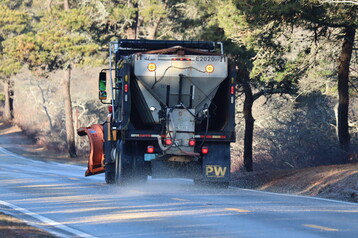
Is Nantucket pouring too much salt on its roads to combat winter conditions, especially near the island’s public water wells? During a recent meeting of the Nantucket Water Commission, water director Mark Willett suggested that might be the case. But Department of Public Works director Drew Patnode told the Current that his crews use only as much salt as necessary to keep the island’s roads safe.
Patnode, Willett, and Nantucket Land and Water Council executive director Emily Molden recently met to discuss Nantucket’s snow response program, including the use of salt on public roads and the potential implementation of low-salt zones around the town’s public water wells.
When it snows, the DPW pours pure, unmixed salt on public roads. It’s an effective way to keep streets clear of snow and ice, but some of that salt eventually makes it down to Nantucket’s sole-source aquifer. That could be an issue for water quality.
“There's a lot of better stuff for the environment than the salt. There have been multiple wells in New England that have been closed from salt from the chlorides,” Willett told the Water Commission. “If the road's a mess and you got to do it, you got to do it. But if it's an inch or two, maybe we could go a little easier and have low salt zones around our well fields.”
Currently, Nantucket actually uses more salt when there is less snow. During the small snowstorm that hit Nantucket on February 7th and 8th, the DPW used 100 tons of salt. During the larger storm that brought 8-10 inches of snow to the island, the DPW used less salt, as they were primarily focused on plowing the roads, but still poured around 40 tons.
“I don’t think it’s accurate to say we use too much salt without a scientifically accepted definition of what ‘so much salt’, is,” Patnode said. “We use what’s needed to keep roads safe for everyone, including first responders, and to keep schools, businesses, and Town services running.”
Patnode said that he and Willett had discussed the possibility of implementing low salt areas near public drinking water wells, but suggested that doing so could be problematic.
“The challenge is that most public wells are in the vicinity of our busiest roads and intersections, like Old South, Fairgrounds, Milestone, and Polpis,” he said. “Because of this, we often only salt the most important spots, like hills, intersections, and curves, to make sure we use salt where it’s needed most and avoid using too much.”
Willett was more optimistic, noting that low salt areas are common across New England.
“I think it's something that's going to happen,” he said. “I want it to be for every storm. I want it to be anytime you use salt. I want low salt zones unless…the road is horrible, and now it's a public safety thing.”
Willett also suggested that the DPW consider switching to a brine solution or a sand-and-salt mixture instead of using pure salt.
“They are using straight salt - no mix with sand, no anything,” Willett said. “That started with (former DPW director) Rob McNeil. It had never been that way. It was always cut - one scoop salt, three scoops of sand. During very harsh storms with colder weather and more ice, (it was ) 50-500, two scoops salt, two scoops of sand. We are (now) 100 percent pure salt. That's why all of our vehicles look like they look.
“New Hampshire, Maine, Vermont, where they get a ton of snow, they don't use salt anymore,” Willett added. “They use brine, brine liquid. It's a liquid that they put down, and it really gets into the road, and it really protects it.”
Patnode was skeptical that brine would be a good option for Nantucket.
“We’re not actively planning to switch to brine, but we always look at different ways to handle snow and ice to do what’s best for Nantucket. Switching to brine would be expensive because our trucks would need new equipment, and we’d have to buy a brine generator and storage tanks,” he said. “Since brine is water-based, it isn’t practical when temperatures drop, or winds pick up, which happens a lot here. Also, many of our storms start as rain and then turn to snow, so brine would wash away even faster than rock salt, making it a waste of time and money.”
He also cautioned against cutting the salt with sand.
“Sand acts as an insulator, keeping the pavement colder and allowing snow and ice to stay on the road longer,” he said. “There’s already plenty of sand on our roads, so adding more would just make things worse without much benefit. Sand can also harm our storm drains and wetlands.”
Whether or not the salt currently poured on Nanutcket’s roads is a potential threat to the island’s sole-source aquifer, the debate around how to respond to snow on public roads is likely to carry on as one of the coldest, snowiest winters in recent memories continues.