Amid Drought, Are Nantucket Homeowners Complying With Water Restrictions? Yes And No.
Jason Graziadei •
Despite last week’s heavy rains, Nantucket remains under a Level 2 drought status, which includes strict water restrictions prohibiting irrigation and all non-essential outdoor water use. But are island residents complying with those restrictions? Yes and no.
Compliance and enforcement dominated last Thursday’s discussion at the Nantucket Water Commission’s monthly meeting.
The good news? Wannacomet Water Company’s so-called “production” report, which measures how many gallons it sells by month, shows a nearly 20 million-gallon reduction in water use on Nantucket in June compared to the same month last year. The Siasconset Water Company showed a similar decrease in water use. Both were roughly 20 percent lower than last June and were the lowest totals for that month since 2020.
“We’re showing improvement and people are listening,” Nantucket Water Department director Mark Willett told his commission. “There are actually some that are trying, and have made a 20-million-gallon difference in a month. This is what the Drought Task Force and DEP (Department of Environmental Protection) will be looking for. So we’re doing okay. We’re not doing as good as some communities, but we’re doing way better than other communities in Massachusetts.”
Still, Willett emphasized that many homeowners are not complying with the water use restrictions and that enforcement is a significant challenge for his department.
“There are still so many people watering a lot,” Willett said.
The elected Nantucket Water Commission has implemented the following fine schedule for municipal water users who violate the restrictions:
- 1st offense: warning
- 2nd offense: $250 fine
- 3rd offense: $500 fine
- 4th offense: water will be shut off at the violator's property
Willett told the commission last Thursday that “hundreds” of warnings had been issued, but as of yet, no fines. Although one person in the Monomoy neighborhood may be close.
“I think he made adjustments when I said ‘Look, we're going to probably skip over the $250 fine. I've already told you three times. It might go to $500 a day.’ He did the quick math. He said, ‘$500 a day, about 30 days in a month, that's $15 grand. Okay.’ Obviously, I think there was some sarcasm in that. He did say he was calling his irrigation guy.”
The man was not identified at the meeting, although the commission is considering releasing a public list of violators as the drought continues this summer. Given some of the attitudes toward the restrictions that Willett described, however, that may not be a deterrent either.
“I've had some irrigation guys tell me the customers go to them and say 'either you turn it (the water) up or I'm going to find somebody that will',” Willett said.
Nonetheless, the conservation efforts have made an impact, and the municipal water supply is more stable now, headed into the peak of summer, when compared to prior years.
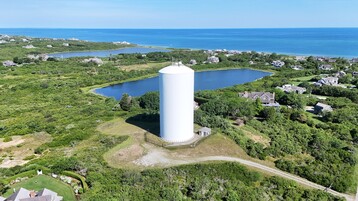
“We're in a much better place,” Willett said. “I'm not coming in early in the morning and calling the fire chief and saying, ‘Hey, tanks are pretty critical.’ Even the small number of people who are doing the right thing is making a huge difference. The tanks are in a much healthier place. The fire protection is strong. We haven't been below 79 feet in a tank yet. So last summer, we were dealing with 58 feet, 57 feet, 60 feet. So we have 15 to 18 more feet of water in the towers during the high peak demand time, so we're in a much better place. So even though there are a lot of people not listening, the few that are helping are making a huge difference.”
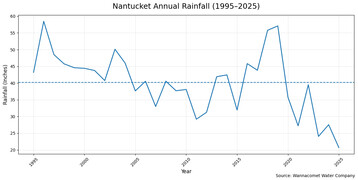
The state controls Nantucket's municipal water supply, and the Wannacomet Water Company operates under a withdrawal permit that is monitored and enforced. And while Willett has continued to emphasize that the drought caused by the reduced rainfall over the past two years is real, the island's water supply is stable. Nantucket's ponds are not drying up (with the exception of very shallow, small ponds like Almanac Pond), and his department's monitoring of the primary municipal water wells shows the aquifer's levels have not been significantly impacted.
But the restrictions - which only apply to those on the municipal water system and not to private wells - have prompted a surge in property owners contacting island well-drilling companies to install new private wells. The increase began last summer, and has only accelerated since then. It's a reality that Willett and the Nantucket Water Commission are cognizant of as they consider their approach to enforcing the water-use restrictions. Will a hardline approach lead more homeowners to drill private wells to avoid complying with the restrictions?
"A lot of private wells are going in, and when a private well goes in, we don't manage that," Willett said. "But it's still the same straw in the same bowl."
Last week’s deluge provided roughly 4.7 inches of rainfall over 48 hours. That single storm gave Nantucket as much precipitation as the island had received in the first six months of year combined.
“It was a really, really good thing to see, especially later in that second day of the storm,” Willett told the commission. “Not the torrential downpours, which are nice, but steady, easy, for multiple hours. That's what we're looking for. If we get one or two more of those this summer, I think we'd be getting (the drought designation) adjusted.”
But for now, Nantucket’s Level 2 “significant” drought designation remains in place. The state’s latest declaration was released last Friday, and the island’s status remained unchanged. The latest rain storm was not part of the state task force’s calculation, and it actually briefly considered moving Nantucket to a Level 3 drought designation before deciding against it, Willett said.
The state's drought task force unilaterally issues the drought declaration by monitoring groundwater levels on Nantucket at a well off Russell's Way. The USGS website provides data on that specific well, which has equipment that radios information about the groundwater table and elevation to the state task force.
The state monitors the groundwater level of the upper aquifer, and although the Wannacomet Water Company pumps most of its water from a lower level of the aquifer, the island's water withdrawal permit doesn't differentiate between the two, and the restrictions are automatic.
Willett said there is some concern about the well on Russell's Way, and that it does not always accurately reflect the full picture of groundwater levels on Nantucket because of the soil type in which it was drilled. He is actively lobbying the state to allow Nantucket to use multiple wells to determine the groundwater levels and the island's drought status.
"We now have a consultant and myself working to get that change with DEP to not just be this well," he said at the commission’s meeting in June. "This well is screened in a tight soil, so yes, it's recovering, but it's a slow-recovering well. Throughout its history, there are other wells that are in a different material, that are more sand and gravel and less tight, silty clay that recover faster."
Willett said last Thursday that his staff is working continuously to issue warnings and monitor the situation, but “calling 8,000 people” takes a lot of time and puts additional pressure on Wannacomet Water Company’s small staff.
“We’re not waving the white flag yet; we're going to keep pushing,” he said. “I want those numbers to continue through July and August, and we're going to look pretty good in the eyes of the DEP and the Drought Task Force that we're doing something that's showing improvement.”