As Drought Conditions Worsen, Enforcement Of Restrictions Puts Water Department In Difficult Spot
Jason Graziadei •
Mark Willett isn't exactly looking forward to this summer.
In fact, he's expecting to be persona non grata around the island. That's because Willett, the director of the town's Water Department, is in the unenviable position of enforcing a set of water restrictions that will impact a huge segment of island residents and businesses.
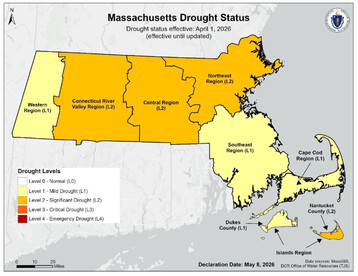
The restrictions are being imposed after the Massachusetts Drought Task Force moved Nantucket back to Level 2 "Significant" drought status, which mandates conservation measures, including a prohibition on automatic irrigation and a limit on all non-essential outdoor water use.
The Nantucket Water Commission has approved fines for those on town water who violate the mandatory use restrictions, which are being imposed just as the island's landscaping crews and irrigation companies are entering their peak season. But they aren't the only businesses on Nantucket worried about the impacts of the drought. The island's golf courses, car washes, boatyards, and yacht clubs - all heavy water users - are making adjustments to their operations and seeking guidance from the Water Department to remain in compliance.
"I’m looking for ways for us not to shut businesses down and still stay in compliance," Willett said this week. "Obviously, I'm not going to do anything to put the commission in long-term danger of permit issues or license issues, but talking with them (the state), there is some wiggle room, and their intent isn't to close businesses. So their intent is to conserve as much as we can."
While the town's Water Department - often referred to as the Wannacomet Water Company - manages Nantucket's water resources, it is actually the state of Massachusetts that technically owns and controls the island's sole source aquifer. The state issues a water withdrawal permit to Wannacomet, monitors groundwater levels, and mandates compliance with use restrictions when drought conditions are declared.
What Restrictions Are In Place Now?
Effective immediately, the Wannacomet Water Company has implemented the following restrictions and advisories for all those connected to municipal water:
- Limit all non-essential outdoor water use
- No automatic irrigation of any kind, including drip irrigation
- No watering except with a handheld hose or water can after 5 p.m. or before 9 a.m.
- Fix indoor leaks, check toilets, faucets, and showers
- Limited power washing of sidewalks and buildings
- Limit pool fills (call Wannacomet at 508-228-0022 for consideration)
The restrictions apply only to municipal water users. Private wells are exempt from these restrictions.
"I've also had many conversations with the drought task force people about what they consider essential and non-essential," Willett said. "It's really easy for someone outside of Middleboro, Massachusetts, to say, washing is not essential. Well, the Great Harbor Yacht Club called (and asked ) 'Can we wash our boats? We're putting our customers' boats in - a galley, sailboats - taking the shrink wrap off.' It's essential to my eyes. Business-wise, is it essential for the landscaper to have the ability for some watering? You know, the handheld? We're not trying to get away from the 'no outside watering.' But it's hard to go tell someone they can't run a business. I think that's the direct opposite effect of what their intent is. But it's such a broad statement, ‘what's essential'?"
What Fines Have Been Established?
The Nantucket Water Commission has already implemented the following fines for those on town water who violate the mandatory use restrictions:
- 1st offense: warning
- 2nd offense: $250 fine
- 3rd offense: $500 fine
- 4th offense: water will be shut off at the violator's property
When similar restrictions and fines were imposed in 2025, Willett described one Wannacomet customer who said he would rather pay the fines than comply with the restrictions. “We had a gentleman, and I'm not going to name names, who said, 'Just fine me, I’ll write a check,’” Willett said last year. “I said 'thank you for being part of the community'.”
One year later, Willett indicated that he's sensing a different attitude, at least among some around the island.
"We all know about the warning and the fines and how that's going to go," Willett said. "I've talked with the irrigation guys quite a bit, and they're doing the best they can. So far, I will have to say, it's been different. I know it's just starting, and they're just starting to open up and just starting to get things going, but it seems at this point, it's a little bit better response than last year."
The Wannacomet Water Company will also closely monitor the situation with improved technology and surveillance this year.
"We've already contacted multiple people on irrigation systems. We've set up the meters now. There are some meters that we have direct reports for. There's 88 meters that are for irrigation only, not just deduct through the house and outside water use, direct irrigation. We have those broken out in their own class, in our meter software," Willett said. "In the next few weeks, we'll be able to set up and read and get a report daily on who's using water between midnight and 6 a.m. And there's a difference between getting a drink of water or flushing the toilet or a shower in the middle of night. If it's thousands of gallons of water use from midnight to 6 a.m. that's irrigation. We'll get those reports daily."

How Bad Is Nantucket's Drought?
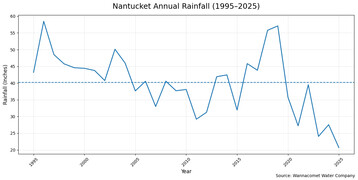
In 2025, Nantucket experienced its lowest recorded rainfall in at least the last 30 years, receiving just 20.7 inches. Through the first four months of 2026, that trend has continued, with just .09 inches of rain recorded in April, making it one of the driest months in decades.
"We've never been in this condition before," Willett told the Nantucket Water Commission on Thursday. "If you look at our historical rainfall, we've never been like this, ever. The last three years are 24 (inches), 27 (inches), and 20 (inches). We're usually in the 40s and 50s. I'm not saying climate change or global warming. I'm not getting into that. But it ain't raining. We're getting half of what we used to get.”
How Are Businesses And Residents Responding?
The owner of one Nantucket irrigation company, who asked to remain anonymous, put it this way: "If the restrictions are due to a drought, then they should be metering and restricting private wells. We are all using the same aquifer. Private wells are just sucking with a different straw. Or is it more the case that our current town well pumps can’t keep up with the pace of building? Some people are nervous to install systems. Some want to comply with the restrictions and then there’s a lot of customers who either just planted new plants and hedges, overseeded, or sodded their lawns. Without water these will die so they have decided to keep watering less. We leave it up to the homeowner to let us know how they want to handle the restrictions."
During the drought in the spring and summer of 2025, the fact that the restrictions did not cover private wells led to a surge in property owners contacting island well-drilling companies to install new private wells.
"We have seen an increase in recent requests for irrigation wells from Madaket to Sconset. With more and more demand from mid-island residents that are currently on town water since the announcement of the restrictions and fines," one well-drilling company told the Current last July.
It's a reality that Willett and the Nantucket Water Commission are cognizant of as they consider their approach to enforcing the water-use restrictions. Will a hardline approach lead more homeowners to drill private wells to avoid complying with the restrictions?
"Is it better for us to say you can water one or two days a week or have people going and driving private wells that they can run 24 hours a day?" Willett asked at Thursday's meeting. "It's all the same straws in the same bowl. It's better for us to work with people and be able to manage it, or we're just going to push them to drill private wells. And enforcement on private wells is almost impossible, so the best way to manage it is to come up with a solution where we can still conserve and still do the right thing through the drought conditions. If you want a private well, do it, but maybe there wouldn't be so many private wells if we could give them a little bit, and they won't take a lot."
What About The Golf Courses And Car Washes?
While the island's four golf courses are all on private wells and are not subject to the town's restrictions, they have their own withdrawal permits from the state. That means they, too, must comply with another set of restrictions.
"They're going to be restricted under these conditions," Willett said. "They can't water driving ranges. They can't water the rough, greens, tee boxes, limited fairway. So this impacts them as well. They (the state) know that golf courses are a lot of money to build and maintain, but they're in restrictions now. So things are going to be different."
The island's car washes, Willett said, will also be allowed to continue operating as they "recycle" roughly 80 percent of the water they use. Other users, including Great Harbor Yacht Club, will limit water use by not using pressure washers.
"So people are moving towards working out how to operate, and it's a good thing," Willett said.
How Does The State Monitor Nantucket's Drought Status?
The state's drought task force unilaterally issues the drought declaration by monitoring groundwater levels on Nantucket at a well off Russell's Way. The USGS website provides data on that specific well, which has equipment that radios information about the groundwater table and elevation to the state task force.
The state monitors the groundwater level of the upper aquifer, and although the Wannacomet Water Company pumps most of its water from a lower level of the aquifer, the island's water withdrawal permit doesn't differentiate between the two, and the restrictions are automatic.
Willett said there is some concern about the well on Russell's Way, and that it does not always accurately reflect the full picture of groundwater levels on Nantucket because of the soil type in which it was drilled. He is actively lobbying the state to allow Nantucket to use multiple wells to determine the groundwater levels and the island's drought status.
"We now have a consultant and myself working to get that change with DEP to not just be this well," he said. "This well is screened in a tight soil, so yes, it's recovering, but it's a slow-recovering well. Throughout its history, there are other wells that are in a different material, that are more sand and gravel and less tight, silty clay that recover faster."