Civic Association Proposes Restrictions On Public's Use Of Sconset Bluff Walk
JohnCarl McGrady •

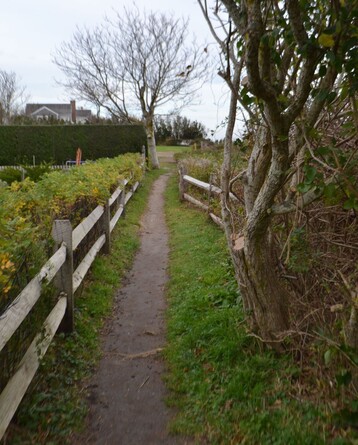
The Sconset Civic Association is proposing a set of restrictive regulations for the Sconset Bluff Walk that would limit the public’s use of the iconic walking trail. Town administration isn’t sure that some of the restrictions are advisable - or even legal.
The Sconset Civic Association’s proposal would restrict access to the public walking path during July and August to 8:30 a.m. - 5:30 p.m. and install turnstiles at the north and south entrances.
“Limiting use during peak season is essential for preserving the physical condition of the Path, which suffers extensive erosion from foot traffic, runners, bicycles, and strollers,” the proposal reads in part.
Comments provided by town administration in advance of a Select Board hearing on the proposal suggest that “there is no legal authority to restrict the hours of access to this public way” and that “a gate or turnstile raises accessibility and maintenance concerns.”
The Sconset Civic Association is also suggesting hiring seasonal “Bluff Rangers” to enforce the regulations. The rangers would be paid $50 per hour, a full $20 more than the highest-paid Community Service Officer employed by the town, with the cost borne by Sconset residents, the Sconset Civic Association, and the Sconset Trust. Town administration is similarly skeptical of this proposal.
“There are concerns that negative interface with ‘Bluff Rangers’ may contribute to conflict in the Bluff Walk,” the town administration's comments read in part. “A Bluff Ranger (not employed by the Town) would have no enforcement authority.”
The Sconset Civic Association is also requesting that the town stop promoting the Bluff Walk as an attraction for the public.
"Remove promotional references to the Path from digital, print, and social media outreach," the recommendation reads under the bullet "Revise Town Website & Publicity" in the association's proposed management plan. "With over 1,000 visitors per day in high season, the Path is already beyond sustainable capacity. Public messaging should focus solely on the education of the rules for safe and respectful use, not on attracting additional traffic."
The town administration claims that recommendation "is endorsed, and has already been accomplished - with information that is in control of the town," although a page on the town's website describes the Bluff Walk as "an exceptional walk on a public footpath along the east shore bluffs behind private houses."
The Sconset Civic Association’s proposal has the support of the Roads and Right of Way Committee, a minor town advisory board.
The Bluff Walk has a long history. A similar path was described as early as 1775, and may have existed much longer. In 1892, developer William Flagg conveyed the land that comprises the current path, and the town now holds it in trust as a public way. The legality of the Bluff Walk was reaffirmed in a decision by the Supreme Judicial Court of Massachusetts in 1930.
The management plan proposed by the Sconset Civic Association would also install split-rail fencing “where appropriate” to protect the path and the bluff and add additional signage to make it clearer where visitors should enter the Bluff Walk.
“The task ahead now is to balance the preservation of public access and thoughtful maintenance of the path with the privacy and quiet enjoyment of abutting property owners as a key goal,” a memo from the Sconset Civic Association reads in part.
The Select Board will consider the association's request on Wednesday, March 4th, during its regular meeting at the community room in the town's Public Safety Facility at 5:30 p.m.
To register to participate via Zoom, click here.