Flock Fallout: Deputy Police Chief & Town's Chief Technology Officer Weigh In On New Cameras
David Creed •
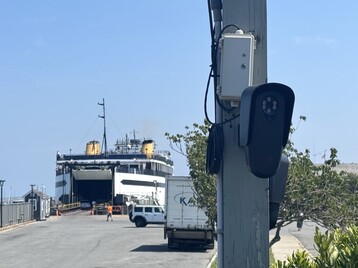
On Tuesday, the Current broke the news Flock cameras have been installed on the island, and in our Wednesday morning newsletter, posed the question of why they are on Nantucket while providing an in-depth description of what these cameras are. Prior to the publication of the article, the Current reached out to the Nantucket Police to learn more about the cameras but had not received a reply.
Shortly after 9 a.m. Wednesday morning, Deputy Police Chief Charlie Gibson provided some answers to submitted questions revolving around why these cameras are valuable to the police and when they were installed. On Wednesday evening, the town’s Chief Technology Officer, Michael Alvarez, expressed major concerns about the cameras' presence on the island, offering differing perspectives on the technology.
“I want to be very clear,” Alvarez said. “The Chief Technology Officer is not part of the Nantucket Public Safety chain of command. Neither I nor my predecessor had any involvement in the purchase, approval, or installation of any Automated License Plate Readers on Nantucket. I also want to be equally clear about my personal opinion. I do not believe Automated License Plate Readers belong on this island.”
Gibson claimed in his response these cameras have been around for years and were installed back in March of 2021. Meanwhile, Alvarez said during his remarks that police chief Jody Kasper told him they had been installed for “approximately a decade.”
“However, my own research into the make and model of the cameras currently installed suggests they may be a much more recent installation,” Alvarez said.
Flock cameras have become a hot topic of debate nationwide out of fears they could be used to stalk individuals or create warrantless mass surveillance of the public that can reconstruct private patterns of life of people with very little oversight.
Flock has several articles posted on its website describing how its technology helped solve crimes, including kidnappings, capturing a man threatening a mass shooting, finding a missing child after 30 minutes, and capturing a homicide suspect in Wisconsin. However, there have been numerous criminal cases that have prompted scrutiny, including one in which Milwaukee police officer Josue Ayala, who pleaded guilty to searching a romantic partner’s plate 124 times and the partner's ex 55 times. He was sentenced to one year of probation and paid a $500 fine. The detective who investigated him is now facing similar charges.
The Boston Globe recently reported on the controversy, and Massachusetts residents told the publication these cameras have “crossed a line." On Thursday, the Globe reported Littleton officials shut down their Flock cameras on pubic roads and Flock turned them back on without alerting the public.
There have also been concerns about wrongful arrests due to errors made by the technology and their accuracy, including a town in California where Flock allegedly misread 71 percent of the plates in alerts sent to police.
Gibson said the cameras at the intersection of Easy Street and Broad Street are the only Flock cameras on the island.
“The intent of the Flock cameras at the intersection of Easy & Broad Streets is to primarily capture license plate information of vehicles coming or going from the Steamship Authority,” Gibson said. “The system automatically scans plates against state and federal databases (like the National Crime Information Center). It sends audio or text alerts to officers within seconds if a stolen car, wanted suspect, or vehicle tied to an Amber/Silver Alert passes a camera. This is particularly useful if a wanted vehicle is coming or attempting to leave the island via the Steamship Authority.”
Gibson said the Department “often receives reports of missing persons” and that being able to check whether the vehicle went to the Steamship Authority is very helpful for those investigations.
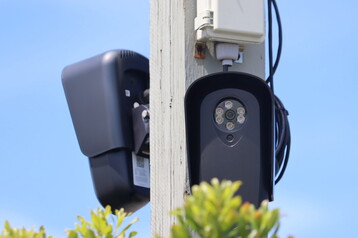
“The camera only captures the license plate image and vehicle color/types,” Gibson said. “It does not take photos of occupants.”
Alvarez expressed a different perspective during his three-minute remarks to the Select Board on Wednesday.
“Modern vehicle recognition technology can collect far more than a license plate number,” Alvarez said. “Depending on the system, it can identify a vehicle's make, model, color, and other distinguishing characteristics. As these systems continue to evolve, they are capable of extracting increasingly detailed information about the vehicles, and by extension the people, passing before them. I believe that collecting this amount of information on residents and visitors without individualized suspicion or a warrant poses a real threat to our civil liberties and has no place in our community.”
Gibson said data is retained on the cameras for 30 days.
“Flock Safety ALPR data is stored for a default period of 30 days, after which it is automatically and permanently deleted,” he said.
When asked if the NPD would be open to considering a public presentation or community forum on the cameras to further educate them on their use and value to the police/community, Gibson said the department is “always open to discuss community policing initiatives.”
Alvarez said he does not fault the Nantucket Police Department for using tools they believe will help keep the island community safe, acknowledging that protecting the public is one of their core responsibilities the entire community entrusts them with. His concern is with the technology.
“My concern is not with the officers who use the technology. My concern is with the technology itself, the data it collects, how long that data is retained, who ultimately has access to it, and how it may be used in the future,” Alvarez said. “We have seen numerous reports across the country of unauthorized access to these systems, as well as legitimate users accessing data for improper personal reasons. Once this information exists, it creates risks that extend well beyond Nantucket.”
Alvarez added that Kasper explained to him that requests from outside agencies require approval from the Nantucket Police Department and that, to date, no outside agency has been granted access.
“I appreciate her willingness to share that information,” Alvarez said. “Even so, I remain concerned about what access may exist through the vendor that stores this data and whether information could ultimately be shared beyond Nantucket's control.”
According to DeFlock Maps, which tracks data sharing by Flock cameras across the country, there are no departments listed as recipients of any data from the Nantucket Police Department's cameras. However, NPD reportedly receives data from nine departments including:
- Cheektowaga, New York PD
- Hamburg, New York PD
- Newport, Rhode Island PD
- Newtown, Connecticut PD
- Pittsboro, Indiana PD
- Saratoga Springs, New York PD
- Tiverton, Rhode Island PD
- Weymouth, Massachusetts PD
- Woonsocket, Rhode Island PD
However just because there are no publicly disclosed departments receiving data from Nantucket, doesn't mean it isn't happening. According to deFlock, of the 6,400-plus agencies using Flock, only about 900 run a public transparency portal. Only approximately 530 of those agencies actually disclose who they share data with.
"The rest redact their sharing list or don't publish one at all," deFlock states.
Alvarez said after his conversation with Kasper, he reviewed Select Board agendas and meeting minutes looking for any public discussion or vote regarding the installation of automated license plate readers like the Flock cameras.
“I could not find one,” he said. “Whether that means no discussion occurred, or simply that I was unable to locate it, I believe a decision with this level of impact deserves a full public conversation.”
Alvarez is asking the Select Board to do two things. First, he wants the board to ask NPD to publicly disclose when these cameras were installed, the total cost of the contract, the department's policies governing data retention and sharing, and how many investigations have meaningfully benefited from the use of these cameras.
“Second, direct the police department to suspend the use of these cameras until the Town can hold a public information session where residents can hear why this technology was adopted, ask questions, and participate in an open discussion about whether it reflects the values of our community,” Alvarez concluded. “This is not simply a discussion about technology. It is a discussion about privacy, transparency, public trust, and the kind of community we want Nantucket to remain.”