Dispute Over Deer Fence And Grates At Surfside Estate Resolved By Select Board, But Court Challenge Likely
JohnCarl McGrady •
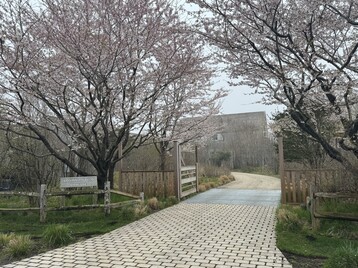
The Select Board voted 4-1 on Wednesday to uphold a Historic District Commission decision ordering the owners of a Surfside property on Nonantum Avenue to remove previously installed deer grates and relocate a deer fence, though an attorney for the homeowner suggested that the case would be appealed again, landing the matter in court.
During the hearing, several Select Board members expressed frustration with the existing process for appealing HDC decisions.
“A larger policy discussion needs to happen to tighten up processes, and on this appeal process, because we are put in this very narrow box on these things,” Select Board member Tom Dixon said.
After the Schwartz family installed deer control measures without HDC approval on its Nonantum Avenue property, they were called before the commission, which ultimately voted against allowing the grates and only approved the fence subject to significant revisions. The Schwartz family filed an appeal of that decision, bringing its case to the Select Board.
“Alas, the deer issue created havoc - literally destroying so much that is carefully planted and tended to every single day,” homeowner Heather Reisman, who is married to Gerald Schwartz, wrote to the Select Board, describing the situation which led the family to erect the fence and grates around their 15-acre property. “Roses are gone while still in buds. True, too, about the Salix, Viburnum, Callicarpa, Ilex, Quince, Hydrangea, Climbing Hydrangea, and Privot all around the property. We would no sooner replace what had been eaten and gently nurtured then deer would literally mow it down. We talked with other residents who had experienced the problem and did our research around the entire island. It was clear many people had erected deer fences and have been allowed to keep them.”
While the appellant raised several concerns with the HDC’s process, the Select Board’s decision ultimately hinged primarily on whether the existence of other similar properties with visible grates that had been approved, or had been installed without permission and have not yet faced removal orders, rendered the HDC’s decision arbitrary.
“We have a system here that is driven by complaints, and is administered without clear standards, and it’s simply just not defensible because it invites and results in exactly what we see here, which is an inconsistent treatment of similarly situated properties, and decision-making that is, frankly, vulnerable to bias,” said attorney Ryan Douglas, who represented the Schwartz family during the hearing.
Douglas said that, according to a public records request filed by the appellants, the town received several complaints about similar properties in the area, but did not issue any enforcement letters against them. Instead, Douglas asserted that his clients’ property was singled out.
“The end result is selective enforcement, and arbitrary and capricious selectment,” Douglas said. “We would ask the Board make a decision one way or another tonight so we can either have a reversal or we can bring this up on appeal.”
The HDC replied that it had not gotten around to taking action against the other homeowners who had complaints lodged against them.
“We get busy,” land use specialist Cathy Flynn said. “Things do get lost in our workload, and that was one of them.”
The Select Board can only remand or overturn an HDC ruling if it finds that the commission’s decision was arbitrary and capricious or legally defective, a high standard that is rarely met. They cannot substitute their own judgment on the merits of the case for that of the HDC.
“I continue to feel, as I have in the past, that arbitrary and capricious in their deliberative process is a very hard standard,” Select Board chair Dawn Hill said. “There may be some flaws in the administrative process that could be improved…but that’s not what we’re hearing this for. This is about whether that board met, had a proper review and discussion, and made a defensible decision.”
Ultimately, the Select Board found that the decision was not arbitrary and capricious and upheld it, but several members did flag the grates that have been allowed to remain as a potential issue.
“I’m not sure I want to see the town defending this in court,” Select Board vice chair Matt Fee said. “I understand if [the HDC is] arbitrary, but what if just the whole system [is arbitrary]? What if we are not enforcing equally? What if there are complaints and those aren’t acted on, but others are?”
During appeals of HDC decisions, Select Board members often raise concerns with the appeal process, and even the HDC’s deliberative process in general.
“We had a consultant’s report on this a couple years ago. We were going to bring it back for review, and I don’t think we ever did,” Select Board member Malcolm MacNab said. “I don’t see any arbitrariness here. I see a lot of problems with the process, and I truly encourage the next board to not let it get overwhelmed by other things, because until that’s really sorted out and streamlined, that’s going to continue to come up.”
So far, those concerns have not resulted in any substantive change.
The homeowner’s representatives have argued that the deer grates are necessary to protect mandated vegetative screening. Nantucket’s deer population is one of the largest in the state, and despite a variety of state and local initiatives to curb the deer herd, far too many deer remain on the island for the numbers to be sustainable.