Graham Veysey To Challenge Neil Paterson In Land Bank Race
JohnCarl McGrady •
Graham Veysey has pulled papers to run for the Land Bank Commission, pitting her against long-time incumbent and former commission chair Neil Paterson.
The contest comes at what both candidates characterized as a crucial moment for the Land Bank, as the organization pivots from decades of work largely focused on conserving the island’s open spaces to an approach that also attempts to address other community needs.

“I am running for the Nantucket Land Bank Commission because I believe it is at an important moment, with a real opportunity to think about how its mission continues to evolve, and I would love to be part of that conservation,” Veysey said.
Veysey, a local parent and business owner, has been outspoken in her support for a Nantucket Public Schools’ plan to install a turf playing field at Vito Capizzo Stadium, and she emphasized recreational facilities as a key issue the Land Bank should address, referring to ongoing discussions between the Land Bank and the schools about potentially finding space for playing fields on Land Bank property.
“I am especially passionate about expanding access to recreational spaces for the next generation,” said Veysey, who owns the Good Bones interior design firm. “I found the most recent discussion with the school inspiring, as it shows a willingness to engage with the community around real needs.”
The Land Bank has faced pressure to provide both outdoor field space and an indoor recreational facility in recent years. Veysey has spoken in favor of an indoor recreational facility at past Land Bank meetings, calling it a potential “gamechanger.”
Paterson, who owns a landscaping and stonemasonry business on Bartlett Road, suggested that both proposals could be too costly to pursue and that the Land Bank might be better off focusing on other areas.
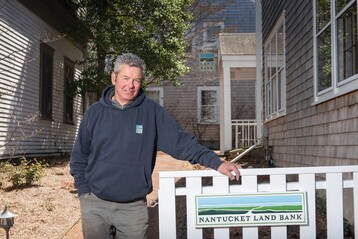
He suggested that indoor recreation would require a $40 million investment, which could “consume everything.” On outdoor playing fields, he was more uncertain, saying that “if we can, we should,” but that he wasn’t sure if they would be feasible for the Land Bank.
While the Land Bank has branched out under pressure from the community and explored new ways to use its funding, derived from a 2 percent tax on local real estate transactions, it still maintains an internal policy blocking the use of Land Bank land for indoor recreation.
Instead, Paterson focused on his extensive experience with the Land Bank.
“I really enjoy giving back, and I have the time and the experience,” Paterson said. “I’m going to stand on my record, and I’m going to ask the Nantucket voters if I have been receptive and open, and I think that I have…I’ve got an open mind. If you don’t agree with something I say, talk to me. Maybe you can persuade me.”
He also pointed to several recent Land Bank initiatives he has supported, including an agricultural processing facility on Boynton Lane that helped the Nantucket Food Pantry secure a long-term home and the move of several homes from the Land Bank’s property at 41 Jefferson Avenue to a location in Madaket where they will serve as attainable housing for year-round residents.
“The Land Bank is at an interesting stage in its career, and I think we’ve given the public a taste of what we’re willing to do,” he said. “I would like to see a few things through.”
The move, just approved by the Historic District Commission, marks the latest in a series of Land Bank projects that seek to support affordable housing without spending any Land Bank funds on housing directly. While the Land Bank’s enabling legislation prevents it from directly funding the purchase of affordable housing on-island, the Land Bank has indicated that it is permitted to purchase employee housing and has recently found several creative ways to help combat housing insecurity on Nantucket.
Veysey’s experiences as a parent, a youth soccer coach, and an active supporter of the Nantucket Racquet Sports Association shaped her desire to run for her office and the priorities of her campaign.
“I’ve seen firsthand the positive impact the Land Bank can have through thoughtful community engagement and recreational access,” she said. “I have tremendous respect for all it has done to preserve the character of Nantucket, and I see a real opportunity to strengthen coordination with the town and deepen public engagement so the Land Bank continues to evolve in a way that is thoughtful, aligned, and responsive to the needs of the community.”
It’s not the first time Paterson has faced a challenger running primarily on a desire to shift the Land Bank’s focus towards an issue they felt passionate about. Five years ago, Howard Dickler ran for the Land Bank on a platform focused on affordable housing. Paterson defeated Dickler by a wide margin.