How Much Cocaine Is In Nantucket's Sewage? A Lot
JohnCarl McGrady •

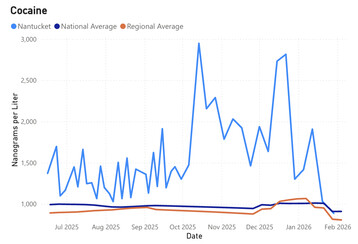
Eight months of wastewater surveillance data show consistently elevated levels of cocaine in Nantucket’s sewage - with spikes in October and December 2025 that were nearly three times the national average - even as island police have made numerous high-profile cocaine busts, including the largest in the department’s history.
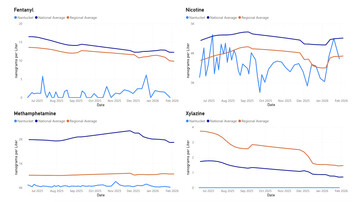
The levels of other harmful substances in Nantucket’s wastewater, including fentanyl and meth, are far below regional and national levels, and even nicotine levels have largely remained below average. But the cocaine concentrations, which dramatically outstrip benchmarks for the region and the country at large, have drawn the most attention, making national headlines.
When the body metabolises cocaine, most of it is converted to benzoylecgonine (BZE), the primary substance used in urinary drug tests for the stimulant. When cocaine levels rise, BZE levels usually follow. But despite the strikingly high levels of cocaine in Nantucket’s wastewater, BZE levels have mostly remained close to the national average, aside from a couple of significant spikes.
“Because Nantucket’s cocaine levels are above national and regional averages while BZE is often at or below average, the most likely explanations include dumping events, repeated small-scale disposal, or concurrent use with alcohol, which changes how cocaine is metabolized,” a note on the monitoring website reads in part.
Nantucket’s wastewater isn’t monitored for alcohol content.
Health director Roque Miramontes echoed these explanations.
“Certainly, dumping is a possibility,” he said. “Another is when cocaine is consumed with alcohol, it changes the metabolite that’s developed.”
Nantucket Police, along with their counterparts on the mainland and federal authorities, have seized nearly six pounds of cocaine from mid-island locations over the past year and a half. Six island residents have been charged in those incidents with drug trafficking or distribution.
In an interview with the Current, Nantucket Police Chief Jody Kasper said those cocaine busts were the result of her department cracking down on illicit drug distribution on the island, not necessarily cocaine specifcally.
"There hasn't been a focus on cocaine specifically, but in 2024 we really did focus on drug trafficking and drug dealing in our community, whatever substances those may be," Kasper said. "And if you look back at any of my presentations I've done to the Select Board, or if you look at annual reports, my listed goals, you'll see on there a focus on identifying drug traffickers and dealers.
"They have made a dent, but we certainly understand that the narcotics industry is the supply and demand industry, so that we need to stay on top of it," Kasper said. "When we make one trafficking arrest, we recognize that we need to continue to focus on the area, because there are more people who will step up and deal."

The Nantucket Police Department has been monitoring the wastewater surveillance data, Kasper said, but the results don't necessarily line up with what her officers are seeing on a day-to-day basis. While the cocaine prevalence in the wastewater is concerning, Kasper emphasized that other illicit drugs being monitoring are below state and national averages.
"Overall, the data shows that most substances monitored in Nantucket are well below regional and national averages, and that is very encouraging to us," Kasper said. "I know there has been focus on cocaine, but in all the other areas, we're encouraged by what we're seeing in those areas. And as far as the rest of the data goes, I think for us, we'll be curious to watch it over time and begin to understand trends as we're looking at different weeks and months to help us better understand this issue on the island.
"It's interesting, because when this data started coming in, we certainly have talked about it internally, and although we've had those high-profile cases, and this is something that we continue to target, it's really not something that our officers are seeing day-to-day on the street," Kasper added. "So we're not having a lot of people come into the booking room, and when we search them, finding cocaine in their pockets, or we're not pulling over a lot of people and finding cocaine in the car. We're not responding to a lot of incidents around cocaine distribution or seeing cocaine present. So it's not something that is in our day-to-day work that our officers and detectives are seeing out there. I think every community has its own challenges with substances. This data has been helpful for us to better understand what our problem is here in Nantucket."

Human services director Jerico Mele previously said that the wastewater surveillance data would help Nantucket understand baseline levels for drug use and monitor whether those rates were rising or falling throughout the year or between years. In the data collected so far, cocaine levels appear to have spiked between October and December 2025.
“We released this data with the goal to provide near real-time, ground-level information to our behavioral health partners to implement interventions and to medical providers so they can learn to ask the right questions and provide treatment when available,” Miramontes said. “If the release of this data contributes to even one intervention that saves a life, then it's worth far more than the $30,000 the town pays to carry out this initiative every year, and that's why we're doing it.”
The town’s surveillance efforts for dangerous substances grew out of previous efforts to measure the amount of respiratory illness on the island. During the COVID-19 pandemic, Nantucket joined many other communities throughout the country in tracking the virus using wastewater. Wastewater surveillance can be a highly effective tool for tracking illnesses in a community, as it does not rely on individuals volunteering to be tested, and can even detect cases before they are symptomatic. Nantucket later expanded its efforts to also track influenza and RSV.

"Anytime we're talking about drugs, it's rare that we're talking about a drug that doesn't have a risk of having fentanyl cut into it," Kasper said. "So any illegal substance that you're taking, there's a risk that there are other substances that are in there. And when we talk about narcotics used in general in our community, our focus is on community health, and we want to prevent overdoses, and we want to prevent impaired operation of vehicles. So that's really our area of focus. We don't talk specifically about cocaine alone."
Nantucket Current editor Jason Graziadei also contributed reporting for this story.