In Solar Dispute, Select Board Sides With Historic District Commission On Front-Facing Panels
JohnCarl McGrady •
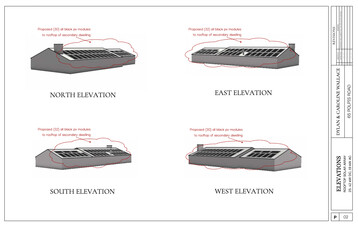
The Select Board on Wednesday unanimously denied an appeal of a Historic District Commission decision that conditioned approval for a front-facing solar panel array at 65 Polpis Road on the relocation of an existing driveway.
In making their decision, Select Board members emphasized that they cannot substitute their own judgment for that of the HDC, even if they disagree with the HDC’s conclusions. Their only authority is to determine whether the HDC’s ruling was arbitrary and capricious or legally defective, a high bar that is rarely met.
“I struggle with the bigger, 40,000-foot above picture of this,” Select Board member Tom Dixon said. “I think, reading what your guidelines are and what your decision was, that I don’t think I can find it arbitrary and capricious on this decision, even though my own judgment says that [the homeowner] should be able to put those solar panels on his house.”
The HDC voted unanimously in October to approve a rear-facing solar array at 65 Polpis Road, owned by Dylan and Caroline Wallace. But the HDC would only approve a front-facing solar array on the condition that the Wallaces relocate their driveway and add vegetative screening to reduce the array’s visibility from the road.
“The concern is just the guidelines we've established for solar, which is avoiding the front of the main structure,” HDC member Angus MacLeod said at the time.
The appeal was handled by ACK Smart Energy, a local solar installation company, represented at Wednesday’s Select Board meeting by director of sales Tobias Glidden. The appeal alleged that the HDC’s preference against front-facing solar is detrimental to Nantucket's well-being and is not properly codified.
“The term ‘front’ or ‘front-facing’ does not appear anywhere in the HDC’s photovoltaic solar thermal guidelines…the commission’s decision relied on a standard that does not exist,” Glidden said. “Through the benefits resulting to the economy, renewable energy supports year-round residents, it supports agriculture, it supports affordability, while protecting the environmental conditions that sustain Nantucket’s economy. Sustainability is not contrary to preservation; it is essential to it.”
The Select Board was not convinced.
“I’m not conflicted or complicated at all,” Select Board member Malcolm MacNab said. “They’re following the guidelines.”
HDC chair Stephen Welch argued that, while the opposition to front-facing solar is not codified in writing, there are visual representations of where solar is recommended to be placed in the HDC’s guidebook, and the general opposition to front-facing arrays is well understood.
“There are graphical representations,” he said. “This is not an arbitrary definition; it is not based on no standards.”
Welch emphasized that the HDC has agreed to allow solar on the property. They had even suggested solar could be allowed on the front-facing roof if the homeowner was willing to move the driveway and provide sufficient screening.
Glidden also compared solar installations to utilities like transformers and electricity meters, claiming that strict regulations on solar were inconsistent with the HDC’s lack of authority over other portions of the electrical grid.
“Treating solar differently than utility infrastructure is inconsistent, especially when roof-mounted solar has far less visual impact than existing utility infrastructure,” Glidden said. “It’s an inconsistent standard.”
Welch argued that the HDC does not have any legal ability to regulate public utilities, whether it would prefer to regulate them or not.
“We’d love to have more oversight on public utilities,” Select Board chair Dawn Hill said.
The appeal hearing was noticeably more cordial than several recent HDC appeals, including a hearing on the denial of a deer fence heard the same night.