Is Great Harbor Yacht Club In Violation Of Its State License To Develop Nantucket's Waterfront?
JohnCarl McGrady •
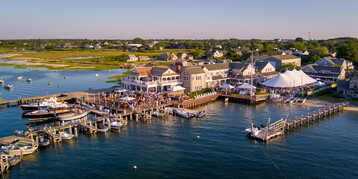
The Harbor and Shellfish Advisory Board (HSAB) has alleged that the Great Harbor Yacht Club (GHYC) is out of compliance with several stipulations of the permit that allows the yacht club to use and develop the waterfront near its Washington Street property. The yacht club denies some of these allegations, and enforcement could be difficult, as it generally rests on overworked state bodies that do not frequently visit the island.
Over the last five months, HSAB has claimed that GHYC is out of compliance with at least three of the requirements of its Chapter 91 license issued by the state Department of Environmental Protection. The HSAB members claim GHYC is not properly hauling vessels from the water in cases of emergency, has failed to appropriately advertise required public access, and is not providing a fueling station.
“It’s very sad, in a way, what we have devolved to,” HSAB chair Andy Lowell told the Current. “It really bothers me what we are going to leave behind for the next generation.”
GHYC contends that it does haul vessels when needed, has adequate signage, and cannot feasibly provide fuel.
Chapter 91 is intended to protect public access to the water in Massachusetts, rooted in a doctrine dating back to the 17th century. A state website dedicated to the regulations says that “Chapter 91 regulations serve to protect traditional maritime industries, such as fishing and shipping, from displacement by commercial or residential development.” The vast majority of activities taking place in tidelands, great ponds, or rivers and streams require a Chapter 91 license.
HSAB alleges that GHYC has been out of compliance with its permit for years.
“The Chapter 91 licenses in this town are a joke,” HSAB member and charter boat captain Bob DeCosta said. “This is supposed to be a working waterfront…that yacht club should cease to exist until they have some kind of fuel.”
The provision to provide fuel has become the central issue in the dispute. HSAB claims that GHYC is mandated to provide a fueling station.
“[GHYC] is supposed to have fuel,” DeCosta said. “It's in their Chapter 91 license. They were supposed to have fuel from day one.”
The license twice mentions that the approval includes the construction of a fueling station, but there are no special conditions related to that fueling station.
HSAB sent a letter outlining its concerns to GHYC, including the lack of a fueling station. The GHYC did not deny that it is not providing a fueling station, but made two counterarguments. First, it argued that providing fuel would be expensive and inconvenient, an argument that is unlikely to convince HSAB members.
“If a fueling station was established at GHYC, the cost of establishing the station, operating the station, maintaining insurance, and the increased number of personnel required to operate the unit would make the cost of the fuel as much, if not a lot more than Nantucket Boat Basin,” GHYC general manager Stephen Creese said. “Operating a fueling station would most likely interfere with [marine operations contractor Finger Boat Works, also called FBW] launching and hauling operation due to lack of waterfront space.”

Second, it claimed that both Harbor Fuel and Sun Island Fuel declined to perform fueling, making it impossible for GHYC to provide fuel.
“Both organizations declined wanting to perform any fueling at 96 Washington Street citing amount of time required and the amount of insurance they would have to maintain to perform over the water fueling,” GHYC general manager Stephen Creese said. “Fuel would not be delivered by either of the on-island companies.”
HSAB members don’t see the refusal by local fuel providers as an excuse for the lack of a fueling station.
“[The license] says you provide a fueling station; it doesn't say you provide a fueling truck,” HSAB member Dave Fronzuto told the Current.
HSAB members suggested that an alternative could be an above-ground fuel tank supplied in the same manner as a residential home, but available for local boaters to use. It’s not clear if fuel providers on-island would agree to this. Regardless of the method, it is undisputed that the yacht club’s permit requires them to provide a fueling station, and that they are not providing one.
Fronzuto served as the Harbormaster when GHYC first received its license and was responsible for negotiating the terms of the license with the yacht club.
“It's insane, to be perfectly honest,” he said.
When pressed, Creese admitted that GHYC’s permit requires them to provide fuel.
“It does require us to provide fuel, but we are unable to find a provider to provide fuel service,” Creese said.
The dispute is complicated by GHYC’s ongoing philanthropic efforts. Just last month, GHYC donated $630,000 in grant funding for waterfront projects, underscoring the organization’s commitment to supporting local non-profits doing work along the harbor. HSAB hopes to avoid taking action that could imperil this funding.
“I believe they really do care about the health of the harbor, but at the same time, they're not abiding by the conditions of their permit,” Lowell said.
Creese also emphasized the yacht club’s charitable giving.
“Responsible stewardship around fuel and Nantucket Harbor is of particular importance to Great Harbor Yacht Club,” he said. “Through our foundation, we have contributed over $2 million dollars in the past few years toward improving the health of the harbor and protecting its fragile ecosystem.”
HSAB members also claim that GHYC is not pulling boats from the water in emergency situations and during inclement weather, a violation of its permit.
“There has been an incident where a boat was disabled and taking on water, and they turned him away,” Lowell said.
GHYC denies these accusations.
“GHYC has never declined a request from FBW to affect emergency marine repairs on members' or non-members’ vessels. FBW uses discretion in determining what constitutes an 'emergency' repair,” Creese wrote in an email forwarded to the Current. “FBW has NEVER declined hauling/launching/servicing a boat due to the fact they were not a member of GHYC.”
HSAB members have also claimed that the public access GHYC is mandated to provide is not properly noticed, and does not say that it is public. In response to these concerns, the yacht club cited a 2019 memo from former assistant Harbormaster Kenneth Lappin, which said that public access requirements were met.
The license requires that the GHYC “shall place and maintain in good repair DEP-approved signage at the entry to the site on Washington Street advertising said accessway to the general public. Said accessway shall be kept clear of snow and ice and all obstacles including gates, fences, or other structures that would impede or discourage the free flow of pedestrian movement thereon.”
However, it is difficult to enforce any of these provisions. HSAB members have repeatedly said that enforcement lies with the state, and the state rarely takes any action to ensure that licenses are being followed.
“No one enforces these licenses. It's a running joke,” DeCosta said. “The town needs to put pressure on the state to make them be in compliance.”
The town is considering how to create a local enforcement option, but it's unclear if such strategies would be allowed. Lowell also suggested there may be some room for the Conservation Commission to get involved.
“It's not just Nantucket,” natural resources director Jeff Carlson said. “[The state does] not enforce it.”
Nantucket struggles to enforce many of its bylaws. Often, a complaint has to be filed before action will ever be taken. That may be the case with Chapter 91, as well.
“It's passive enforcement,” HSAB vice chair Peter Brace said. “Someone has to complain and file a formal complaint for an enforcement action to happen, so people not complying with their permits can go along for a very long time not complying.”
GHYC is not the only organization allegedly out of compliance with its Chapter 91 permits. Fronzuto told the Current that he believes around half a dozen properties are not providing appropriate public access.
Facing these enforcement challenges, it may be difficult to compel GHYC to change, even if it is out of compliance with its permit.