Judge Grants Temporary Injunction To Block Turbine Maker From Abandoning Vineyard Wind Project
JohnCarl McGrady •
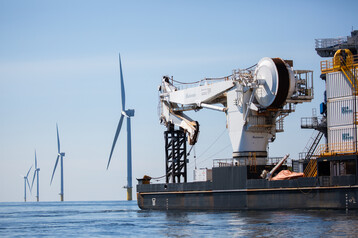
A Boston judge has granted a temporary injunction blocking GE Renewables (GER) from exiting its contract to supply and commission the turbines for Vineyard Wind (VW) after the wind farm sued the energy giant over its plans to abandon the installation off Nantucket’s coast.
Suffolk Superior Court judge Peter Krupp found that GE Renewables had “no basis” to terminate its contract, ruling that the energy company’s exit could threaten the very existence of the first of its kind 62-turbine wind farm located southwest of Nantucket.
“The project is at a critical phase and the loss of VW's principal contractor would set the project back immeasurably and threaten VW's financing,” Krupp wrote. “To pretend that VW could go out and hire one or more contractors to finish the installation and troubleshoot and modify GER's proprietary design without GER's specialized knowledge is fanciful.”
GE Renewables, the corporation responsible for manufacturing the colossal 800-foot turbines, sent Vineyard Wind a termination letter last February, claiming the offshore wind developer had failed to cover more than $300 million in unpaid bills.
GE Renewables claims Vineyard Wind has not paid for its work “in nearly two years.” Specifically, executive project director Sebastian Mertens wrote in a court filing that Vineyard Wind has “refused to pay for the work being done” since a GE-manufactured turbine blade collapsed into the water off the coast of Nantucket in July 2024, littering the island’s beaches with toxic debris. A manufacturing defect traced back to a GE Vernova (the parent company of GE Renewables) plant in Gaspé, Canada was later identified as the cause of the blade collapse. The bonding issue ultimately affected more than 60 blades shipping from Gaspé to New Bedford for Vineyard Wind that had to be taken down and removed from the project over the following year.
“There is no basis for VW's non-payment. Among other reasons, GER has supplied VW with replacement blades corresponding to the Removed Blades, so there simply is no legitimate basis on which to offset previously paid amounts,” Mertens wrote. “In GER's view, the provision of replacement blades constitutes the contractual remedy for any alleged defects in the Removed Blades.”
Vineyard Wind filed suit last week to force GE Renewables to fulfill the terms of its contract, alleging that the energy company’s departure would imperil the project, potentially leaving behind a “dormant wind farm graveyard.”
Now, Krupp has ruled at least temporarily in Vineyard Wind’s favor, requiring that GE Renewables continue to abide by its contract while litigation plays out.
Krupp wrote that the contract between the parties indicates that disputes over unpaid funds are to be resolved by a project engineer, and that the engineer determined it was actually GE Renewables that owed Vineyard Wind over half a billion dollars stemming from the blade failure off Nantucket’s shores.
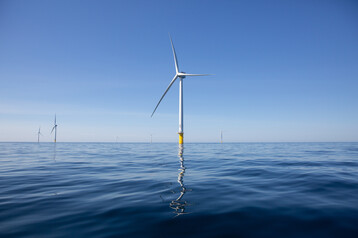
“The Engineer has found that GER owes VW far more than VW has withheld as an offset,” Krupp wrote. “GER's remedy was not to issue a termination notice, but to challenge the Engineer's determination that it owes VW such considerable sums. But at least as of this time, GER has not proceeded down that path.”
GE Renewables argued that Vineyard Wind’s attempt to bind GE Renewables was spurious.
“VW seeks the extraordinary remedy of an injunction not to preserve the status quo but to compel GER to continue performing without pay—potentially for years—pending an arbitration on the merits. That is not equity; it is a forced extension of credit that the Parties expressly negotiated against,” GE Renewables wrote in a court filing opposing Vineyard Wind’s request. “VW’s ‘emergency’ motion is a bid to gain leverage in a long-term, ongoing commercial dispute between the Parties. Having chosen not to pay, VW now asks this Court to force GER to continue performing while the Parties arbitrate who owes what.”
GE Renewables previously planned to exit the contract on April 28th. The judge’s ruling gives Vineyard Wind at least temporary relief, and should keep the wind farm operational in the short term.
Vineyard Wind has alleged that the termination of its agreements with GE Renewables would leave it unable to operate and maintain its turbines, which run on GE Renewables' proprietary designs, technology, and software, according to the legal filing.

“Only GER is able to perform the remaining work necessary to bring the performance of the GER turbines up to the capacity and reliability standards required for Vineyard Wind to supply power to Massachusetts consumers,” the offshore wind developer stated in the lawsuit. “Even if it were doable, however, it will be virtually impossible to find a turbine supplier that would be willing to take GER's place.”
Construction on the wind farm was officially completed in March. Despite this, the project is now in significant danger, facing the potential exit of one of its key partners. Vineyard Wind claims that it could be “months” before every turbine is operational, even though the construction is officially complete, and alleges serious issues in generating power.
Vineyard Wind has also warned that GE’s departure could force the wind farm to default on its loans and lead to the foreclosure of the project. If the installation is shuttered, there is no funding available to decommission the turbines, as the federal government previously waived the requirement to hold such funds in escrow.
The difficulty of finding a replacement contractor, should GE Renewables exit, is likely exacerbated by the Trump administration’s recent assault on offshore wind.
Trump attempted to shut down construction on nearly all wind farms along the East Coast last year, including Vineyard Wind, though his efforts were largely stayed by the courts, and his administration has routinely taken a hostile approach to offshore wind development.
In July 2025, the town of Nantucket announced a $10.5 million settlement with GE Vernova that will compensate island businesses that suffered losses as a result of the blade failure. Although it was not a signatory to the agreement, Vineyard Wind directly benefited from it, as the settlement released the company from all liability related to the failure. A community fund for residents to submit claims has now been established.