Nantucket Banned Corporate-Owned Short-Term Rentals. A Loophole Is Allowing Some To Continue Operating
JohnCarl McGrady •

Nantucket banned corporations from owning short-term rentals (STRs) on the island in 2024, but some companies have been undeterred by the ban, exploiting loopholes that may prove difficult to close. A new investigation by the Current exposes how one such loophole works, and why the bylaw passed by island voters at last year's Annual Town Meeting is unable to stop corporations from operating short-term rentals on Nantucket.
While Nantucket voted to legalize STRs across the island without further restrictions at a Special Town Meeting last month, there are still some requirements that STR operators must meet. They must register their property with the town, pay a portion of their revenue in fees, and remain in compliance with health and safety ordinances.
Critically, Chapter 123 of Nantucket’s town code also prohibits STRs in “dwelling units owned by a corporation, partnership, real estate investment trust, or any similar entity.” Nantucket voted 592-542 to codify this restriction at the 2024 Annual Town Meeting, and then expanded and clarified the bylaw at that year’s Special Town Meeting in the fall.
But some STR corporations have continued their operations on Nantucket despite the ban. Perhaps the most high-profile example is Stay Heirloom, a corporate STR giant with over 300 listings across the United States, which still operates six rentals on the island. A review of the available records and conversations with leading figures in Nantucket’s STR debate suggests that Heirloom may be exploiting a loophole in the island’s corporate ban.
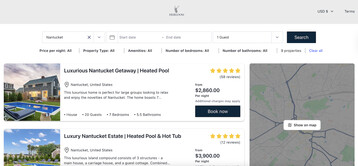
Heirloom’s official website has nine listings for Nanutcket, spread across six separate buildings and three properties, the most expensive of which costs almost $4,000 a night and accommodates up to 27 guests.
“I don’t understand how they can continue to operate,” Planning Board member Hillary Hedges Rayport told the Current.
Heirloom isn’t a rental listing site like Airbnb and VRBO, which allow any qualified operator to list their properties. Instead, Heirloom curates a selection of high-end, luxury rentals, claiming on its website that every property it rents is custom-designed by its own interior designers and maintained by its own personal team. A Current review of town property records shows that all of Heirloom’s Nantucket properties are owned by limited liability companies, or LLCs, registered to its co-founder and president, Daniel Glaser.
Nantucket’s bylaws prevent most corporations from owning STRs, but Heirloom does not appear to be in direct violation of that restriction, as its STRs are technically owned by Glaser’s LLCs, and LLCs are allowed to own STRs on the island. The bylaw says that “a limited-liability company and an S corporation shall not be treated as corporations when every shareholder, partner, and member is a natural person.”
Nantucket’s laws are written narrowly to protect residents who choose to keep their personal property in LLCs, thereby enabling Glaser’s company to continue operating them as STRs on the island. There’s nothing in Nantucket’s regulations to stop corporations from dodging the bylaws in this manner, buying up as many properties as they like and renting them short-term as long as the official owner is an LLC.

While Heirloom declined to comment beyond clarifying that their Nantucket properties are registered with the town and renewed annually, it is clear from their branding and direct control over their rentals that private residents cannot simply list their homes on Heirloom. And yet, in an email exchange obtained by the Current, the town of Nantucket indicated that Heirloom’s properties are compliant with Nantucket’s bylaws.
The town refused to answer questions about Heirloom’s properties, saying only that “the Nantucket Health Department reviews all applications to verify eligibility for a short-term rental permit.”
“It should not [be] allowed,” Kathy Baird, the co-founder and president of the pro-STR advocacy group Nantucket Together, said. “I personally would think that that's just wrong, and they should be able to close that loophole with just some additional wording.”
There is evidence that the ban has deterred at least some corporate investors. The town of Nantucket has stated several times that the Health Department, responsible for approving STR applications, has rejected requests from corporate entities to register a property. However, they have also said this is a rare reason for an application to be denied. The town has declined to specify how many corporations have been rejected, and a public records request made by the Current to obtain a list of such instances has yet to be fulfilled.
Most notably, weeks after the ban on corporate STRs was passed, the Copley Group, at the time one of the largest STR operators on Nantucket, listed nearly its entire island portfolio for sale. It’s unclear whether the Copley Group, which lobbied against STR restrictions for years, listed its properties for sale because of the ban. They had faced lawsuits against their STRs before the ban, and were locked in a heated fight with local political action group ACK Now, which advocates for restrictions on STRs. Either way, after the ban was passed, the Copley Group largely pulled out of Nantucket’s STR market.
While the 2024 bylaw may have stopped some corporations, Heirloom has continued relatively unaffected. The company's ownership model was already a common practice even before the ban was enacted. Property records indicate that many of the Copley Group’s STRs were held in LLCs, and Heirloom was also using LLCs well before it legally had to.
Even if voters passed an amendment blocking LLCs from owning STRs, Glaser could transfer the properties to his name and continue in the same manner. Preventing an operation like Heirloom’s might be nearly impossible.
“What you're finding is the shell game, which is moving everything around,” Nantucket Neighborhoods First co-founder Charity Benz said. Nantucket Neighbourhoods First has long advocated for stricter STR restrictions on Nantucket. “I don't know if there's a way of differentiating. I don’t know what you’d do.”
As corporate tax documents are not publicly available and both Heirloom and the town declined to answer questions related to Heirloom’s legal status, it is also possible that Heirloom’s parent company, Glaser Property Management, is registered as an S-Corporation, passing profits and losses directly to shareholders. S-Corporations are also allowed to own STRs under Nantucket’s current regulations.
In practice, this means that Nantucket’s laws against corporate ownership of STRs may be relatively weak.
Heirloom is not a minor player in the STR scene. Before the AirBnB data analytics site AirROI removed its page on Nantucket short-term rentals, Heirloom was listed as the third-highest-grossing STR operator on the island, bringing in nearly $1.2 million annually. AirROI listed Heirloom as the host of the six Nantucket STRs, not Glaser.
After facing pressure from STR operators in the lead-up to November’s Special Town Meeting, AirROI removed its page for Nantucket, and later claimed in emails to the Current that its own data is inaccurate and should not be trusted.
“AirROI has retracted the ‘NANTUCKET REPORT’ because it was a set of unverified estimations based on limited data models, not a final factual source, and should not be relied upon as such,” the company wrote in a message to the Current.
Despite this, their pages for hundreds of other STR markets, including several communities on the Cape and Martha’s Vineyard, remain online. As far as the Current has been able to determine, only Nantucket’s page was removed.
On the national level, Heirloom operates hundreds of STRs in over a dozen cities and towns across the country.
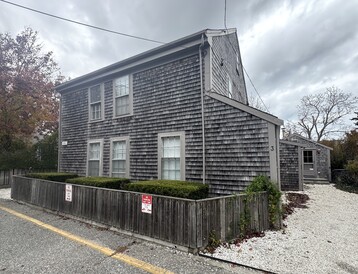
Based on maps included on Heirloom’s website, the town’s property records, conversations with neighbors, and a visual inspection of all three sites, it appears that Heirloom is currently operating STRs at 3 Beaver Street, 5 Surfside Road, and 2 Mayflower Circle. At all three properties, clients can rent the main house, the attendant cottage, or both.
Some of their neighbors are unhappy.
The Hammonds, who have owned a home on Beaver Street for years, directly across the street from the Heirloom property, have no doubt that their neighbors are corporations.
“It’s not fooling anyone, it’s most clearly corporately owned,” Josh Hammond said. “These are residential homes where no one actually lives, and they are for rental 100 percent of the time.”
The Hammonds described enormous amounts of garbage flowing out of the Heirloom property, incredibly high turnover rates, and consistent maximum occupancy. The property, they said, was a massive nuisance to them.
Josh Hammond said that he suspected Heirloom was exceeding the town’s maximum occupancy limits. While the advertised occupancy limit for the home on Beaver Street complies with town rules, the bedroom count appears to be a problem for Heirloom at other properties. Chapter 338 of Nantucket’s town code says that “occupancy of a short-term rental shall be limited to two people per bedroom plus two additional people in the unit.” The listed occupancy thresholds for two of Heirloom’s Nantucket rentals exceed that limit. One advertises the ability to host 27 guests in 10 bedrooms, and another claims to be able to hold 21 guests in 7 bedrooms.
The Hammonds, who repeatedly referred to the STRs on their street as “mini-hotels,” reported Heirloom’s property to the town to no avail. The STR, the town told them, was legal.
According to emails obtained by the Current, at one point, Select Board chair Dawn Hill tried to put Josh Hammond in contact with Frank Glaser, whom she referred to as “the owner of 3 Beaver.” Frank Glaser is not the owner of the property. The property is owned by 3 Beaver Street LLC, which is managed by Daniel Glaser, Frank’s brother. Frank Glaser’s name appears nowhere on any publicly available paperwork connected to the home. His only connection to 3 Beaver Street is through Heirloom.
Baird said that Heirloom is an example of a company attempting to circumvent Nantucket’s regulations.
“People are always going to try to find a way around it,” she said. “There's obviously not a lot of them, but people are going to do it. It defeats the whole purpose. I personally would hope that loophole could be closed.”
It’s possible that Heirloom isn’t the only company that has discovered this legal end-around.
“If there’s one, there could be others,” Benz said.
DJV Rentals, a smaller company with a similar business model that operates seven rentals in three states and five towns, lists three properties on Nantucket. DJV Rentals is an arm of the Connecticut-based real estate company DJV Real Estate. Its Nantucket properties are registered to LLCs operated by Don Vaccaro, the founder and CEO of the online secondhand ticket marketplace TicketNetwork.
Vaccaro’s personal website describes DJV Real Estate as “the property management company for Don [Vaccaro’s] rental properties. Properties managed by the company include large and small commercial buildings with office space, industrial units in a range of sizes, as well as residential, seasonal, waterfront, and vacation rentals in Connecticut and Nantucket Island, Massachusetts.”
DJV itself is an LLC, meaning it could legally own its Nantucket properties outright if all members are natural persons. AirROI listed it as the fifth-highest grossing STR operator on-island.
A representative of DJV told the Current that they are completely compliant with both the letter and the spirit of Nantucket’s regulations, and that they have no plans to buy up any more properties on-island. In fact, DJV most likely intends to sell its portfolio “by the end of the year,” due to what a representative described as shifts in the market. DJV denies that Nantucket’s ban on the corporate ownership of STRs has impacted its decision.
Even some of the most outspoken STR advocates on Nantucket expressed concern with business models like Heirloom’s.
“That doesn’t seem like it’s in the spirit of what we’re trying to do here, which is to protect individual owners,” former Nantucket Association of Real Estate Brokers president Penny Dey said of Heirloom. Dey was a staunch supporter of the article that legalized STRs across Nantucket last month.
“It’s not what Nantucket has voted to do,” she said.
Dey described Heirloom as an investor, saying that the true purpose of the island’s corporate bans is to prevent investors from buying up Nantucket properties to use as wealth-generating STRs. This brings into focus one of the central problems with Nantucket’s efforts to regulate corporate STRs: not all corporations are investor-owned, and not all outside investors use corporations. The former complication is the reason for the exceptions baked into the law that have allowed companies like Heirloom to hold their STRs in LLCs. The latter complication might be even thornier.
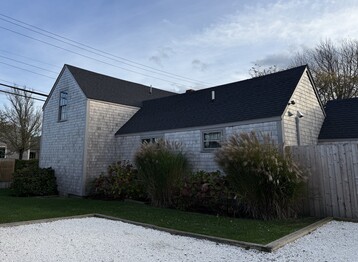
Daniel Glaser and his brother, Frank Glaser, are also affiliated with an LLC that owns 33 Milk Street, which is listed as an STR on several websites but is not available for rent on Heirloom’s website. At first, this seems more in keeping with the spirit of Nantucket’s regulations: the property is owned by real people, and is not part of a sprawling, nationwide STR network. But the Glasers are still the co-founders of Heirloom, and they aren’t the only people associated with the 33 Milk Street property.
Also listed on the registration for the LLC that owns 33 Milk Street is the highest-grossing STR operator in AirROI’s Nantucket records, who is an individual. The Airbnb listing for 33 Milk Street names Frank Glaser as the host and mentions multiple co-hosts, including an Airbnb host with at least five listings of his own. Including 33 Milk Street, this STR operator is associated with seven Nantucket-based LLCs.
The operator is an Airbnb “superhost,” a distinction also shared by Frank Glaser and listed on the DJV Rentals website.
The superhost prefers to operate his rentals individually. Vaccaro prefers to use an LLC. The Glasers, perhaps because of the sheer scale of their enterprise, use a larger, more institutionalized corporation. But which of the three, if any, is truly in keeping with the spirit of Nantucket’s regulations? And is it even possible to draw a line fine enough to stop “investors” without harming anyone else? What even makes someone qualify as an investor?
These are questions Nantucket may have to grapple with now that the island has codified STRs by right. To do so, the island may first need to decide once and for all what it is about STRs that some people are so opposed to - or, as the former Short-Term Rental Working Group asked, “what is the problem we’re trying to solve?” Answers range from their disputed impact on affordable housing to the noise and nuisance issues they generate, and no simple solution presents itself.
“The bottom line, my opinion, is no one wants to live next to a house occupied by rowdy people, regardless of whether they are renters,” Dey said.
Dey thinks STRs are the wrong target for people concerned about rowdiness. In her opinion, the problem is the noise generated by a home, regardless of whether it is an STR.
“I think people are conflating behavior and use,” she said.
But people like Benz and the Hammonds disagree.
At this point, it seems unlikely that Heirloom will be forced to cease its Nantucket operation any time soon, and efforts to change the laws that enable the company to continue running STRs on the island may prove difficult. Closing the loophole without hurting the STR operators who Nantucket voted to protect this fall is a challenge, and doing so might take years - if it ever happens at all.
Either way, while the battle over STRs on-island has shifted, it remains far from over.