Nantucket Public Schools Enrollment Falls Again, Dropping To Lowest Level Since 2016
JohnCarl McGrady •

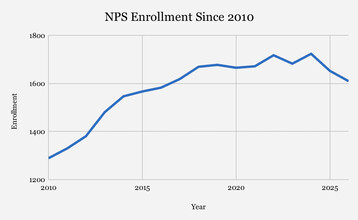
Enrollment at Nantucket Public Schools has declined for the second year in a row, falling by another 43 students to the lowest level since 2016.
Enrollment is now at 1,610 students, a decline of around 2.6 percent from last year. Decreasing enrollment two years in a row does not necessarily represent a reliable trend: the previous year, enrollment increased to a record high, and the sample size remains small.
Either way, however, the decline is important, as some of the district’s funding comes from the state and is determined in part by enrollment. The news isn’t all bad, however. Lower enrollment can also allow the district to explore new opportunities and reallocate funds as student-teacher ratios fall and the amount of resources required to support the student population drops.
In some ways, this year’s decline is more significant than last year’s, even though the absolute numbers are smaller. Since the beginning of the COVID-19 pandemic, enrollment had bounced around but remained roughly flat in the aggregate, and school leaders explained last year’s 3 percent decline as, in part, the result of a small incoming kindergarten class and the departure of the so-called “bubble” of larger-than-usual classes that led to the construction of the new intermediate school in 2017.
This year, enrollment has fallen well below pre-pandemic levels. The decline was largest in the elementary school, driven by that small kindergarten class progressing to first grade and being replaced by another small class that is only six students larger. However, school-specific declines should be treated with caution given the small numbers involved, and every single school in the district saw enrollment fall by some amount.
Nantucket Public Schools Superintendent Beth Hallett suggested that the decline could be caused by broader structural factors, including a general trend of decreasing enrollment across Massachusetts and a hostile political climate that may discourage some immigrant families from attending public school.
“The political climate has caused some decreases across the state in bilingual students,” Hallett said. “Massachusetts in general has been showing a decrease in population. Our fellow districts on the Cape and Islands have also seen decreases.”
While estimates of the total population of Massachusetts show a marginal increase last year, overall student enrollment in the state fell slightly.
Another possibility is that students are homeschooling or attending private schools on or off the island at a much higher rate, although there is currently little data available to test this theory.
There is one other option. It could be that Nantucket’s year-round population is in decline, or at least has stopped increasing. Public school enrollment expanded by 36 percent in the 2010s, paralleling a sharp increase in the island’s year-round population. Now, halfway between already-unreliable decennial censuses, public school enrollment is one of the few concrete data points available to judge Nantucket’s population, and it has declined by over 6.6 percent in the last two years.
The exact enrollment will likely remain in flux throughout the year. Last September, enrollment stood at 1,670, but the district ultimately reported 1,653 to the state. It is the October data that is used as a state-level benchmark. Then, over the course of the school year last year, enrollment started to rise, reaching 1,680 by June. Hallett said that there are a small number of students currently in the enrollment pipeline.
But even accounting for that variance, this year’s numbers represent a notable decline, and it seems unlikely that enrollment will increase enough to make up the difference in the next few months.