Nantucket Short-Term Rental Tax Revenue Rebounded In Summer 2025, But Still Fluctuating
JohnCarl McGrady •

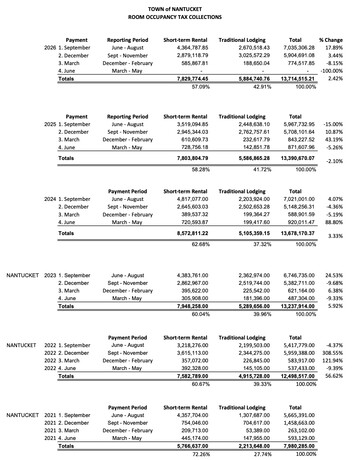
Short-term rental occupancy tax revenue collected by the town of Nantucket jumped 24 percent last summer, but remained around 9 percent lower than the record high set in the summer of 2023.
Traditional lodgings now account for a larger share of Nantucket’s room occupancy tax than at any point since the tax was expanded to cover short-term rentals in the summer of 2019.
The island’s short-term rental tax revenue can fluctuate significantly from year to year, and no clear pattern has emerged in the data since the COVID-19 pandemic began in 2020. The town collected a little under $4.4 million in short-term rental occupancy tax in the summer of 2025, up from $3.5 million in the summer of 2024 and essentially the same as in the summer of 2022.
“Things are mostly kind of flat,” said local real estate broker Penny Dey, a former president of the Nantucket Association of Real Estate Brokers. “I think we need more years of data to really draw any constructive conclusions.”
The year-to-date numbers for 2026 show short-term rental tax revenue up around 11 percent over last year and roughly even from the record-breaking revenue brought in the year before.
“I think if we had accurate information on the number of [short-term] rentals, you would see that they are actually declining,” Dey said. “What's happening is things are getting more expensive.”

The data does not show any downturn in short-term rental revenue in the months leading up to a pivotal Special Town Meeting vote in November 2025 that codified short-term rentals as legal across the island, despite fears that adverse judicial rulings against some short-term rentals could have harmed the industry on-island.
“It does fluctuate, and trying to link the fluctuation to some logical, coherent, historical foundation is pretty difficult,” Nantucket Neighborhoods First representative Charity Benz said. Nantucket Neighborhoods First has advocated for stricter regulations on short-term rentals.
While short-term rental occupancy tax revenue has swung back and forth since 2020, revenue brought in from traditional lodgings has been on a mostly steady upward trajectory, increasing in four of the last five years. Since 2023, the year that set the record for tax revenue from short-term rentals, the tax revenue from traditional lodgings has climbed over 15 percent, easily outpacing inflation.
“I think that's fairly straightforward,” Benz said. “In the old days, people would go to an Airbnb or something like that because it would save them money...I think that is not the case anymore, certainly not here. If you're only going to come for two or three nights, why would you go to all the trouble?”

Dey agreed that shorter trips could be contributing to the increase in revenue from traditional lodgings, especially given restrictions on some short-term rentals that require them to be rented for a week or more at a time.
“People can come for shorter times than one week, and that's what they can afford,” Dey said. “The inventory of traditional lodging has been elevated. The people that are owning these places today have brought them into this century.”
At the onset of the COVID-19 pandemic, traditional lodgings accounted for roughly 28 percent of Nantucket’s room occupancy tax revenue. That figure jumped to 39 percent the following year, and has since risen to nearly 43 percent. While the island’s focus has remained on short-term rentals, it has been traditional lodgings that have seen a persistent and significant revenue increase.