New Zoning Changes Imposed By State Could Mean Less Local Control Over Development
JohnCarl McGrady •

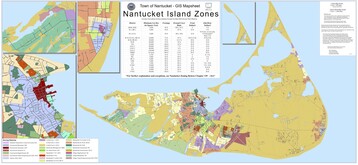
The sweeping budget bill passed by the Massachusetts legislature and signed by Governor Maura Healey last July included provisions that, rather than relating to the state’s budget, changed how zoning works in Massachusetts. Town of Nantucket attorney Amy Kwesell of KP Law briefed the Planning Board and Zoning Board of Appeals on the changes last week, but the meaning of some of the new laws remains unclear.
Broadly, the changes curtail the ability of local authorities to limit development, particularly residential development, and make it easier for developers to obtain variances from local zoning bylaws and avoid restrictive conditions and administrative procedures that could bog projects down.
Critics have attacked the changes for their opacity and for replacing local expertise with the state’s blanket judgment about how development should progress in Massachusetts.
“They’re basically just gutting the zoning bylaw,” Zoning Board of Appeals member Lisa Botticelli said. “This is ridiculous.”
But the revisions could also be seen as a move to make it easier to build more housing as the state continues to languish in one of the country’s worst affordable housing crises. Variances have historically been difficult to obtain in Massachusetts, and restrictive zoning bylaws can sometimes make efforts to create housing for the state’s residents both frustratingly slow and prohibitively expensive, if they can go forward at all.
Perhaps the most significant revision to the state’s zoning law is a change to how variances are granted, which dramatically changes the standard the Zoning Board of Appeals is supposed to apply to variance requests. In short, the old standard required the Zoning Board of Appeals to find that unusual “soil, shape, or topography” of a lot resulted in “significant hardship.” Now, applicants only need to demonstrate “practical difficulty.”
At this point, it’s unclear what “practical difficulty” means, and local authorities will likely only learn through lawsuits. Until the courts rule, the regulations will remain opaque.
“It’s probably going to take some time to get more clarity on this,” Kwessel told the members of the Planning Board and Zoning Board of Appeals during the joint meeting last Wednesday. “I will say, the way this is set up, it’s kind of teed up for, if a variance comes through that has to do with housing, if it’s denied, it might be overturned.”
Kwessel gave several examples of cases that may or may not constitute “practical difficulty.”
“This is crazy,” she said. “You could have a developer come in, and they have room to put an enormous expansion on their house, but they’ve come to you for a variance for a setback because they want to make it even bigger. Is the practical difficulty that the setbacks are not allowing them to create the house that they want?”
Kwessel gave another example she said came up during a recent conference featuring many municipal lawyers: someone was allowed to build a three-story structure but asked for a variance to add a fourth story because they would make more money if they could rent more apartments.
“I would hope a situation like that would not be a practical difficulty, that we are not just looking to increase developers’ revenue, but again, in that situation, it was housing,” she said. “There [were] a lot of opposite interpretations.”
Relatedly, it is now also unclear if the Zoning Board of Appeals can still include conditions that restrict the use of a property in a variance approval. A clause in the state law that explicitly allowed such conditions has been removed, and until legal precedent is set, it will remain uncertain what local authorities can and cannot do.
“We have got a big issue here where not only was it deleted, but now we have legal issues that conflict with each other,” Kwessel said. “There’s a legal holding that deletions from statutes are to be treated as intentional and meaningful, but then we also have an interpretation that says that conditioning a permit comes with the authority to issue that permit, and so, again, we just don’t know what the courts are going to do if the [Zoning Board of Appeals] decides it’s going to condition a variance.”
Another change allows property owners to extend or alter structures that do not conform to current zoning regulations but were built before those regulations existed by right as long as the alterations comply with dimensional regulations such as limits on building height and mandatory setbacks. In the past, such alterations required a special permit. Now, existing non-conformities such as ground cover irregularities can be extended without needing a special permit.
The language of that change says that it refers to “pre-existing nonconforming structures or residential uses”, but Kwessel said that, at the moment, nobody knows what “residential uses” means in this context.
“We have no idea what they’re talking about,” Kwessel said. “We actually think that it’s a mistake.”
Certain zoning districts where residences were previously not permitted may now see some residential development. If the regulations governing a zoning district are silent on whether a use is allowed, state law previously held that variances could not be granted to allow that use. Now, variances can be granted, so long as the use is residential.
“It doesn’t matter what your bylaw says, you have to allow for residential use variances,” Kwessel said.
The law does not qualify residential use, meaning that vacation homes count as a residential use for the purpose of the new zoning code.
The new laws also make it easier to obtain a so-called “zoning freeze.” Zoning freezes lock existing zoning regulations in place for a given development, meaning that any subsequent changes to those regulations won’t apply to that project. In the past, to get a zoning freeze, developers needed to obtain a permit for their project. Now, they just need to apply for one.
The revisions also increase the duration of zoning freezes from 12 to 24 months, extend the duration of variances from one to two years, block future changes to zoning ordinances that increase setbacks or lot sizes from applying to residential lots, slightly alter the requirements for notifying abutters about public hearings, and extend the period of inactivity before a property can be considered abandoned from two to four years.
“This is just sort of opening the door to not really having a zoning bylaw,” Botticelli said.
Kwesell also reviewed further zoning changes currently included in a draft of the state’s economic development bill that is pending before the legislature at Beacon Hill. That bill could still be amended before it is passed, though Kwesell said that Healey is pushing for it to be on her desk by January.
The most notable changes in the draft reviewed by Kwesell include allowing accessory dwelling units and duplexes by right in all zoning districts and allowing unused commercial buildings to be converted into residential buildings.
It would also make permanent a temporary but repeatedly extended provision that has allowed local regulatory boards to meet in a hybrid or remote fashion since the beginning of the COVID-19 pandemic.