Overloaded Boats, Lack Of Life Jackets Prompts Safety Advisory From Station Brant Point
David Creed •
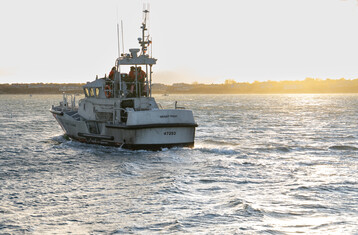
Coast Guard Station Brant Point issued a safety advisory on Monday to all mariners operating in and around Nantucket Harbor following recent interactions that created a level of concern for master chief John Lowell. Those interactions include a consistent pattern of overloaded vessels, unregistered dinghies, an insufficient number of properly sized life jackets on board vessels, and a lack of required navigation lights on small boats operating after sunset.
"The goal of the recreational boating safety mission for the Coast Guard is search and rescue prevention. That's the whole idea," Lowell said. "The idea isn't to go out there and write a bunch of violations. It's to prevent search and rescue, more or less. We have done quite a bit of education, and we're going to be shifting to more of an enforcement posture on this kind of stuff. We want to make sure we're getting the word out because again, the goal is search and rescue prevention, not to write a bunch of violations.”
Lowell said the Coast Guard is strongly urging all mariners to verify that there are enough U.S. Coast Guard-approved, properly-sized personal flotation devices readily accessible on their vessels for every person on board. The Coast Guard estimates that life jackets could have saved the lives of over 80 percent of boating fatality victims. Lowell said children under 12 years old must always wear a life jacket while underway on an open deck.
Lowell also expressed his concern about vessel capacity and said that overloading a vessel increases the chances that it may capsize. He is reminding boaters to never overload a vessel, tender, or dinghy beyond its safe carrying capacity. He said the issue personally hits close to home, given a tragic incident he witnessed while stationed in Long Island years ago, when a boat capsized and three children lost their lives.
"The vessel capacity, the overloading one, that one is particularly sensitive to me," Lowell said. "When I was stationed in Long Island about 10 years ago, a boat that was overloaded capsized while they were watching the Fourth of July fireworks, and three kids got trapped inside and drowned. So when we talk about overloaded vessels, that is something that is pretty personal to me, and I think people maybe don't understand the danger and the stability ramifications of overloading a boat. So that's why we have a particular emphasis on that one.
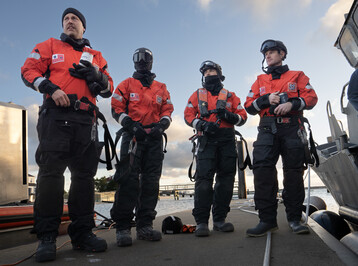
"We have done quite a bit of educating people on some of these things, including overloading, especially on Fourth of July," Lowell continued. "We talked to a few boats and sent a few boats back that were overloaded. We have definitely seen it (so far this summer)."
Lowell is also asking all boaters to verify that all required navigation lights are functional. He said operators of small, unpowered vessels must carry at least a bright flashlight or lantern to display in sufficient time to prevent a collision at night.
"What we see with navigation lights is a lot of dinghies that don't have proper navigation lights," Lowell said. "I think a lot of people think dinghies are exempt from having navigation lights. But generally speaking, unless you're under oar power or your dinghy is incapable of doing more than a maximum speed of greater than seven knots, then you need regular navigation lights just like any other power-driven vessel. You need a green and red side light, a white masthead light, and a white stern light, which can be a combined all-around white light. A lot of people think dinghies are exempt from that, and they are not."
Lowell is also urging all vessels, including motorized dinghies and tenders, to ensure that they are properly registered and carry the correct, up-to-date documentation on board. He said safe boating certificates are now required by the state of Massachusetts for all persons operating powered recreational vessels, and that courses can be found here.
"My biggest fear is somebody's out there in an unlit dinghy, and they get run over by a boat that doesn't see them," Lowell said. "Or an overloaded boat capsizes, and then we have more people drown, or they don't have enough life jackets. I mean, this stuff can lead to pretty serious consequences. So we're just trying to get out ahead of that."
Boaters seeking to verify their vessel’s compliance are encouraged to schedule a free Vessel Safety Check (VSC) through the local Coast Guard Auxiliary. For more information on required boating safety equipment, mariners can visit the U.S. Coast Guard Boating Safety Resource Center here.