Land Bank Sued Again By Neighbors Over Petrel Landing Pier Project
David Creed •
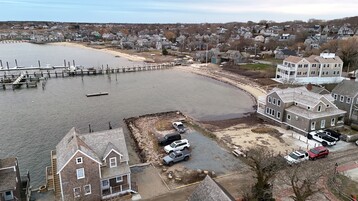
The Nantucket Land Bank's plan to install a new floating pier at Petrel Landing on Nantucket Harbor is once again facing a legal challenge.
The owners of 21 and 25 Commercial Wharf filed a lawsuit in Nantucket Superior Court on Tuesday asking the court to rule that the Land Bank's plan for Petrel Landing “vastly exceeds the Land Bank's limited statutory authority and is otherwise contrary to law.”
The lawsuit, filed by Richard G. Corey of 21 Commercial Wharf and 25 Commercial Wharf LLC, owner of 25 Commercial Wharf (LLC managers listed are William H. Barney and Ruth M. Barney), is not the first lawsuit filed by Corey against the Land Bank over the project, which has been in the works for more than a decade.
Corey filed a lawsuit in Suffolk Superior Court against the Land Bank, Conservation Commission, and Massachusetts Department of Environmental Protection back in November of 2022, appealing the final decision made by Martin Suuberg, who was the commissioner of the Massachusetts Department of Environmental Protection from January 2015 through January 2023, approving the project.
Corey expressed concern about the wooden pier providing dockage for "numerous large motor boats and will be open 24 hours a day, all within 60 feet of Corey's seasonal residence."
In February of 2024, Corey lost the court battle when judge Michael Doolin ruled that Corey's motion for judgment on the pleadings was denied and the defendant’s cross motion was allowed.
“Accordingly, the court hereby declares that the Department's decision regarding the coastal bank and project on 21 Commercial Wharf was lawful and not arbitrary and capricious, and as such the Department's decision is affirmed,” Doolin said in his decision.
Petrel Landing, purchased in 2004 by the Land Bank and located at 17 Commercial Wharf, is about 60 feet away from Corey’s property with a small parcel of land and a building separating the two. The LLC’s property is separated by two properties to the east of the Corey property and is about 170 feet from Petrel Landing.
The project in question has been in the works for over a decade and would remove the existing three-foot sloped riprap wall that has historically served as a barrier for Petrel Landing. A new vertical stone revetment on the westerly and southerly sides of Petrel Landing, on the toe of the existing stone riprap, and a sloped, granite revetment will replace the existing riprap wall on the easterly side of the wharf.
“The area behind the new revetments will be backfilled with crushed stone and gravel, raising the elevation of Petrel Landing to six feet above mean low water and substantially expanding the usable footprint of the wharf,” the lawsuit reads. “As part of the project, the Land Bank intends to dredge approximately 20,080 square feet of Nantucket Harbor and remove approximately 1,200 cubic yards of material. Upon completion of this work, the Land Bank plans to construct a 140-foot-long pile-supported floating pier, designed to accommodate vessels up to 25 feet in length. The proposed pier will be located off the south side of the property and run easterly 140-feet parallel to the shore. The easterly end will be located about 90 feet across open water from the Corey Property. The proposed dredging footprint extends to within approximately 25 feet of the Corey Property.”
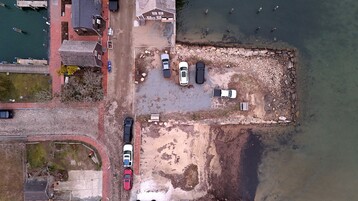
The Land Bank, in its own words, described the phases of the project in an environmental notification form to the Massachusetts Environmental Policy Act (MEPA) Office as installation of a replacement stone revetment around the perimeter of the existing solid fill pier; a floating pier system being proposed, which will be held in place by driven pilings; the area behind the revetment will be filled level using clean soil, covered with topsoil, landscaped with a driveway, perimeter boardwalk, benches and plantings; and dredging being proposed to facilitate navigation within the waterway for access to the pier and floating dock system.
“The Lank Bank has stated that it is undertaking the project to meet the town's expanding need for temporary dockage of dinghies,” the lawsuit says. “The Land Bank acknowledges it is proposing a commercial pier because it provided an assessment of how the project comports with the Wetlands Regulations governing commercial piers. On information and belief, the north side of the pier, closest to the Plaintiffs' properties, will be used for drop off and pick up by boats to allow individuals to access larger boats moored elsewhere, creating a significant amount of boat traffic within close proximity to Plaintiffs' properties. On information and belief, the south side of the pier will be used for docking dinghies.”
The plaintiffs reference the Land Bank Act in the lawsuit and state that it authorizes the Land Bank to “acquire, hold, manage land and interests in land" with specific parameters. They argue that while the act does allow the Land Bank to hold land for “future public recreational facilities and use,” this project doesn’t meet the criteria since the pier will be used for private parties as well.
“A commercial pier providing transit and docking services to private parties for a fee does not constitute ‘public recreational facilities,’” the lawsuit reads. “The Land Bank's proposed project does not retain the Locus predominantly in its natural condition. To affect the proposed redevelopment of Petrel Landing, the Land Bank must conduct extensive dredging under the ocean. The Land Bank requires authorization from the Secretary (of the Massachusetts Executive Office of Energy and Environmental Affairs (EOEEA)) to convert the open land at Petrel Landing into the project.”
The plaintiffs also referenced a letter to the editor submitted to the Current by the Land Bank in August of 2025, in which the commission stated it they would begin evaluating how they can better tackle issues the island faces over the next 40 years. The plaintiffs referenced one sentence of the letter in which they quoted the Land Bank saying it is time for it to “begin transitioning away from a purely open space acquisition mode to a far more collaborative, visionary, and broader public policy role.”
The full context of the quote from the letter is below with the paragraphs before and after the cited sentence appearing in the lawsuit.
“It is time for the Land Bank and Nantucket to assess our successes over the past 40 years and decide how we can best collaborate with the town, our citizens, and a myriad of island-based organizations to better tackle the issues we face over the next 40 years. As we undertake this important planning exercise and begin transitioning away from a purely open space acquisition mode to a far more collaborative, visionary, and broader public policy role, we need the active involvement, deliberation and creativity of all our island residents. This will not be a simple or straightforward process or evolution, but it is of critical importance to determine what we will do over the next 40 years, and to ensure we keep Nantucket Nantucket, for future generations.”
Land Bank executive director Rachael Freeman told the Current that the Land Bank was not aware of a lawsuit having been filed prior to the Current's request for comment. She said the status of the Petrel Landing project is that the Land Bank was in the process of assembling information to file for a Chapter 91 license with the existing design.
The plaintiffs are requesting the court to:
- Declare that the Petrel Landing project is not a "public recreational facility" within the meaning of the Land Bank Act.
- Declare that the project is not "in the interest of conservation.”
- Declare that the Project is beyond the scope of the Land Bank's authority under the Act.
- Grant their attorneys' fees and costs.
- Grant any other relief that the Court deems fair and just.