Ship Strike Suspected In Death Of Sperm Whale That Washed Up On Nantucket Last Year
Jason Graziadei •
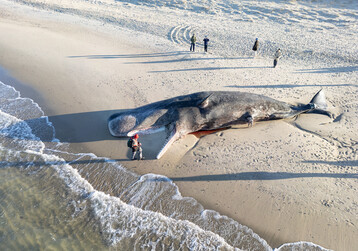
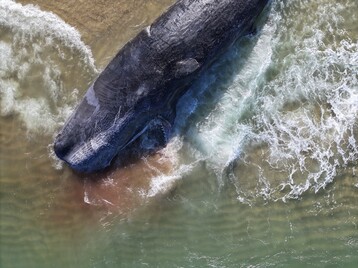
The cause of death of the 46-foot sperm whale that washed up along Nantucket’s north shore last November is being categorized as suspected vessel strike trauma, the Marine Mammal Alliance Nantucket (MMAN) announced on Wednesday.
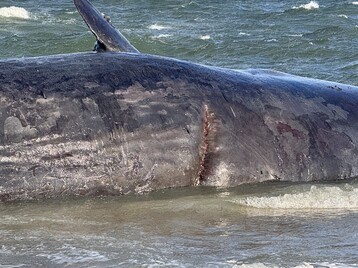
The adult male sperm whale was suffering from chronic impacts from “a significant wound likely caused by a vessel - from the shape and depth, specifically a skeg,” MMAN stated. A skeg is a sternward extension of the keel of boats and ships that have a rudder mounted on the center line.
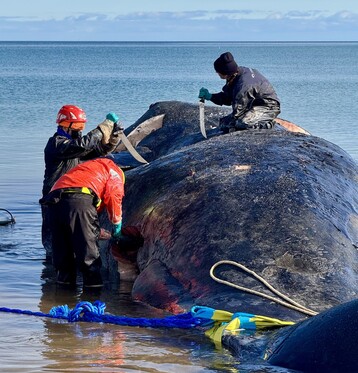
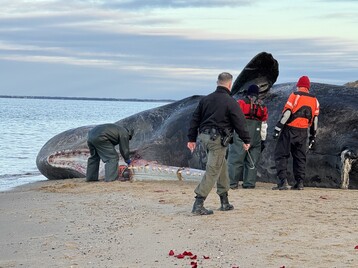
While a formal necropsy was not performed on the sperm whale due to its state of decomposition, weight, and location, marine mammal officials were able to conduct a so-called “window exam” in which they took tissue and organ samples from its carcass. A team of veterinarians and biologists from the International Fund for Animal Welfare (IFAW) and the New England Aquarium performed the exam several days after the whale came ashore at 40th Pole Beach, and before its carcass was towed out to sea to be disposed of.
The tissue samples were sent by IFAW to the University of Illinois’ College of Veterinary Medicine’s Zoological Pathology Program for histopathology review. The report issued by MMAN on Wednesday was based on conclusions by the International Fund for Animal Welfare (IFAW) that were substantiated by the pathology report, MMAN’s Pam Murphy told the Current.
“Based on their findings, the cause of death will be categorized as vessel strike trauma (suspect) from the chronic impacts of the observed wounds,” MMAN stated in its announcement. “The large skin wound we could see on the whale’s back had thick scar tissue, and didn’t have evidence of infection. The muscle and tissue samples taken from near this wound showed evidence of tissue death and bleeding. There are a few ways this could happen: - Some of this muscle damage could have been from the original traumatic event, - While the wound healed, it created scar tissue, and the muscles used in swimming were aggravated and damaged by the scar, or - Another acute traumatic event happened prior to the whale’s death and stranding. Muscle damage during any of these events could have led to kidney damage, which could have given us additional information, but the kidneys were not able to be collected during this exam.”
IFAW animal rescue veterinarian Dr. Sarah Sharp was one of the marine mammal experts who conducted the window exam on the sperm whale last November.
"The injury observed on the whale’s back was deep and had a significant amount of scar tissue present throughout the blubber and muscle, indicating that it had been present for some time, as well as evidence of active bleeding and tissue death in the muscle, indicating ongoing trauma," Sharp told the Current this week. "There are a few ways this could happen: 1) some of the muscle damage could have been from the original traumatic event; 2) while the wound healed, it created scar tissue and the muscles used for swimming were aggravated and damaged by the scar; or 3) another acute traumatic event happened prior to the whale’s death. The death of this endangered sperm whale is another tragedy that could have been avoided with increased protections for these animals that would allow them to thrive alongside humanity rather than be victims of it."
According to the National Oceanic and Atmospheric Administration (NOAA), ship strikes and entanglements in fishing gear are the primary causes of death for large whales.
“We do not know where or when this whale was injured,” MMAN stated. “With any stranding, it’s important that we not jump to conclusions until a thorough exam could be performed and get the full story.”
The Current requested a copy of the report from NOAA via a Freedom of Information Act request. The full pathology report from the University of Illinois can be found here.
“The wound was determined to be old, as chronic scarring was present,” MMAN stated. “However, even an old wound could still cause continuing damage that could have ultimately contributed to the whale’s death.”
Marine Mammal Alliance Nantucket stranding coordinator Kim Schulam led a presentation at the Whaling Museum on Wednesday evening outlining the organization’s response to the 52-ton sperm whale coming ashore last November, and also spoke on the findings from the window exam.
"It could have been that routine muscle movement around that scar, tugging on the healthy muscle and breaking it down when it was diving and swimming," Schulam said. "It could have been constant chronic inflammation, or it could have been another acute event where it could have been hit a little bit more recently."
Schulam was asked by a community member in the audience whether a ferry was the vessel to strike the whale. She dismissed the idea of it being a ferry but added it is impossible to know who or what vessel hit it.
“There is nothing I can think of in nature that could have caused bruising like that, it was not a bite,” Schulam said. “It is impossible to say who or what boat hit it, but it probably was not a ferry. Who knows where it was hit? It was an old wound. It could have been months ago that it sustained that injury.”
The carcass of the 46-foot male sperm whale weighed an estimated 104,000 pounds, or 52 tons, and was the talk of the town when it washed ashore on Nov. 16, 2025 at the popular 40th Pole beach.
Sperm whales, which were hunted by Nantucketers for their spermaceti oil all over the world during the 19th century, are the largest toothed predator on Earth. The species inhabits deep oceanic waters and is classified as endangered, so it’s a rare occurrence to spot one - alive or dead.
The one that washed up at 40th Pole was the first sperm whale stranding on Nantucket since 2002.
Senior reporter David Creed contributed to this report.