Sperm Whale Tooth Sold For $125,000 At Nantucket Auction
Jason Graziadei •
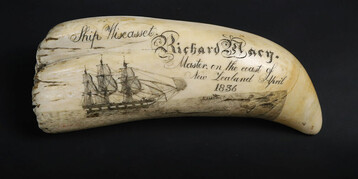
A scrimshaw sperm whale tooth was sold for $125,000 last week at an auction on Nantucket.
The 9.5-inch tooth was taken from a sperm whale killed by Capt. Richard Macy, of Nantucket, and the crew of the whaleship Wiscasset during a voyage that took them all the way to the coast of New Zealand in April of 1836.
It was sold last week at the American Legion hall on Washington Street by Rafael Osona Nantucket Auctions on behalf of a man who had quietly held on to it for more than 80 years after it had been handed down in his family for generations.
For Osona, a third-generation antiquarian who has sold more than 5,000 sperm whale teeth over his 45 years doing auctions, it was still a remarkable artifact that stood out to him for many reasons - not just the high sale price.
"So this one was of high value because it was a large tooth in relation to most other teeth - nine and a half inches - and it's the weight of two bricks," Osona told the Current. "And the scrimshaw was fabulous. It had a Nantucket tie, because it was Richard Macy...When I unwrapped it to show a potential buyer, it was a moment of silence, you know. One guy said, 'Holy Mother******,' you know? They had to pause for a couple of seconds to get the right words because it was something that you don't see in your lifetime."
While Osona declined to name the buyer, he described the man as a dedicated collector who was the only bidder for the tooth at last week's auction.
"That's all I can tell you because he's kind of private," Osona said. "But the funny thing is, while the auction was still going on, he came in and took out his checkbook and wrote a check. We wrapped it up in paper and put it in a Stop & Shop brown bag, and he went walking up the street. So here he's got this incredible treasure in a grocery bag and $125,000 less in his bank account. That's all we had. So we all said, yup, typical. Cas(ual). Nobody showed up with a Gucci bag to stick it in.
"I've been here 63 years, and I've been just so blessed to have done simple deals like this that do not take attorneys and advisors and all of that stuff," he added. "And so it was kind of just charming. I go, 'Yeah, that’s Nantucket'."
According to Osona's description of the tooth that was posted to his website ahead of the auction, "The ship Wiscasset commanded by Captain Richard Macy (1797-1850) hailed from Nantucket, and was manned by men from the Wiscasset area in Maine. The piece commemorates the ship’s 1834-1837 voyage to go deep-sea whaling in the Pacific and the successful capture of a large sperm whale off the coast of New Zealand in April 1836. The details are beautiful including the intricate rigging, the men stationed at the lookouts on three masts and the humorous depiction of a porpoise on the verso. After successful whaling out of Wiscasset, the Wiscasset was sold to a whaling outfit in Sag Harbor and was ultimately retired from whaling around 1847..."
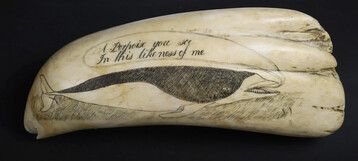
Scrimshaw - which is the engraving of ivory sperm whale teeth - developed as a significant folk art form in the first quarter of the 19th century, according to the Nantucket Historical Association. "A common practice aboard whalers was for the captain to divide the teeth from the sperm whale's jawbone among the crew. Most engraved scrimshaw teeth were the work of anonymous sailor artists, though some of the finest early specimens were signed," reads a description at the Nantucket Whaling Museum. Whalemen would pass the time on long voyages - some of which stretched over years - by making decorative and functional items from the ivory, merely a byproduct of the sperm whale, which was hunted for the more valuable spermaceti oil in its head.
Osona said the Nantucket Historical Association expressed interest in the tooth, going so far as to borrow it from Osona for a day to allow its team to inspect it and consider a purchase. But ultimately, the organization passed on the opportunity to bid on it and add it to its extensive scrimshaw collection at the Nantucket Whaling Museum.
The scrimshaw sperm whale tooth that sold at auction last week had not been on anyone's radar, Osona said. He became aware of it earlier this year thanks to a phone call out of the blue.
"A gentleman in his 80s contacted me from the middle of the country, and they had this tooth," Osona said. "It was dated 1836, and he had it for 80 years. He remembered his father was praising this thing and loved it. And he remembered his grandfather having this on his mantle. So that's three generations there. So that's what? 150 years of babysitting this damn thing? So he did not want to continue the handling of this or taking care of it, because it was valuable at this stage. So he flew and handed it to me. He was afraid of shipping in case of loss - you know you can imagine if the plane goes down or the boat sinks, and here you have something that you've been the steward of for so many decades or centuries. So they Googled who the experts are, and I came up. So that's how he calls me, and when you get a phone call like this, it's like 'Wow, is this real? Is this possible? Is this a joke?' And then he says, 'Oh, and I'm gonna fly and hand it over to you.' Wow."
The sale last week was also notable as it followed the beaching of a deceased sperm whale on the north shore of Nantucket - the first sperm whale to wash up on Nantucket since 2002. Osona, of course, took some time to go out and see it for himself.
"It just meant so much to me when I was standing there," he said. "Holy cow, you know? You've gotta have some guts to go lower the boat and go after these massive animals."