State Rejects Environmental Justice Challenge To Surfside Crossing Development
JohnCarl McGrady •

The state has rejected a petition from a group of Nantucket residents seeking a review of the environmental justice impacts of the proposed Surfside Crossing housing development, which has languished in a quagmire of legal appeals for the last six years.
The petitioners alleged that the initial hearings on the development, which consists of 156 housing units, did not consider how it would affect the state-designated environmental justice community spanning the mid-island area and sought a “fail-safe” review.
But the state replied that because the project qualified for and received standard environmental review and was filed before Massachusetts created the relevant environmental justice regulations, a fail-safe review was not available, and the state’s environmental justice provisions did not apply. To receive a fail-safe review, the state said, a project must not meet the standards for a traditional review, which Surfside Crossing did.
As a result, the state’s reply primarily focused on whether the project had changed significantly enough since those environmental permits were awarded to merit further review. The state concluded it had not.
“The development has not changed as compared to the [Environmental Notification Form (ENF)],” the state wrote. “The Petition has raised a variety of issues related to Project impacts, including impacts to local roadways and drinking water supply; unresolved plans for wastewater disposal; increased demand on Nantucket’s electric grid; inconsistency with local and state planning policies; and construction impacts, including tree clearing. A close reading of the ENF Certificate demonstrates that these issues were already addressed during the prior review. In particular, the ENF Certificate discussed the results of a traffic study conducted for the project; the potential need for wastewater system upgrades to accommodate the project; stormwater and water supply issues; and climate change adaptation and resiliency.”
Surfside Crossing’s attorney Paul Haverty called the petition "another in a long line of misguided attempts" to stop the controversial development.
“We stated at the time that the fail-safe request was not appropriate, as we had already received a MEPA Certificate," Haverty said. "This ruling unequivocally shows that the project complies with all applicable MEPA requirements, and that the efforts of the opponents to the project to assert a fail-safe claim were just another in a long line of misguided attempts to thwart the development of much-needed affordable housing in Nantucket.”
Island resident and vocal Surfside Crossing opponent Meghan Perry, who took the lead on the petition, disagreed with the state’s decision to reject a fail-safe review.
“[Massachusetts Environmental Policy Act] review is not a permitting process,” she said. “It does not pass judgment on whether a project is or is not beneficial or whether a project can or should receive a particular permit. In an environmental justice community the developers must engage the community and do community outreach to make sure everyone is involved.”
The state established environmental justice communities in 2002 to create a legal framework that allows the state to respond to the disproportionate environmental burdens on disadvantaged residents of Massachusetts.
An environmental justice community is any neighborhood where the annual median household income is 65 percent or less of the statewide median, minorities make up 40 percent or more of the population, 25 percent or more of households identify as speaking English less than “very well,” or minorities make up 25 percent or more of the population and the annual median household income of the municipality in which the neighborhood is located does not exceed 150 percent of the statewide annual median household income.
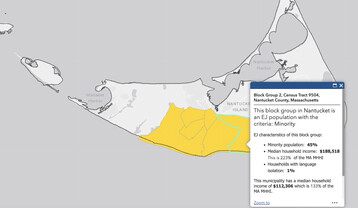
The state’s ruling comes as the Surfside Crossing project goes before the Massachusetts Housing Appeals Committee for the second time, with its developers asking the state committee to overturn the denial they received from the Nantucket Zoning Board of Appeals earlier this year. The Housing Appeals Committee previously voted to approve an early version of the development, and opponents worry the Committee might side with the developers again.
In addition to Perry, the environmental justice petitioners included Will Willauer, president of the Nantucket Tipping Point Board of Trustees, along with Sean Perry, Diane Cabral, James Cabral, Jay Cabral, Joan Stockman, Jack Weinhold, Linda Meredith and Christopher Meredith.
“Within a one-mile radius of the proposed development are five other affordable housing projects, all concentrated in the same area,” the petition read in part. “This creates an overwhelming and disproportionate burden on one section of the island—an area home to working families, low-income households, and residents who often lack the time and resources to advocate for themselves.”
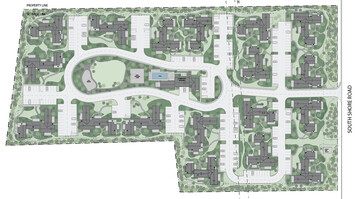
Surfside Crossing’s 156 condominium units would be contained within 18 three-story buildings (two stories above grade) on 13 acres off South Shore Road that were cleared in August 2023. As a Chapter 40B development, 25 percent of those units are required by the state to be deed-restricted for affordable housing, or a total of 39 units within the development, for residents earning at or below 80 percent of the area median income. The other 117 units would be sold at market rate, priced between $500,000 to $1.5 million.
Surfside Crossing developers Jamie Feeley and Josh Posner have pitched the project as a critical piece of the fight against Nantucket’s housing crisis that could singlehandedly create dozens of affordable housing units. However, the development has always been intensely controversial due to its size, density, and potential impacts on Nantucket’s natural resources.
The hearings before the ZBA in late 2024 and early 2025 were considered a "remand," as it was the result of a Nantucket Superior Court judge’s decision back in January 2024 to reject the state approval for Surfside Crossing and send the project back to ZBA for further review. Judge Mark Gildea's decision was the result of legal challenges brought against the project by the Nantucket Land Council and a group of neighbors. They had appealed the state Housing Appeals Committee's approval of the project in September 2022, and its ruling that Surfside Crossing's 156 condominium unit proposal under Chapter 40B did not constitute a "substantial change" from what had previously been approved by the Nantucket Zoning Board of Appeals: a scaled-down development of 60 single-family homes and 96 condominiums.
In April 2023, the town announced that it was dropping its lawsuit against Surfside Crossing after reaching a “collaborative agreement” with the developers. The agreement outlines a commitment by the Select Board and the Surfside Crossing developers to earmark 75 percent of the 156 condominiums in the development to “directly serve year-round housing needs.” That goal would be accomplished through long-term deed restrictions at various income levels. Critics noted at the time that there was no written agreement that could bind Surfside Crossing's developers to such restrictions, and the dismissal of the town's lawsuit sparked frustration and “blindsided” the board as a whole.
Feeley subsequently said in a statement that he hoped potential partnerships and collaborations with the town, as well as with island businesses and organizations, would result in up to 75 percent - the 117 market rate units - ending up in local ownership.
The plans for Surfside Crossing were filed under a state statute known as Chapter 40B, which allows developers to bypass local zoning regulations and increase density if at least 20 to 25 percent of the new units have long-term affordability restrictions.