Town Opens Hummock Pond To The Atlantic Ocean
Jason Graziadei •
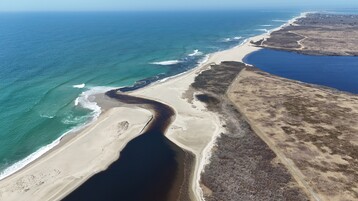
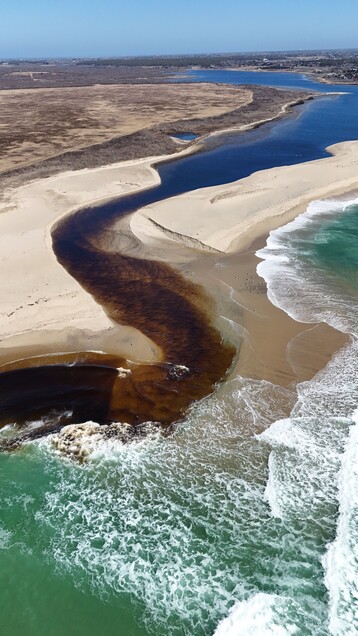
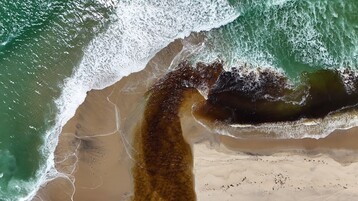
Hummock Pond was opened to the Atlantic Ocean last Thursday, the first of its semi-annual openings.
The great pond is opened to lower nitrogen levels, raise salinity through the exchange of brackish pond waters with high-quality offshore waters, and allow entry of marine species including herring, blue crabs and other species. The opening followed a similar operation at Sesachacha Pond on April 4 (which closed up quickly and was reopened by the town last Thursday as well).
Hummock Pond covers more than 220 acres of the island, with an average depth of eight feet.
“More than a mile long, but largely a narrow pond running northeast-southwest, Hummock Pond, which includes Head of Hummock Pond connected to it by a ditch, is an outwash pond extending from the middle of the western portion of Nantucket down to the ocean with a barrier beach in front of it,” according to the Nantucket Pond Coalition. “Prior to 1978, Hummock Pond formed a hook-shaped water body, but the ocean storm, part of the Blizzard of 1978, hacked off the westside of this pond known as Clark Cove into its own pond, now separated from Hummock by beach, dunes and the ocean end of Sanford Farm’s Ram Pasture.“
the colors of the Hummock Pond opening
— Nantucket Current (@ACKCurrent) April 10, 2026
The town’s Natural Resources Department opened Hummock Pond to the Atlantic Ocean on Thursday. The great pond is opened twice annually to lower nitrogen levels, raise salinity through the exchange of brackish pond waters with high… pic.twitter.com/Dl98DJveQx
“Hummock Pond and its head are classified as coastal salt ponds. Both are considered impaired or, eutrophic, with Head of Hummock labeled as severely impaired," according to the coalition. "As fresh/brackish ponds, they support a variety of wildlife including painted and snapping turtles, American eels, blueback herring, chain pickerel, sunfish, crappy, and small-mouth bass. Mute swans and several species of ducks breed and raise young on the edges of these ponds. There are two osprey-nesting poles where pairs of ospreys nest almost every spring and great blue herons, great egrets, little egrets and black-crowned night herons work the shoreline shallows for small fish.”