Turf Field And Synthetic Track Endorsed By School Committee
JohnCarl McGrady •
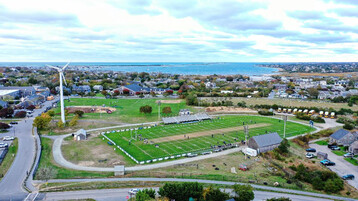
After months of intense debate and public hearings, the School Committee voted Tuesday evening to advance a plan to renovate the high school’s athletic complexes with a turf field and a synthetic track. The plan, a revision of an earlier proposal that featured a grass field and an asphalt track, passed 4-1, with Dr. Tim Lepore opposed.
The School Committee’s decision reverses a decision from its September 22nd meeting, when the Committee voted unanimously to back the natural grass field and an asphalt track. The new plan, which will cost around $23 million, will be reviewed by the Capital Program Committee and the Finance Committee, and would have to be approved by Town Meeting voters this spring.
Since the September meeting, the School Committee has heard from dozens of concerned islanders staunchly opposed to grass and asphalt, who have repeatedly pushed for synthetic alternatives.
While some members of the public have voiced their support for natural grass, the overwhelming majority of those who have spoken at the School Committee’s meetings have come down in favor of turf, and that weighed heavily on the Committee’s decision Monday.
“[The public has] been very loud and very clear in what they want,” School Committee member Shantaw Bloise Murphy said.
This isn’t the first time the School Committee has looked favorably on a plan to install turf at the high school. Three years ago, NPS floated a $17.5 million proposal to install two artificial turf fields as part of a larger campus-wide facilities improvement project, but backed down after facing intense opposition from local groups concerned about the impacts of the so-called “forever chemicals” known as PFAS, which have been tied to cancer and other health problems and are sometimes found in turf.
Proponents of turf fields contend that new formulations no longer contain PFAS, a position Nantucket Public School (NPS) consultants ultimately supported. The consulting firm Weston and Sampson, hired by NPS to review the problem, reported on several tests paid for by turf manufacturers that showed little to no PFAS in their products.
“We have seen, quite specifically, that the PFAS issue is not there,” School Committee member Vince Murphy said. “It's not just science. It's school-need, student-need, children's-need, and economic relevance.”
Bloise Murphy amended the initial motion to support a turf field to include a clause instructing NPS to specifically test the actual turf product that will be installed for PFAS at an independent lab, as concentrations may vary by batch, and some commenters have worried about the accuracy of industry-sponsored testing. Her amendment passed with the initial motion.
Not long before the vote, the School Committee once again heard public testimony primarily in favor of turf, including from the student representative who sits on the Committee.
“It's something that the student athletes need,” student representative Danielle Lewis said. “This can't go on.”
Girls soccer goalie Madden Myers, who has been an outspoken supporter of turf, also spoke again, referring to a petition she previously circulated with over 300 student signatures in favor of turf. Myers also presented the Committee with an essay arguing for a turf field.
Lepore was ultimately the lone dissenter.
“I would be very much in favor of a track, but I think I am opposed to the turf field. I think that we can do a better job with grass,” Lepore said, raising concerns about PFAS and microplastics. “I appreciate the students' concerns, and I appreciate the students' wants, but I don't think in the long term that this is the way to go.”
Before the vote to support the turf field, Lepore attempted to make a motion to table the discussion. No one seconded the motion, meaning that it failed.
If ultimately approved, the new athletic complexes will also feature bathrooms, improved ADA compliance, a new booster and concessions building, lighting that complies with dark sky regulations, and new bleachers. None of these features have drawn significant controversy.
Construction would take around two years to finish, and NPS administrators have urged voters to pass whatever version of the plan reaches the floor of Town Meeting, before the cost to improve the outdated and noncompliant infrastructure increases any further. Just since discussions began in September, estimated costs have ballooned from $15 to $18 million, to $23 million now.
Cost could be an issue for the project, which will need the support of voters facing a litany of expensive capital projects at the 2026 Annual Town Meeting. In total, the borrowing before voters this spring might be as high as $200 million.