URI Student Studying Wind Farms' Impact On Jonah Crabs
JohnCarl McGrady •
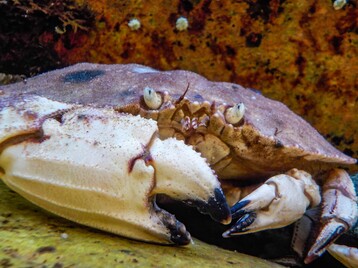
How is offshore wind impacting marine life? One way, it seems, is by creating reef-like habitats for organisms that live on the sea floor.
After turbine foundations are installed, they function much like rocks or artificial reefs. The same organisms that crowd natural rock foundations, like barnacles, cling to and crowd around the bases of the turbines. The larger animals that feed on those small organisms follow them to the turbines. One of these larger animals is the Jonah crab.
University of Rhode Island doctoral student Emmanuel Oyewole is studying the impact of offshore wind on Jonah crabs, a common red crustacean that has recently become more popular in the culinary world as lobsters migrate farther north due to climate change and their populations continue to fall.
“The turbines can create a kind of ‘mini ecosystem.’ They provide food and habitat, which can draw marine life into the area and potentially change how species use the surrounding environment,” Oyewole said. “The question is whether they are increasing the overall amount of marine life in the ocean by creating new production or simply concentrating animals that were already living in the surrounding areas.”
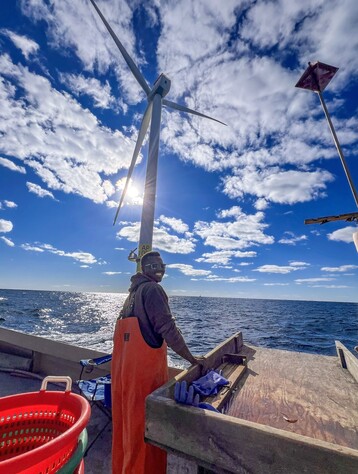
He believes that understanding how offshore wind turbines impact Jonah crabs could provide a window into how offshore wind impacts marine life more generally.
“Ecologically, Jonah crabs also play an important role in the marine food web,” said Oyewole. “They are both predators and prey, helping to maintain balance within benthic ecosystems. Because they are closely connected to seafloor habitats, they can help us understand how offshore wind farm structures may influence local biodiversity, habitat use, and the productivity of fisheries.”
Oyewole’s research is particularly relevant to Nantucket, given the wind farms to the southwest of the island and the community’s long history with commercial fishing. Oyewole’s research will benefit the Commercial Fisheries Research Foundation, a nonprofit.
“This project has been shaped by listening to [local commercial fishermen’s] experiences, concerns, and needs. Their knowledge of the water, species behavior, and changing fishing patterns provides insight that scientific sampling alone can’t capture,” Oyewole said. “Even as data collection continues, their support remains a critical part of the work.”

The topic of the offshore wind's impact on marine life - especially whales - has been hotly contested for years. Some groups, including the Nantucket-based ACK For Whales, believe the noise from offshore wind farm activities and operations could be disruptive and pose risks to whale species, especially the critically endangered North Atlantic right whale.
"The North Atlantic Right whale is on the brink of extinction," ACK For Whales states on its web site. "We do not want to 'wait and see' what the damage is after it’s too late and the turbines are erected. These wind farms are going to be an untested, unregulated, industrial experiments that are not supported by anything but promises of foreign energy giants?"
However, the National Oceanic and Atmospheric Administration (NOAA) has stated "At this point, there is no scientific evidence that noise resulting from offshore wind site characterization surveys could potentially cause whale deaths. There are no known links between large whale deaths and ongoing offshore wind activities."
The North Atlantic Right Whale Consortium emphasized in a recent population assessment of the species that entanglements and ship strikes remain the leading causes of right whale fatalities.