What The Storm Looked Like Underwater In Nantucket Harbor
Betsy Sherman, Maria Mitchell Association •
It’s been a rough few days on Nantucket. We’ve watched the harbor churn, felt the wind and rain, and dealt with canceled ferries and outdoor plans. But while we experience a storm from above the water, what is happening to the organisms living beneath it?
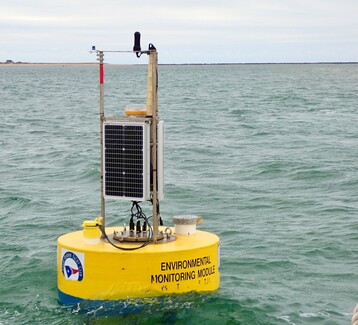
The Maria Mitchell Association has a buoy moored near the mouth of Nantucket Harbor that gives us a remarkable window into that world. Every 15 minutes, its sensors record conditions including water temperature, salinity, dissolved oxygen and light. During this storm, those measurements told a compelling story.
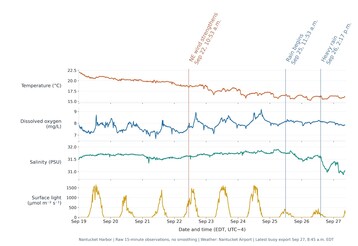
On September 19, harbor water was about 22°C (71.6°F), already beginning its seasonal cooling from summer highs. By the morning of September 27, it had fallen to nearly 16°C (60.8°F).
For us, that may simply sound like colder water. For life in the harbor, temperature influences nearly everything — metabolism, growth, feeding and photosynthesis. Eelgrass, in particular, depends on the right combination of temperature and light to produce the energy it needs.
Then came the rain.
Salinity had remained relatively steady for several days before dropping sharply following the heavy rain on September 26. The change — from about 31.7 to 31 — may not look dramatic on a graph, but it represents a measurable pulse of fresher water entering the harbor.
Rain falling directly onto the harbor and runoff from the surrounding land may both have contributed. Our buoy can show us that the change happened, but it cannot tell us precisely where that freshwater came from. Runoff can also carry nutrients and other materials from land into coastal waters, one of the many reasons long-term monitoring of the harbor is so important.
The light sensor told another part of the story. During the rainiest period of the storm, the buoy measured considerably less light reaching the water. That matters because eelgrass and other photosynthetic organisms form the foundation of much of the harbor ecosystem. Less light means less opportunity to photosynthesize.
And then the buoy showed us something I didn’t expect.
Earlier in the week, dissolved oxygen followed a clear daily rhythm, rising and falling over the course of each day. During the storm, it settled near 8 mg/L and barely moved. That is still plenty of oxygen for the animals in the harbor — but the disappearance of that daily rhythm was fascinating.
Why did it happen? Reduced sunlight may have limited the daytime increase in oxygen produced by photosynthesis, while strong winds may have mixed and aerated the water. The buoy clearly shows us the change, even if it cannot tell us exactly how much each process contributed.
That is one of the things I love about collecting real-time environmental data: sometimes it answers our questions, and sometimes it gives us entirely new ones.
The storm is still unfolding. Above the water, we experience it as wind, rain, waves and disruption. Beneath the surface, harbor life is experiencing something different: rapidly cooling water, less light, a pulse of fresher water and a changed daily oxygen cycle.
That is the harbor’s underwater weather.
And thanks to a small buoy quietly taking measurements every 15 minutes, we can watch it happen.