Water Use On Nantucket Dropped Dramatically This Summer Amid Drought-Related Restrictions
David Creed •
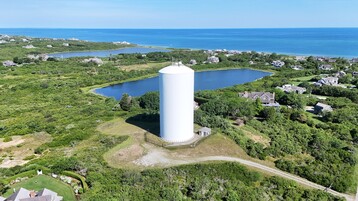
As the island continues to navigate through its Level 2 drought conditions in the final weeks of summer, the latest statistics from the Wannacomet Water Company indicate water usage has substantially decreased this summer compared to last year. Nantucket Water Department director Mark Willett told the Nantucket Water Commission Thursday morning that production through mid-August is “significantly down” by tens of millions of gallons compared to last year.
"We did almost 30 million gallons less in July and 20 million gallons less in June," Willett said. "So far, through where we are now (in the summer), we're 50 or 60 million gallons of less water pumped (compared to last year). So I know there's a lot of irrigation still going on, but there are people helping. But you flip the hat around and think we got to make some money. We want to sell water. I mean, we do need to sell water. This is significantly down. It's like 25 percent. Sconset's going to be over 25 percent less and 22 to 23 percent less in town.”
Willett said that last August there wasn’t a day when Wannacomet pumped less than 4 million gallons of water. Through the first 13 days of August this summer, his department has yet to have a single day when it pumped over 4 million gallons.
"Our biggest day (last year) was like 4.5 (million) around the Boston Pops that just happened," Willett said. "Boston Pops weekend (this year), I think the biggest day was 3.4 (million). So, you're a million less a day so far in August, so we're going to be another 30 to 35 million less this August compared to last August. So, when we talk overall summer, we're going to be like 100 million gallons less.”
Willett acknowledged that Wannacomet Water had projected to sell the water and that these 100 million gallons will cut into its projected year-end revenue. He remains optimistic, however, that it will not be operating at a deficit and just needs to do “a little wiggling.”
"When we did the budget, knowing that we're in a drought condition, I expected and projected lower revenue from water sales. I think I did 12 or 13 percent. I didn't know it was going to be 20. So there's going to be like a 7 percent, 8 percent difference. We're going to have to do a little wiggling, and I'm okay. We're fine business-wise and the economics side of it. We're going to be okay. We're not going to be running a deficit, and the budget will be fine. We won't break the budget, but it is a significant difference, and we're close enough now where there's light at the end of the tunnel. Talking to some of the irrigation guys, they're going to start turning stuff off in September.”
Willett said the United States Geological Survey (USGS) is currently reviewing data submitted by Wannacomet from all its wells across the island, not just the well off Russell’s Way, which is currently the only well checked by the state to determine the drought condition on the island.
“All the data that we have from our well fields has been submitted," Willett said. "(The Mass DEP) said the USGS is reviewing it. We're just waiting for their comments and to see what they say about adding one or two of these wells off of this list to take an average, and I'd like it to be, you know, one in the middle, one in the east, one (in the west)."
“Our monitoring wells are showing a comeback; the depth of these wells is important,” Willett continued. “Our aquifer isn’t just a simple bowl of water. We're trying to get them to look at other places on the island and at different levels. Do some from 140 feet. Do some from 40 feet. You could even have a deep one at 400 feet, see what it's doing. Just to get a better look.”
Willett is also perplexed at how Martha’s Vineyard went from Level 2 drought conditions to no drought in one month’s span while Nantucket has been unable to move from its Level 2 drought status.
“Again, even if we took the average of the wells and we averaged it, and you look and base it against our permit, we wouldn't be out of a drought. We'd be a level one,” Willett said. “We wouldn't be lucky like the Vineyard and be a zero. They went from level two to zero with the same amount of rain we got. They are no drought. I mean, it's the same material, same island structure, same geological time frame, same geological construction. Glaciers built them too, and they went from a level two in one month, to no drought. I don't know what's going on, but we got the (Island) Cup though.”