Current Nature: A Pine Time On Nantucket
Saliha Nazir, Conservation Research And Stewardship Fellow, Linda Loring Nature Foundation •
My time on Nantucket began late spring in the pitch pine forest at Lost Farm and with the quiet solitude of shorebird monitoring before the busy season. During my free time, I took the chance to explore the different areas and habitats here. On an island that is less than 50 square miles, the diversity of habitat and resilience of plantlife and wildlife is truly amazing.
When I first arrived, most of what I had heard of Nantucket was the beaches backed by grass-covered dunes and (coming from a conservation background) a little bit of the coastal heathlands. So I was stunned to discover, upon arriving at Mass Audubon’s Lost Farm Wildlife Sanctuary, that I was surrounded by tall pitch pine trees, very much like the ones back home in Albany, New York. It was a comforting and welcoming sight.
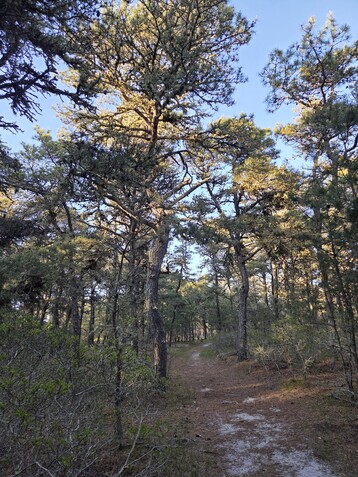
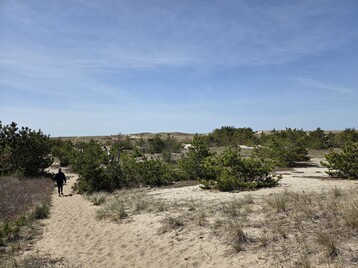
These iconic coastal pines are a familiar sight along the Northeastern shore, so you may be wondering what they are doing in a place like upstate New York–a place that is very much not coastal. These trees are actually specially adapted to thrive in sandy, well-drained soil, and, surprisingly, a small part of New York has sandy deposits that are perfect for pitch pines (Pinus rigida). Each tree has an extremely long central root, called a tap root, that can reach over 8 feet long. Although all pitch pines share certain characteristics, each individual can appear quite different depending on where it grows. The pitch pines at the center of the island grow straight and tall for the most part. Closer to the beach, the trees are shorter and take on a more gnarled and stumpy form thanks to the wind and seaspray. It is amazing to see just how much these resilient trees can be sculpted by their environment.
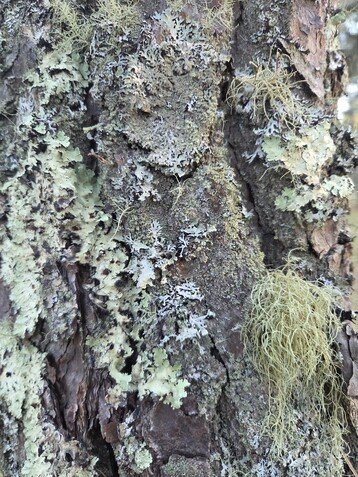
Pitch pines also provide important habitat for a number of species on the island. The long, craggy branches make great nesting for songbirds like Pine Warblers or the perfect roost for a resting owl. Even standing dead trees, or snags, provide good habitat for animals–woodpeckers will excavate holes, nuthatches will nest in cavities, Northern Long-eared Bats will overwinter in the cracks, and insects will burrow beneath the bark. Step a little closer, and the surface of each tree almost becomes an environment of its own. The bark of a pitch pine is built up in thick layers, so that it almost feels like you are looking down over a canyon, and different kinds of lichen add texture to the many-layered bark. Who knew a single tree could hold so much life!
The other pine tree you may be familiar with on the island is the Japanese Black Pine (Pinus thunbergii). It can be confusing to differentiate between the native Pitch Pines and the invasive Black Pine. A trick I like to use is to count the number of needles in a bundle: pitch pines have 3 needles to a bundle and black pines have 2. While these two species may look very similar, Japanese black pine does not provide as much habitat diversity as pitch pines do. Black pines grow very quickly and shade out the surrounding area, preventing other native plants from sprouting. They also reduce biodiversity when they overtake other habitats, like the globally rare sandplain grasslands like at the Linda Loring Nature Foundation. Thankfully, efforts are being made to remove black pine from the landscape and to restore habitats that support more biodiversity.
As I prepare to leave the island soon, I would like to take a moment to not just appreciate the wonderful nature of Nantucket, but to recognize the incredible organizations and island community that work so hard to protect and maintain these natural spaces and their native species.
Stay tuned for more editions of Current Nature, a bi-weekly column featuring seasonal topics, natural history information, and advice on the outdoors from the staff at the Linda Loring Nature Foundation.