Current Nature: Biodiverse Butterflies
Seth Engelbourg, Director of Education and Interpretation at the Linda Loring Nature Foundation •
As the weather gets warmer and more plants begin to flower, we will begin to see more flights of butterflies on Nantucket. Although some butterflies start their seasonal flights as early as April, May through August tends to see a flurry of activity, with a significant peak in June. Butterflies on Nantucket come in all shapes and sizes and are found in a variety of different habitats. Some butterflies, such as the Monarch, are well known, but I am going to highlight less talked about species.
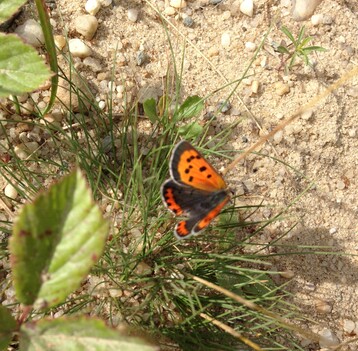
One of these is the American Copper, a small butterfly with a wingspan of approximately one inch. This species is easy to miss, not only due to its small size, but also its habit of staying close to the ground. However, they are quite abundant in the spring and summer on Nantucket and can be found in open fields and along trails. Their larval host plant is mainly Sheep Sorrel, an introduced Eurasian weed associated with former areas of agricultural activity, but as adults, they feed on and pollinate many types of flowers. When its wings are closed, they are a dull gray color, but when opened, you can see their beautiful orange and black colorations.
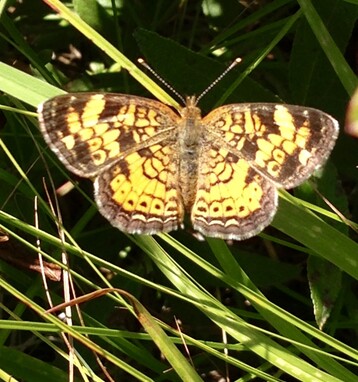
Another notable orange and black butterfly is the Pearl Crescent. While slightly larger than the American Coppers, they are still relatively small with a wingspan of only about 1.25 inches. It has a long flight period, beginning in mid-May and continuing until early September. Typically, they are found in open habitats such as grasslands and meadows, and are associated with plants in the Aster family. On Nantucket, we have many different species of Asters blooming during the summer and fall, which support a large population of Pearl Crescents.
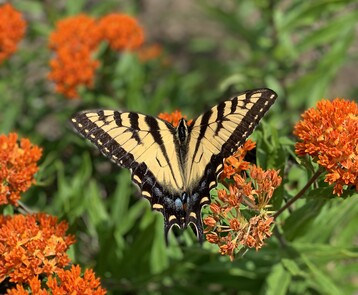
On the larger end is the Eastern Tiger Swallowtail, a beautiful black and yellow striped butterfly with extended ‘tails’ on their hind wings. Their flights generally coincide with the blooming of Common Milkweed. While adults do nectar on and pollinate a variety of garden-cultivated and wild flowers, they are limited to blossoms that can support their weight. This leads them to have some very odd feeding behaviors not shared by the other previously mentioned species. In the summer, males congregate in masses on patches of damp sand or soil and attempt to extract nutrients from them. They are especially attracted to areas that have been dampened by urine or the seeping fluids of carrion and have even been observed feeding on the remains of other dead butterflies!
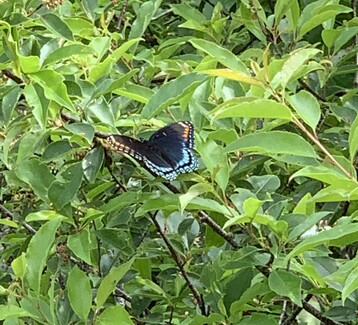
Lastly, is the Red-Spotted Purple, which prefers meadow edges and shrub thicket habitats. Adults of this species only infrequently visit flowers for their nectar, but rather prefer rotting fruit and animal feces as their main food source.
Beyond these four highlighted species, we have dozens of other butterflies that can be found on Nantucket, many of which are extremely important pollinator species. Without the ecological service these butterflies provide, many of our native plants would not receive effective pollination. So next time you eat a delicious wild-foraged blueberry from the side of a trail, you can thank butterflies for doing their part!
Stay tuned for more editions of Current Nature, a bi-weekly column featuring seasonal topics, natural history information, and advice on the outdoors from the staff at the Linda Loring Nature Foundation.