Current Nature: Latest Invasive Species Listed With Help From Nantucket
Sarah Bois, PhD, Linda Loring Nature Foundation, Director of Research And Conservation •
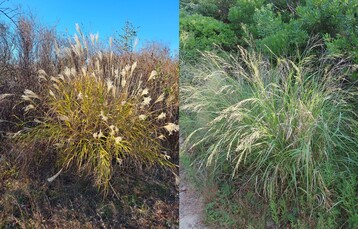
Earlier this month, the Massachusetts Department of Agricultural Resources (MDAR) added Miscanthus sinensis, aka Chinese silvergrass, to its Prohibited Plant List with a one-year phase-out period. This means the species cannot be sold or planted in Massachusetts after the end of 2026. How does this affect Nantucket homeowners?
Chinese Silvergrass (aka Miscanthus) is one of the most popular plants lining many of Nantucket’s driveways. It’s just one of the ornamental grasses that blow freely in the breeze of Nantucket landscapes. These grasses often add movement and provide a bit of drama to a yard. However, many of these grasses are now showing themselves to be weedy, if not invasive, on the island. One such grass, Chinese Silvergrass (aka Miscanthus), was recently evaluated by MDAR and found to check all the boxes for invasiveness.
Chinese silvergrass, Miscanthus sinensis, has become popular in landscaping due to its easy maintenance, showy flowers and seed heads in the late summer and early fall, and tall, bunched growth. It is adapted to a wide range of habitats, growing successfully in well-drained, moist soil and in partial shade or sun. The very qualities that make it good in the garden – easy to establish, fast to grow, and able to survive a multitude of water and light conditions – also contribute to its invasive characteristics.
Miscanthus is a genus of grasses that are native to Eurasia and the Pacific Islands. M. sinensis was first introduced to the US in the 1890s. It was brought to Massachusetts in 1916. We don’t know exactly when it was first on Nantucket, but we do know its use was widespread by 1970. M. sinensis was noted to be aggressive and was first evaluated as an invasive species as early as 2005. The Massachusetts Invasive Plant Advisory Group (MIPAG) considered the evidence (including photo documentation, herbarium specimens, and expert testimonials) and deemed not to have enough evidence, stating: “More data needed for minimally managed habitats.” “Minimally managed habitats” are natural areas like much of our conservation land on Nantucket.
We’ve had nearly 20 years to assess and gather more data.
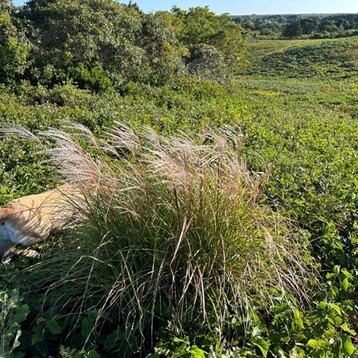
In the intervening years since it was first evaluated by the State, many more populations of Miscanthus have been found and the use of this plant as an ornamental has increased. Data collection methods have also improved with databased like iNaturalist making it easier for people to report.
Given the concern over this species Nantucket Invasive Plant Species Committee (IPSC) members, including staff at the Nantucket Conservation Foundation and the Linda Loring Nature Foundation, compiled the new information as evidence of Miscanthus invasiveness. Testimonials were collected from conservation professionals elsewhere in Massachusetts and in New York State where the species is already regulated. This info was used by MIPAG to re-evaluate M. sinensis. Key criteria for designating a plant as invasive include rapid dispersal and establishment in minimally managed habitats, dispersal across spatial gaps, and the potential to occur in high numbers.
Why do we care so much? M. sinensis can form large clumps along disturbed areas, displacing native vegetation. The grass is also highly flammable and increases fire risks of invaded areas. Not only does it carry fire, but fire can also benefit the plant, causing increased spread. Here on Nantucket, the IPSC monitors non-native species across the island. The IPSC has been keeping tabs on Miscanthus and the habitats it invades are particularly worrisome. Of particular concern are our globally rare habitats, sandplain grasslands and coastal heathlands, where Miscanthus has been shown to invade.
On Nantucket, there have been continuous management efforts by the Land Bank, the Linda Loring Nature Foundation, and the Nantucket Conservation Foundation (NCF) at several sites around the island since at least 2019. M. sinensis has been a target for manual and chemical treatment across the island by multiple conservation groups. The Nantucket Land Bank has dug, pulled, and treated Miscanthus at several properties throughout the years. Miscanthus hot spots are found throughout the Middle Moors and west to Sanford Farm, two properties owned and managed by NCF. Given how invasive the plant is in other locations, some have adopted a “zero tolerance” policy for it.
The decision to ban Miscanthus at the State level wasn’t made lightly. The proposal was first brought to MIPAG in September of 2024, followed by multiple meetings and open comment periods. After more than a year of consideration, MDAR released its findings in early December. The proclamation includes a one-year phase-out period where “Agents/Growers will no longer be able to receive new stock, or begin growing new stock, but may sell any existing stock during the phase-out period,” which ends December 31, 2026.
What does the ban mean for those who already have this plant in their yard? Well, the ban doesn’t mean you have to dig it up immediately. It’s an opportunity to consider a replacement plant. There are great native alternatives to planting Miscanthus that can provide beauty without the risk of ecological harm. Native switchgrass (Panicum virgatum), big bluestem (Andropogon gerardii), or Indian grass (Sorghastrum nutans) are tall bunch grasses that combine visual appeal with ecological benefits. If you use landscapers or gardeners on your property, ask for these alternatives. Consumer demand is an important driver of change.
Why bother with Miscanthus? At this point, it’s an ecological problem that can be solved. In invasive species management, we use the “early detection, rapid response” approach. This means that it is much easier to control an invasive plant infestation while the population is still small. Right now, we are at a critical juncture with Miscanthus: we know it is invading natural habitats, and if we act soon, we have a chance to address it before it becomes a much more widespread and expensive concern.
Want to help prevent the spread of non-native invasive plants? Contact Sarah Bois at stbois@llnf.org to be added as a volunteer to the Invasive Plant Species Committee for Nantucket.