Current Nature: Still Hanging On
Seth Engelbourg, Director of Education and Interpretation, Linda Loring Nature Foundation •
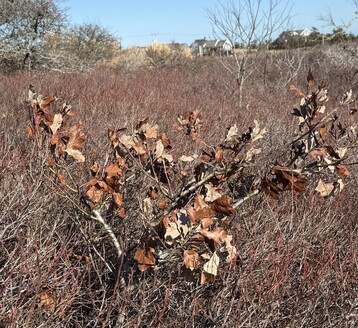
According to the venerable Noah Kahan, it is ‘stick season’ on Nantucket. If you go for a walk during this time of the year, you’ll see many trees and shrubs bare of leaves and notice that browns and grays are the dominant color pallet in nature. Most people know that evergreen trees retain their leaves year-round, whereas deciduous trees drop their leaves in the fall and go dormant to survive the cruel cold and winds of winter. The reality of nature; however, is a bit more complex.
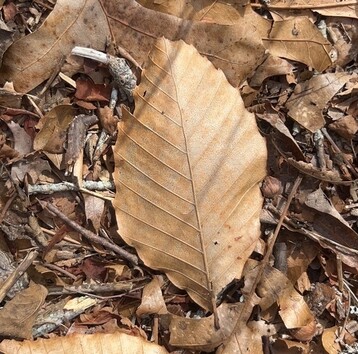
Some deciduous tree species undergo a biological process known as marcescence. Instead of dropping their leaves in the fall, these trees retain their dead leaves throughout the winter and spring as they slowly wither and decay on the branches. On Nantucket, the most common trees that display this trait are oaks and American Beech. In discussing why this process may exist, it is first important to examine why broadleaf trees in cold climates drop their leaves in the fall in the first place. As the days get shorter and colder, photosynthesis becomes more difficult, until a point where it would be a losing battle in which more energy was expended than produced. Freezing temperatures can also rupture cell walls and snow buildup on leaves can cause the added weight to snap branches, causing more harm to the overall health of the tree. To prevent this, deciduous trees adapted the drastic solution of dropping their leaves and going dormant. Botanically, the base of most deciduous leaves has a specialized zone called an abscission layer which becomes weakened by colder temperatures and shorter days in autumn, allowing them to break off. However, marcescent trees such as oaks and beech do not have this abscission layer in their leaf stems, which is how they remain on the branches until spring unless browsed or sheared off by wind.
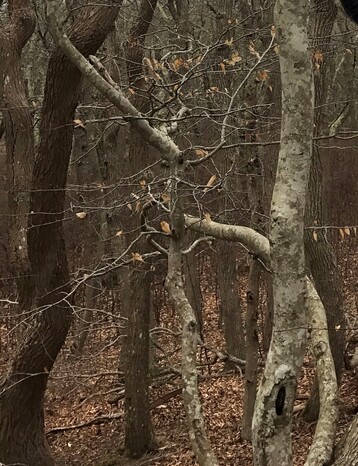
Although there is no concrete scientific consensus on the exact reason for marcescence, there are several theories pointing to the benefits of this strategy. One thought is that the old, dead leaves physically shield new leaf buds from winter conditions, which may make them less susceptible to frost, desiccation, and harsh winds. A related theory is that the presence of dead leaves hides new buds from herbivores such as deer. Since these dried out leaves are nutritionally poor, it convinces deer to browse elsewhere. There is also some evidence that there may be benefits via nutrient cycling. Rather than dropping leaves in the fall, when the tree is about to go dormant, having leaves fall and decay in the spring releases more bioavailable nutrients to support growth of new leaves.
Regardless of the ultimate explanation for this phenomenon, I find marcescence fascinating. The dead, withering leaves provide pops of texture and subtle color whenever you walk through the woods. Despite Nantucket not being heavily forested, some well-known walking locations such as Squam Swamp feature plenty of oaks and beeches that highlight this phenomenon. So go take and walk and check it out! Given that all the other species such as maple, sassafras, and tupelo lost their leaves months ago and are solidly in ‘stick season’, it should be easy to quickly identify the groves of oak and beech. As you gaze around, take a moment to think about if you have noticed this phenomenon before. What you perhaps previously thought was just an ‘accident’ is actually the specific, but mysterious biological process of marcescence.
Stay tuned for more editions of Current Nature, a bi-weekly column featuring seasonal topics, natural history information, and advice on the outdoors from the staff at the Linda Loring Nature Foundation.