Motion To Dismiss Charges Against Stabbing Suspect To Be Heard In Court On Tuesday
David Creed •
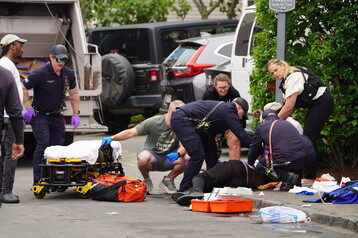
Kemar K. Downer, the man who was arrested and charged after the downtown altercation and stabbing on June 23, will be in court Tuesday morning seeking to have the two charges of assault and battery with a dangerous weapon against him dismissed. Downer's attorney, Rob Moriarty, is basing his motion to dismiss the charges on the fact that Nantucket Police failed to bring him in for an arraignment promptly and held him in custody overnight.
"The Nantucket Police essentially decided that they were not going to abide by the Constitution because they think they are above it,” Moriarty said during Downer’s arraignment last week.
In his motion, Moriarty is citing Jenkins v. Chief Justice of the District Court Department, a 1993 Massachusetts Supreme Judicial Court case, as well as Article 14 of the Massachusetts Declaration of Rights, which calls for prompt judicial determination of probable cause. During last week's arraignment, which was held the morning after Downer's arrest, Moriarty voiced his displeasure with law enforcement over his client being held overnight and not being arraigned the day of the stabbing.
"This incident occurred at approximately 10:30 a.m. and he was done giving statements to the Nantucket Police by around 1 o'clock and then they didn't bring him to court as they're required to under the law while court was sitting, while there was defense counsel there waiting for an arraignment, while the Commonwealth was ready," Moriarty said. "He's charged with stabbing. They should have brought him to court (Tuesday) afternoon. His right to a prompt arraignment was denied, and the complaint under Jenkins should be dismissed.”
Downer was arraigned at approximately 11:15 a.m. Wednesday, a little more than 24 hours after he was arrested by police. He was brought into the courthouse at approximately 10:20 a.m. He was eventually released from custody on $2,500 bail and is required to wear a GPS monitoring device.
Nate Amendola, a defense attorney with a practice on Nantucket, agreed to speak with the Current about the case and Moriarty's motion. He said such a bid for dimissal is uncommon, but believes Moriarty may have a case while also trying to figure out what information the police were looking for that led to the arraignment taking so long to take place.
"The burden is on the government to explain why there's such a delay in getting somebody arraigned,” Amendola said. “So the government, through the prosecutor and the Nantucket Police, are going to have to say the burden's on them to show why there's this extreme delay. I think what's particularly problematic in this case is, and this is just pure speculation, but if they're like, 'We're doing an investigation.' Okay, did you have the video? Because if they had the video and they didn't present it to the clerk magistrate, that is a major, major problem. I think Rob is onto something. I think he's onto something relative to the amount of time it took them to bring (Downer) to court, and he may be trying to figure out exactly what information they were gathering and what they presented to the magistrate. Because the video certainly supports his theory of self-defense and completely, I think, casts doubt all over the police report.”
During Downer's arraignment last week, the District Attorney's office requested more time to review and prepare for the hearing on Moriarty's motion after he presented it to Judge James Sullivan. When contacted last Friday, both Danielle Whitney of the Cape & Islands' District Attorney’s Office and Lieutenant Angus MacVicar of the Nantucket Police declined to comment on the case.
While it is not the focus of the hearing on Tuesday, Moriarty argued during the arraignment session last week that the incident was a clear case of self-defense, and that Downer did not pull the knife until he was attacked from behind, a claim that appears to be supported by a surveillance video obtained by the Current of the incident:
“The guy is minding his own business, and then he's under attack,” Amendola said. “Who knows if they were exchanging fighting words beforehand. I think what Rob may be on to is he's also probably going to challenge the probable cause determination at some point saying, 'Look, if they held him for this long and they were trying to get some evidence, if they got this video, it should have been presented to the clerk magistrate,' and even if it was, I think there's really a question as to whether there's sufficient probable cause based on what we see in the video.' Self-defense is a question of fact for the fact finder. It is very rare for a self-defense claim to prevail at a probable cause determination. This might be one of those situations where self-defense might actually come up in probable cause. Again, that's a factual determination, but there are some situations (where it does), and this may be one of them.”
Moriarty also declined to comment on the case, telling the Current he “does all of his talking in the courtroom.”
The man who attacked Downer and was then stabbed was rushed to Nantucket Cottage Hospital by ambulance before being transported by Medflight helicopter to a mainland hospital. On Monday, he was identified as Andre Hamilton when Nantucket Police decided to file charges of assault and battery, and assault and battery with a dangerous weapon against him. He is scheduled to be arraigned during Nantucket District Court’s August 3rd session.
Hamilton was driving a garbage truck for Myles Reis Trucking at the time of the altercation. His current condition is unknown.
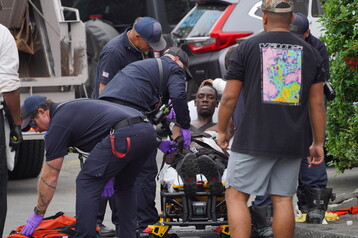
Amendola said there is going to need to be some pretrial litigation, and while there is always a chance for the prosecutors to dismiss it on their own (in what is known as a "Nolle Prosequi"), he doesn’t believe that is what will happen in this case.
"I think there's definitely some cognizable pre-trial litigation here, and Rob's definitely onto something with the Jenkins case, and then maybe sort of like a violation of the integrity of the complaint process,” Amendola said. “That would be under Commonwealth v. O'Dell, that basically the presentation of the facts to the magistrate were distorted. Because that is just not what the video shows.”