14-Year-Old Angler Reels In First Cubera Snapper Ever Caught On Nantucket
Jason Graziadei •
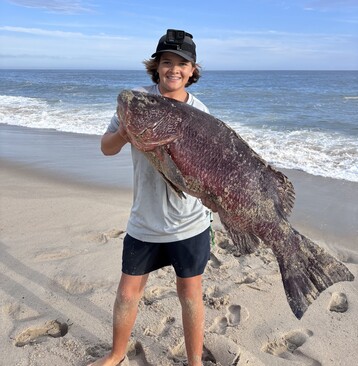
Fourteen-year-old Stone Fornes thought he had a shark on the line Friday evening as he was fishing along Nantucket’s south shore. But what he reeled in was far more surprising.
Out of the surf came a cubera snapper, believed to be the first one ever caught from a Nantucket beach.
“I said, ‘Oh my goodness, that’s a cubera snapper, and I’ve wanted to catch one of those since I was six years old,” Fornes told the Current. “I was in absolute shock that there was one cruising the south shore of Nantucket.”
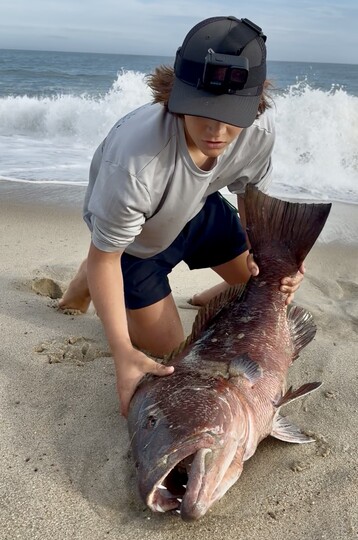
Cubera snappers are the largest snapper species in the Atlantic, and while their official range extends from South America all the way up to Nova Scotia, they are rarely caught north of Florida and the Carolinas. In Massachusetts, there is no official state record for a cubera snapper, as the species isn’t even listed in the state’s Saltwater Game Fish Records table. Several longtime island anglers told the Current on Saturday that they had never heard of one being caught on Nantucket before.
“It’s just so ridiculous, I can’t even believe I’m saying that,” Fornes said, recalling his phone calls to friends after making the catch on Friday. “ It has no business being in the Northeast, and that's what I'm trying to figure out now, is how did it get here?”
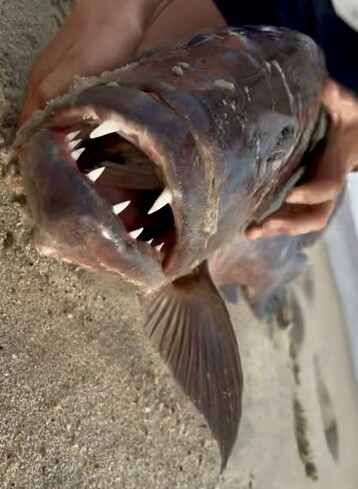
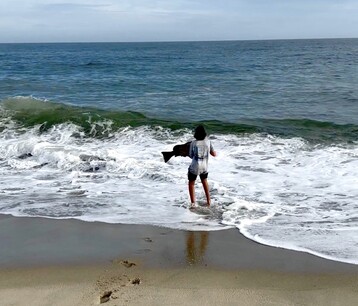
Cubera snappers can grow up to five feet long, with the largest weighing as much as 125 pounds, and have powerful jaws with oversized canine teeth. And while they are supposedly good eating, Fornes said he released the one he caught back into the surf.
If Fornes’ name sounds familiar, it should. In 2024, he caught a 118-pound white marlin off Nantucket, breaking the world junior record.
Here’s Fornes’ full account of catching the cubera snapper:
“I was fishing for sharks, which I do all the time, and it's been a great year for sharks. So the bait got hit, I'd say after about 45 minutes of fishing, and honestly, there was a pretty big shore break, and it was really tough to keep my baits in place, so I wasn't expecting much. But I see I see the rod tip bouncing, and it was a little bit of a weird hit. So I pick it up, open the bail, and I just start feeling the fish taking the bait and the weight dragging on the bottom, and I immediately knew something was a little weird because I've caught 10 or 15 sharks off the beach this year and this was totally different. This hit was much different. It there were a bunch of like chomps, less of the fish just sucking up the bait, more of little hits, and then I could feel the tail beating super hard. The tail would just peel line off the reel every time it thumped, and these fish are used to digging into structure, and that's how they protect themselves. Because typically they live in Florida, Puerto Rico, there's some in Bermuda, and they're used to living on big pieces of structure where they just dig into the structure and cut the line and protect themselves from predators like sharks. But there's not much structure on the south shore, it's a little bit of pebble, a lot of sand. It's pretty empty, so I could just feel this fish as I'm feeding it, digging with its tail and swimming pretty slow, but with a lot of power. So then I set the hook, and I immediately knew it was big from the second I set the hook. It started peeling drag off the reel really fast, and again, every time it thumped its tail, the rod would bend all the way down to the last guide, and it was pretty incredible. So then I fought it for a while, and I was fishing with a buddy of mine who I know through rowing, which is my main sport, Eli Brown is his name."
"And I still thought it was a shark at the time, and I really wanted him to experience fighting a shark because I've done it with him once before, but he hasn't done it as much. So I handed the rod to him and I let him fight it for a bit, and we kind of switched off with it. The whole fight was a little funny, but I just figured it was a shark acting funny. The thumps were really big. You could feel the wire skipping from one tooth to another, because if you saw the picture I posted, those teeth are massive, and the line would just skip from one tooth to another as it just thumped its tail and shook its head and just dug. With sandbar sharks that we typically catch, they will take one or two really long runs, like maybe 50 yards, maybe more, maybe less. And this fish took about five runs, all about 25 yards. So not that long, which is typical behavior of a super big snapper because 25 yards is typically enough to get it back into the structure, but it had no structure. It has no business being in the Northeast, and that’s what I'm trying to figure out now is how did it get here? But after fighting it for a while, it took a lot of runs. I'd say we probably fought it for 10 minutes on a spinning rod.
"Eventually, I saw something splash in a wave that didn't quite look like a shark. So what you have to do when it is a shark is you have to grab the line and you have to pull it up to the beach with the line, and then you have to grab its tail and get it all the way up on the beach to get the hook out, and then put it back in the water. And so I'm looking for a tail as I'm leadering it, which is where you pull it in with the line, and I just see the tail thump in the wash and the break, and I think, wow, it kind of looks like a stingray. So then I'm still leadering it, and I'm waiting to get another look at it, and I see the spikes on its back. I'm like, wow, that is not a stingray. What could that be? So I keep leadering it, and eventually I see its whole body come out of a wave. It froze up onto the shore, and I'm like, oh my goodness, that's a Cabera snapper. I've wanted to. That was six years old, and I was just in absolute shock that there was one cruising the south shore of Nantucket.”