Testing Regimen For New Artificial Turf Field At Nantucket High School Endorsed By School Committee
JohnCarl McGrady •
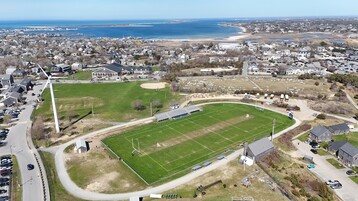
The Nantucket School Committee has officially adopted a testing agreement for the artificial turf field slated for installation at Vito Capizzo Stadium.
The agreement mandates that the field, which was the subject of a firestorm of public debate in the lead-up to Nantucket’s most recent Annual Town Meeting, be tested for the so-called forever chemicals known as PFAS. Opponents of the field had argued that, despite assurances from school administration, the field materials could contain toxic chemicals that would leach into the ground and contaminate Nantucket’s drinking water.
The turf, infill material, and shockpad will be tested using standard Environmental Protection Agency (EPA) methods intended to detect 40 PFAS. This testing regimen was agreed on by town of Nantucket staff as well as experts employed by the Nantucket Public Schools.
“A very large group of people came together to create a pre-installation testing agreement,” Superintendent Elizabeth Hallett said. “The top, top expectations are in place for these current tests that are there. [These are] the expectations that everyone in the group came together for.”
The Nantucket Land and Water Council, an environmental advocacy group that sharply criticized the field proposal, has also assented to the testing protocols, but believes they are limited and has continued to call for groundwater monitoring in the area.
“The NLWC supports the pre-testing agreement as a meaningful step forward, but in recognition of its limitations, we continue to advocate for baseline and ongoing groundwater monitoring,” NLWC environmental program coordinator Willa Arsenault told the Current.
Hallett said that “any sort of testing wells” would have to be under the jurisdiction of the town, not the schools.
“I feel that this is a first step, and I believe that we should move forward,” Hallett said.
School Committee member Tim Lepore, who cast the lone dissenting vote against the artificial turf field when the School Committee originally opposed it, also cast the lone dissenting vote against the testing regimen on Tuesday.
“I think we need to review this, and I think we need to look at it and get a better explanation than we’re getting from this document,” Lepore said. “I don’t think it’s what we want. I think we’re going to go ahead with the field, but I think we have to have the testing to be sure we know what we’re getting into.”
Under the agreement, each individual lot of material for the field that is shipped to the island will be be tested, and any materials that test at levels above the standards set by the Massachusetts Department of Environmental Protection or the Environmental Protection Agency cannot be used.
Lepore doesn’t see those tests as sufficient.
“There are a lot of things I see [that] are holes in it,” Lepore said. “The comprehensive suite of testing is missing the following tests: total metals, cadmium, lead, total semi-volatile organic compounds, ultra-short-chain PFAS analysis—they can be precursors to regulated PFAS—fluorotelomer alcohol analysis, precursors to regulated PFAS, micro- and nano-plastic analysis. We are not asking enough.”
The School Committee agreed to hold another discussion to review the additional tests Lepore requested, but the other Committee members in attendance on Tuesday were unwilling to hold off on approving the agreement before them.
“I feel like we need to move this along,” School Committee member Laura Gallagher Byrne said. “I worry that if we do not vote on this, there will be another dragging of heels, and that deeply concerns me.”