$45 Million Somerset Sewer Expansion Passes, But Voters Reject Betterment Fees On Property Owners
Jason Graziadei •

A $45 million expansion of Nantucket's sewer system into the Somerset area was approved at Town Meeting on Monday, but voters amended the town's proposed funding formula to reduce the financial burden on those required to connect to the system, shifting the entire project cost to the tax base.
The so-called Somerset Sewer Needs Area expansion had been identified in the town’s sewer master plan for more than a decade, and the project would bring sewer service to more than 900 properties in the Somerset area, along with a water main, drainage, and roadway improvements. At Town Meeting on Monday, the sewer expansion was also presented as a method to improve the health of both Hummock Pond and Miacomet Pond by reducing nitrogen loading from septic systems into those water bodies.
But extensive debate ensued over the potential financial impacts on property owners in the Somerset area who would be required to hook into the sewer system and pay fees that some estimated at $25,000 to $100,000 or more per property. Part of that calculation was the town's funding formula, which would have required those homeowners to cover 25 percent of the total project cost through betterment fees, in addition to the standard connection fees for sewer hookups.
"It's a lot of money, and then we're going to ask them to pay on their taxes and then be assessed a 25 percent fee?" said Amy Eldridge. "People are going to be packing up and moving out of here, and you're going to be losing teachers, doctors, nurses, firefighters, police officers. We've got to take a big look at the amount of money we spent, and we can't keep spending like The Giving Tree. It's going to die, and people are going to run out of money and not be able to afford to live here."
Numerous voters mentioned prior sewer expansions in Monomoy and Shimmo that ultimately did not include betterment fees on property owners, and island realtor Brian Sullivan's amendment to remove the language regarding betterments was overwhelmingly approved.
Voters then passed Article 15, the $44.8 million appropriation for the Somerset sewer expansion, on a 304-116 vote. That funding, however, still requires approval as a debt exclusion override by a simple majority of voters at the ballot box on May 19th. It will appear on the ballot as Question 5.
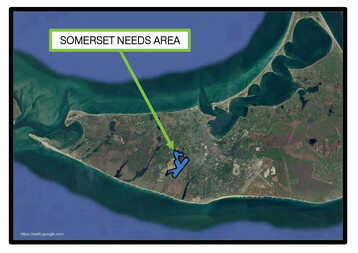
In the run-up to Town Meeting, municipal boards went back and forth on the proposal, but it was ultimately endorsed by both the Select Board and Finance Committee.
Nantucket Sewer Department director David Gray stated that $36.8 million of the total project cost would be eligible for financing through the State Revolving Fund (SRF) financial assistance program, which has a maximum interest rate of 1.5 percent, and could be as low as 0 percent.
"This represents substantial long-term savings for the town," Gray said. "This funding is competitive and time sensitive."
Yet concerns over the project costs, as well as the potential for increased development resulting from the sewer expansion, sparked a lengthy debate on Town Meeting floor.
"So this project is being sold to us for its positive environmental impact to reduce runoff to ponds, but passing it has consequences that are actually a net negative on the environment," said Karen Alence. "It removes and allows for more structures, including pools. Putting in sewer access could enable the construction of two to three times more houses than exist in this area today. This would double or triple the electric consumption produced by fossil fuel and double or triple the number of vehicles and the fossil fuel consumed by them. More houses, more rentals, more vehicles, more negative environmental impact...This is a huge financial burden for year-round people. It could be the tipping point to send more year-round residents off the island, their houses being sold for summer homes."
Somerset area resident Susan Cary agreed.
"I consider myself an environmentalist, but I'm not really buying into the text that this project is designed as a method to save the ponds," Cary said. "My concern with this article is that it appears to be a multi-million dollar project that facilitates increased building density by removing strict limitations imposed by septic systems, such as lot size restrictions and bedroom count, and replacing them with centralized sewer capacity so that the town can accommodate more intense development in this little lovely area of the island. More development, more houses, more pools, and more fertilized landscaping. With this project, homeowners will be mandated to hook up at a cost that we're really not sure of - we're hearing $80,000, and that is not an easy thing for homeowners in this area of the island, as it's going to involve finding engineers, crews, and getting rid of those existing septic tanks."
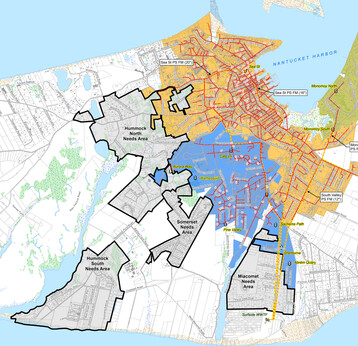
Other residents living in the area, including Julie Fitzgerald and Brian Borgeson, spoke out in support of the project, noting potential innovative/alternative (I/A) septic system improvements they might be required to install that could be even more expensive.
"My septic system is 43 years old, I have a 20-month-old, and if I have to get a new septic system, a four-bedroom septic system for $185,000, my house will be sold to a developer," Borgeson said. "They will knock my house down. They will remove my septic system. They will put in an eight-bedroom septic system, and they will develop my house and put in a pool and put in a guest house and put in a main house, because that's what they're going to do, right?...This is important for locals. It's important environmentally, and it is not going to increase ground cover in this area. Am I super concerned about the hookup costs? Absolutely. Very, absolutely. That needs to be addressed as well, and then we need to pass this project and then monitor how we have hookup costs for the locals and the people like me who can't necessarily afford a $50,000 or $60,000, $70,000 hookup cost."
If the sewer expansion proposal does succeed on the ballot, construction is slated to begin in the spring of 2027 and wrap up in 2029.