Agreement Close On Testing Of Artificial Turf Field Slated For Nantucket High School
JohnCarl McGrady •
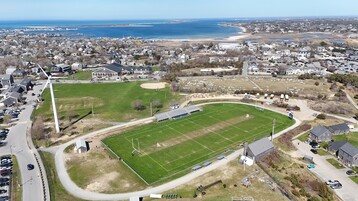
The Nantucket Public Schools and the Nantucket Land and Water Council, a local environmental advocacy group, have nearly reached an agreement on a testing regime for the artificial turf field slated for installation at Vito Capizzo Stadium. Their only remaining disagreement, according to town of Nantucket deputy health and human services director Jerico Mele, is on the testing procedure for an adhesive material.
“The provisional agreement on the pre-testing is largely completed. There is one particular item that has to deal with a relatively knotty bit of analytic chemistry regarding the testing of an adhesive and the particular method of that test,” Mele said. “That is the only significant delta we have.”
If the two groups can reach an accord on that test, they will move to negotiations on testing for the synthetic track set to encircle the field and ongoing monitoring after the track and field are installed.
The negotiations, arranged by the town’s Health Department, are an effort to reach a compromise between pro and anti-turf factions as the Board of Health continues to mull how to respond to the proposed turf field.
The Nantucket Land and Water Council (NLWC) is a private group, and the Nantucket Public Schools (NPS) are not bound to negotiate with them, but NPS may have judged it is in their best interest to do so. So far, the negotiations, which the Board of Health endorsed at a recent meeting, have forestalled what could have been much more dramatic action from the Board: on two separate occasions, the Board of Health nearly voted on motions that would have at least temporarily blocked the installation of the field.
The two sides continue to spar over the safety of artificial turf. The NLWC claims the field, made of large amounts of plastic, may contain harmful substances, such as the so-called forever chemicals known as PFAS, which could contaminate Nantucket’s sole-source aquifer. NPS claims there will be no intentionally added PFAS and that the field is needed for the safety of athletes, as it can withstand far more hours of practice than natural grass without deteriorating in quality.
The negotiations have not gone entirely smoothly. The NLWC has accused NPS of dragging its feet, delaying discussions until after pivotal votes on the field at Town Meeting and in the local elections.
“Despite the Board’s direction at the April 16, 2026 meeting that the parties work together to reach agreement on these issues, NPS has thus far declined requests from the Health Department to meet with the NLWC to continue these discussions,” NLWC environmental programs coordinator Willa Arsenault wrote in a letter to the Board of Health.
Both votes went in NPS’s favor, but even with the voting complete, Assistant Superintendent of Academic Operations Melissa Devitt said last Thursday that the school wanted to delay further discussions until next month.
“Nantucket Public Schools has not declined requests to continue discussions regarding the project,” Devitt said. “We are simply requesting that future conversations resume once the full project team is available, which we anticipate will be after June 1st.”
There is still one more key vote on the horizon: on June 10th, the Select Board will vote on two appointments to the Board of Health. Incumbents Ann Smith and Meredith Lepore, who each planned one of the two motions that would have at least temporarily blocked the turf field, will see their terms expire and will need Select Board support to be re-appointed. Several Select Board members have been sharply critical of how the Board of Health has handled turf, and may be inclined to vote for challengers more sympathetic to the field. If that happens, the threat hanging over NPS will diminish, and the dynamic of their negotiations with the NLWC will change.