Islanders Pack Board Of Health Meeting On Turf Field, But No Accord Reached On Testing Or Moratorium
JohnCarl McGrady •
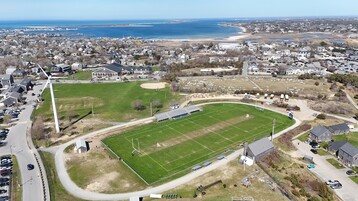
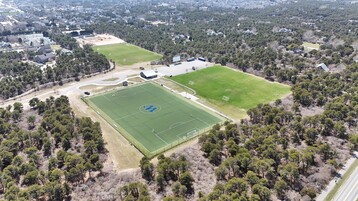
The Nantucket Public Schools (NPS) and Nantucket Land and Water Council (NLWC) are negotiating a testing regimen for a proposed artificial turf field slated for installation at Vito Capizzo Stadium. The parties are still far apart on several points, and the NLWC expressed serious concerns with an early draft of a portion of the agreement at a Board of Health meeting on Thursday, leaving it unclear if the two groups will be able to reach an accord.
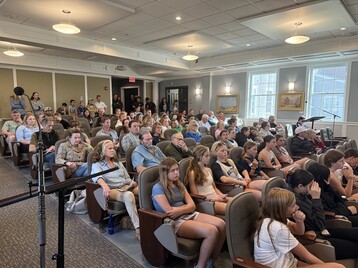
The discussion of the negotiations, which also involve Health Department staff, came during a lengthy, hotly contested Board of Health meeting on Thursday, with dozens of islanders in attendance. Tensions flared repeatedly as attendees debated the merits of turf and a controversial proposal from vice chair Meredith Lepore that would institute a moratorium on turf across the island. Ultimately, no moratorium or testing plan was adopted on Thursday.
Town Counsel John Giorgio told the Board that Lepore’s moratorium could not be adopted at Thursday’s meeting, as new regulations require a noticed public hearing. After initially pushing back, Lepore relented, and no formal action was taken on her proposed moratorium.
Lepore also clarified that she did not intend her motion to block the use of existing turf fields, even though her motion called for “an immediate moratorium on the use and installation of artificial turf systems that can contaminate our drinking water.”
“My intent was never to stop the use of the [artificial turf] Nobadeer Farm field as of today or tomorrow,” Lepore said. “I am happy to take the word ‘use’ out.”
The partial draft of the agreement under negotiation between NPS and the NLWC would require “comprehensive testing” of all materials used in the proposed Vito Capizzo Stadium field, allowing their installation only if they test below established state and federal thresholds for PFAS. But NPS and the NLWC disagree on several points, including whether to have an ongoing monitoring plan for the field.
“The complete suite of testing, I think, is still ongoing,” Health and Human Services deputy director Jerico Mele said. “This represents an initial attempt to iron out a pre-installation testing protocol that would then come back to the board for comment and eventual ratification, if that is what the board desires. This particular proposal is not complete; it is just an indicator of the direction of discussion.”
NLWC environmental program coordinator Willa Arsenault said Thursday that “the NLWC is not in a position to support the field and track components.” The two parties have also not yet agreed on a testing plan for the synthetic track that would encircle the field, or tests for potential contaminants other than PFAS, such as heavy metals.
“Important information gaps remain between what is being proposed and what we believe is needed to minimize risk,” Arsenault said. “Even if the board adopts all of the conditions we’ve outlined, those measures should be understood as a minimum baseline, not a comprehensive safeguard. They reduce risk, but they do not eliminate it.”
With negotiations moving slowly, it appears unlikely that the Board of Health will have a chance to adopt a compromise before Town Meeting votes on the larger $26 million athletic complex renovation project that NPS has put forward on May 4th as Article 12. The project will require two-thirds support to advance, and how voters rule will likely color any future deliberations.
It’s also possible that by the time the Board of Health rules on artificial turf, its membership will have changed. Chair Ann Smith and Lepore’s terms both expire in June, and they’ll need Select Board approval to be reappointed, which could be difficult to find given the criticism the Select Board has leveled at the Board of Health in recent months.
“Trust has been lost,” said Select Board member Tom Dixon, who also sits on the Board of Health. “There is no scientific basis for a moratorium whatsoever. It’s a political argument dressed up as a scientific argument.”
Thursday’s meeting is the latest development in a lengthy debate over the merit of the turf field proposal, which has been the subject of dozens of hours of discussion before the School Committee and the Board of Health, mostly focused on the possibility that the turf could include the harmful substances known as PFAS, which are linked to cancer and other adverse health outcomes. School officials maintain that the field will not include any intentionally added PFAS, but opponents are not confident in the proposed testing regimen and worry that such claims could be misleading.
The shape of the Board of Health’s debate has changed several times. At first, Smith said that an island-wide ban was “a possibility.” She then said that the Board had “never considered” a ban and that the discussion was “limited to this specific proposal at this specific location.” Now, Lepore’s proposal calls for an island-wide moratorium.
Similarly, while the Board of Health was focused on the turf field for the first several months of debate, the scope of their discussion suddenly expanded in March when Smith suggested blocking the installation of a synthetic track if it could not comply with testing requirements.
Smith then told the Current that it was not her intention to prevent the installation of the track, despite the wording of her motion. Lepore’s motion would block the installation of the track, and the NLWC and NPS are slated to negotiate the issue of testing for the synthetic track soon.
Advocates for the turf field proposal argue that it allows for greater use without a noticeable decrease in field quality, is more common in the region, and would protect the health of student athletes.
“Everyone agrees this is a usage issue,” former girls lacrosse coach Jami Lower said. “Even with an exceptional grounds crew, maintaining a safe, stable grass field under such intense demand is impossible. Our field’s current condition is inadequate and dangerous.”
Opponents focus primarily on the possible health impacts of substances such as PFAS and microplastics from the turf field.
“Every field like this is a vote for more unquantified chemical exposure, health impacts—more questions that regulators have not answered, and the industry has no incentive to ask,” said Leah Mojer, who organizes the island’s annual Litter Derby event. “We share one water source. What we place above it, we place in it.”
The Board of Health heard significant testimony both in favor of and against the artificial turf field on Thursday, though the majority of the attendees who spoke supported the proposal.
Meetings on the artificial turf field have routinely drawn high participation before both the Board of Health and the School Committee, including large numbers of students.
“One of the positives in this confusing thing has been student advocacy and students standing up and talking,” Board of Health member Kerry McKenna said. “The students came forward and are using their voice, and that’s an important lesson, just in terms of civics.”
In her communications, Smith has often struck a different tone, stating in an email that she did “not want to hear any more 17 yr olds tell me about their acls and mcls and broken thumbs. Proves nothing and doesn't help us make a reasoned decision.”
Lepore criticized the early draft of the proposal that the NLWC and NPS are negotiating throughout the discussion at the Board of Health’s latest meeting, pushing back against several Health Department staff members and chair Ann Smith to argue that the proposed testing was not stringent enough. Lepore called for the agreement to use a PFAS test intended for drinking water on runoff from the field, rather than the wastewater test currently proposed.
“I think that everybody here is concerned about the stormwater going into our aquifer, so why are we not looking at it as if it was drinking water and holding it to that standard?” Lepore asked. “The majority of towns are looking at it as drinking water.”
Health Department staff argued that, as the runoff is not drinking water, the wastewater standard was more appropriate.
“This is not drinking water,” said the town’s environmental contamination administrator Andrew Shapero. “The method detection limits will be low enough that we can compare to drinking water standards, but there are issues of, for example, particulates being available in the sampled stream, and if you have too many particulates, the drinking water methods are not appropriate.”
Lepore also suggested that tests for microplastics and nanoplastics should be added.
“I do think we need to look at that,” Lepore said. “We really need to make sure that we are doing a robust and comprehensive evaluation.”
Shapero said that, as there are no standards for determining the health risks of microplastics, such testing would be impossible to interpret.
“Those standards do not exist, so if there were a test for microplastics, I would not able to interpret it for you,” Shapero said. “I would not be able to tell you what the implications are for health.”
As an alternative, Lepore has pushed for a total moratorium on turf. Giorgio advised that she could not legally make such a motion at Thursday’s meeting.
“I don’t think the Board really has any authority other than to take a vote, if there is such a motion, to continue to examine the question of whether a moratorium should be considered,” Giorgio said. “That’s the most I think you can do tonight.”
Lepore tried to argue against Giorgio’s advice, stating that a moratorium could be passed if the Board of Health determined that there was an emergency threat to public health.
“The Board is allowed to have, essentially, I think they called it a police power, but have the power to do an emergency for a certain amount of time in order to evaluate something if it is considered a threat to public health,” Lepore said. “I would like to propose an emergency moratorium just until the testing is done.”
Giorgio said that an emergency motion would not be advisable.
“The problem with trying to shoehorn this into some kind of emergency declaration is that this issue has been brewing for…at least six months, maybe even longer,” Giorgio said. “Why, all of a sudden on April 16th, would this be an emergency?”
In a presentation advocating for the moratorium, Lepore repeatedly argued that it was necessary because sufficient testing has not yet been done.
“What we know now is nothing,” Lepore said. “I am asking as a parent, and as a community member, and as a Board of Health member, that we take a minute and really look at what is in this, because we haven’t looked at that. We just haven’t.”
Lepore’s proposed moratorium could only be lifted after three years, or if proposed materials tested at “zero” for PFAS and microplastics. Several experts suggested Thursday that those standards could never be met.
“I’m a chemist. I will tell you it is scientifically impossible to measure zero concentration of any material,” Elizabeth Denly, a chemistry director for TRC Environmental, said. TRC is a consulting group working with NPS. “Every method has a limit of detection. There’s no method that can go to zero.”
Microplastics have been detected nearly everywhere, including uninhabited islands and the bottom of the Mariana Trench.
Giorgio also suggested that limits of zero could risk legally invalidating the moratorium.
“You can’t just enact a moratorium that says no artificial turf unless PFAS tests for zero,” Giorgio said. “There’s got to be more definition to ensure the regulation is not voided for vagueness, and it’s going to have to be reasonable…is the intent of the moratorium simply to have a backdoor way of completely banning turf in the town?”
Lepore agreed to back down from the threshold of zero, but continued to argue for more stringent testing.
Thursday’s discussion came after the Board of Health and Select Board face open meeting law complaints for their handling of the Board of Health’s last discussion on artificial turf. The open meeting law complaints against the Board of Health stemmed from vague agenda items and the circulation of draft motions regarding the Vito Capizzo field before the discussion.
Three Select Board members intervened to shut down the discussion because of those concerns, which led to a further open meeting law complaint against the Select Board.
The Select Board denied any wrongdoing, and their response has been appealed to the Attorney General.
The Board of Health agreed to evaluate current meeting practices and release certain emails, but stopped short of admitting an open meeting law violation. Kate Garrette, who filed one of the open meeting law complaints against the Board of Health, told the Current Thursday that she does not plan to appeal to the attorney general.
NPS has been trying to construct an artificial turf field for years. Three years ago, they backed down from an initial proposal after facing intense opposition from local groups concerned about PFAS. Last September, they came back with a plan for a natural grass field, but a large number of local parents and students called for turf, and NPS changed course again, endorsing an artificial turf field.