Board Of Health & Select Board Respond To Open Meeting Law Complaints After Turf Field Discussion
JohnCarl McGrady •
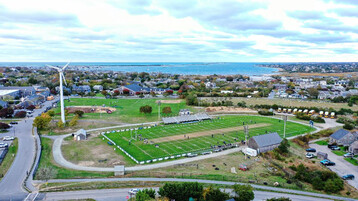
In a pair of letters responding to recent open meeting law complaints, the Board of Health has agreed to release controversial emails from chair Ann Smith, evaluate its current meeting notice and e-mail practices, and revisit the artificial turf discussion that triggered the complaints at a future meeting scheduled for April 16th. But it stopped short of admitting to a violation of the state law intended to ensure that government meetings are open and accessible to the public.
“There was never an attempt to contravene any of the requirements of the Open Meeting Law,” one response reads in part. “The Board recognizes and acknowledges that transparency regarding its proceedings is paramount, including on the Vito Capizzo Stadium project.”
The Board of Health has been considering whether to block the installation of an artificial turf field at Vito Capizzo Stadium for months. In advance of its latest meeting on the topic, chair Ann Smith sent the rest of the board a pair of motions she intended to make, which would have allowed the installation of turf at Vito Capizzo Stadium, but only if it met as-yet-undefined Board of Health requirements.
This email prompted sharp pushback from members of the Select Board, who worried that it might border on becoming a deliberation, which would violate the open meeting law. Select Board members also raised concerns about the lack of specificity in the meeting’s agenda, and ultimately prevailed on Smith to end the discussion before any motions could be made. Open meeting law complaints soon followed.
One complaint, filed by emergency room nurse and parent Kate Garrette, argued that “discussion extended beyond the scope of the posted agenda, that there may have been pre-meeting communication regarding board business, and that substantive deliberation continued after legal concerns were raised, limiting the public’s ability to understand, prepare for, and meaningfully participate in the meeting.”
In its reply, the Board of Health “expressly acknowledges concerns raised by members of the public regarding the posted agenda item,” but does not admit any open meeting law violation.
“The Board states that there were no responses to the draft motions by any members of the Board,” the reply continues. “In addition, prior to hearing from individuals during the meeting regarding Open Meeting Law considerations on the agenda item, the Chair submits that it was her intention to fully release and publicly acknowledge the e-mails at issue.”
The Board of Health’s reply comes after the Select Board denied that it violated the open meeting law during the same meeting, when a quorum of its members pushed Smith to shut down the discussion. The open meeting law complaint against the Select Board was filed by island resident Meghan Perry, who has appealed the town’s denial to the Attorney General and the state’s Division of Open Government.
“I do not agree with the town’s response to my complaint and ask that the Division of Open Government take steps to enforce the Open Meeting Law,” Perry wrote in her appeal. “The facts show that there were deliberations by the Select Board members both prior to, and at the subject meeting.”
Asked if she will appeal the Board of Health’s response, Garrette told the Current she is “focused on the upcoming meeting and ensuring a clear, transparent process moving forward.” The other complaint against the Board of Health was filed by island resident Kimberly Latlippe.
The Board of Health’s reply does not mention Garrette’s concerns with the conduct of Board of Health vice chair Meredith Lepore, who planned to make her own motion, and contested the Select Board’s efforts to end discussion.
While the Board of Health’s reply does not admit any violations of the open meeting law, it is far more equivocal than the Select Board’s strong denial and, unlike the Select Board's response, it proposes several corrective actions.
In their response to Perry’s complaint, town attorneys claimed that “there was no deliberation between or among a quorum of the Select Board prior to or during the Board of Health’s March 19 meeting,” arguing that Select Board members were not seated together, comments made by Select Board members were independent of each other, and the remarks pertained to an issue before the Board of Health—not one before the Select Board.
Perry pushed back on all three claims.
“There is nothing in the Open Meeting Law that requires the members of the board to have been sitting next to each other,” she wrote in her appeal. “Three members of the Nantucket Select Board participated in a meeting displaying prior communications among themselves and engaged in discussions referring to each other by name.”
Perry argued that the issue of artificial turf concerns the Select Board, as the Select Board is the appointing authority for the Board of Health and had previously discussed the Town Meeting warrant article that would, if passed, allow the installation of the turf field under discussion.
Perry accused the Select Board of “trying their best to prevent their appointee Board of Health from voting inconsistently with the Select Board’s voted position, entirely for political reasons.”
While the Select Board did vote to include the proposal for a turf field at Vito Capizzo Stadium on the Town Meeting warrant as part of a broader article seeking to overhaul the Nantucket High School’s athletics facilities, that does not mean the Select Board has endorsed the article. It only means that they have determined it is best to allow voters to decide the project’s fate. There is no recommendation or comment from the Select Board on the warrant pertaining to turf.
Perry also referred to past successful open meeting law complaints she has filed, writing that “two of these Select Board members have a history of being found in the past violating the Open Meeting Law in connection with other town boards, so it’s understandable that they would be so ready now to cover up and deny everything for their lawyer-written response to the complaint.”
Town attorneys nearly always write the town’s responses to open meeting law complaints, and both the Select Board and the Board of Health’s replies were drafted by town counsel.
For half a year, the debate on the turf field, which the School Committee endorsed after significant debate, has centered on PFAS, so-called forever chemicals linked to cancer and other adverse health effects. Advocates of turf claim that the materials for the proposed field at Vito Capizzo Stadium will include no intentionally-added PFAS, which could actually be safer than natural grass, considering the background levels of PFAS present in Nantucket’s soil. On the other side of the debate, some anti-PFAS experts claim that the tests used to make those claims aren’t sensitive enough to detect all PFAS, and that the proposed artificial turf material is likely to add some PFAS to the environment.
“I move that the Board of Health takes no action to prevent the proposed installation of an artificial turf field and related track improvements at Vito Capizzo Stadium,” one of Smith’s motions reads in part. “I further move that no turf, track, infill, backing, shockpad, adhesive, or related product may be shipped, delivered, installed, or placed into service unless and until the contractor has satisfied pre-installation requirements to the satisfaction of the Baord of Health, under standards, criteria, and review procedures initiated and approved by the Board and made a mandatory part of the bid, procurement, and contract documents.”