Alpha-Gal Syndrome Spikes On Nantucket Over Summer As Lone Star Ticks Spread
JohnCarl McGrady •
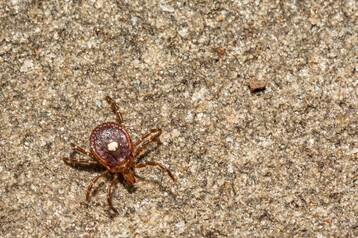
For years, experts have warned that alpha-gal syndrome, the meat allergy transmitted by Lone Star ticks, is coming for Nantucket. This summer, it may have finally arrived.
Nantucket’s case numbers are still much lower than those on Martha’s Vineyard, where alpha-gal syndrome, or AGS, has become an epidemic, and hundreds of Vineyard residents have tested positive for the allergy. But over the last three months, Nantucket Cottage Hospital has recorded 57 cases, more than twice as many as were recorded in the previous two years combined.
Before this summer, the most cases ever recorded in a single month on Nantucket was four. Then, this July, the hospital recorded 22 cases. The next month was 20. Then 15.
Primarily transmitted by Lone Star ticks, AGS causes an allergy to mammal meat and sometimes other products made from mammals, like milk. In the most serious cases, the allergy can be deadly.
Historically, Lone Star ticks haven’t been a concern on Nantucket. But, driven by warming weather and climate change, they have begun to migrate north, bringing AGS with them.
Janie Hobson-Dupont, who recently started an AGS support group on Nantucket, said that over the last few months, more and more islanders have approached her saying that they have been affected by the allergy. Hobson-Dupont, who first noticed symptoms three years ago, before AGS was something that many Nantucket residents were concerned about, had one piece of advice for those who have been diagnosed more recently.
“Don't panic,” she said. “The way I think of it is, there [are] things worse in life. Just don't panic. It can change your life, but also, people really don't know; it may go away, it may not. If it happens, you'll be okay.”
AGS is defined by unknowns. There are no known effective treatments and no cure. No one knows why the ticks have adapted to Martha’s Vineyard so much more quickly than Nantucket, and no one knows why some people who are bitten by Lone Star ticks are affected while other people are not. Perhaps the biggest mystery is why no cases of AGS were documented until 2000, even though Lone Star ticks have been found in the southern United States for over a century.
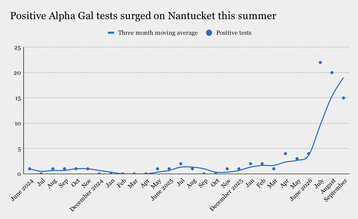
There is some uncertainty with Nantucket’s numbers. Cases have only been elevated for three months and remain relatively low compared to Martha’s Vineyard. Additionally, many people who test positive for AGS are asymptomatic, meaning that 57 positive tests do not necessarily mean 57 people on Nantucket with an allergy to mammal products.
“Some people have the alpha gal sugar molecule in their blood; they test positive, but they don't get any reaction,” Hobson-Dupont said.
Hobson-Dupont said that she founded Nantucket’s AGS support group in an effort to help those dealing with the allergy find community and support each other.
“The motivation was to bring people together who either have it or are afraid of getting it so they can offer support to each other and tips,” she said. “When people are first diagnosed, they are freaked out, so mutual support I think will really help. When you have something like this, it's very important to feel like you are not alone.”
Hobson-Dupont first learned she had AGS when she went into anaphylactic shock after eating a bison burger. She also later had symptoms from stitches made with products derived from cows. Unlike some people with AGS, however, she can drink milk and consume dairy products without any complications. It is unclear why symptoms differ so much from person to person.
“Initially, I was a little scared to go out to eat, so I'd have to talk to the wait staff, and I would say: ‘Have you ever heard of [AGS]?’ and they would say: ‘No, what's that?’ So I'd have to go through the whole thing,” she said. “But this summer was totally different.”
Lone Star ticks can be difficult to identify. While adult females are marked with the white spot that gives them their name, nymphs and adult males do not have the spot, making identification more difficult. Lone Star ticks can be differentiated from deer ticks by color and speed: they are reddish-brown, rather than black, and tend to be faster and more aggressive than their counterparts.
Experts have cautioned that deer ticks and Lyme disease remain by far the larger public health threat to Nantucket, but, fortunately, the same strategies are effective to reduce your risk of both conditions: stay on trails, check for ticks regularly, use insect repellent on shoes, and wear permethrin-treated socks.