Amid Discussions On Raising Easy Street, Select Board Ponders Move Of Steamship Ferry Terminal
JohnCarl McGrady •

Nantucket could be less than a decade from spending tens of millions to raise Easy Street, according to a presentation given to the Select Board by coastal resilience coordinator Leah Hill on Wednesday.
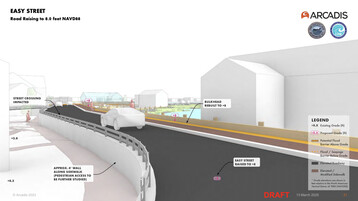
The plan to protect the key downtown corridor from the effects of sea-level rise and flooding is still in the early stages, with three design options under consideration. At this point, the town is focused on planning and outreach, hoping to engage more community members and gain the support of additional property owners on the street.
It’s not the first time the Select Board has discussed the possible coastal resilience projects slated for Easy Street, but with big-ticket capital projects stacking up, the looming cost of protecting the street along the waterfront stands out.
During the meeting, Select Board member Matt Fee wondered if it might be best to move the Steamship Authority and Hyline docks away from Easy Street entirely as part of a long-range planning strategy.
“This a redo,” Fee said. “If there’s another way and a better way to do it, to get us the next 50 or 100 years, we should be thinking about that. The last thing we want to do is spend half a billion dollars to raise it and have the truck route right through town and have that be a parking lot for 16 hours a day because there’s so many cars and they can’t move anywhere.”
During a meeting of the town's Coastal Resiliency Advisory Committee earlier this week, Fee suggested Jetties Beach or Monomoy as potential alternative locations for the Steamship Authority to consider bringing cars, trucks, and freight in the future.
"From a planning standpoint, I think that we have not really looked at, should the Steamship be where it is? Is there another option? Where should the Hy-Line go?" Fee said. "Maybe what should be happening is the Steamship should be, really, rerouting their truck traffic and car traffic somewhere, I don't know where, Jetties or Monomoy, I don't know But they should be, maybe they should be relocating that and the existing should become where all the boats that just have people come."
The possibility is also contemplated in the Nantucket and Madaket Harbors Action Plan:
"A related issue is the lack of a contingency for moving people, goods, and material to and from the Island in the event vessels cannot access or utilize the downtown terminal facilities due to storm-related damage or an emergency such as a vessel sinking or becoming disabled in the approach," the plan reads. "One potential solution is to establish a secondary commercial pier capable of supporting passenger and freight vessels outside the central waterfront. Beyond providing the redundancy needed for ensuring access, this pier could reduce congestion at the in town facility, reduce the amount of hazardous materials transiting through the downtown area, and utilize an existing alternative truck route."
“Does this have to be the route to the ferry?” Mohr asked on Wednesday, referring to the truck route out of town. “Easy Street eight feet higher is not the Easy Street people are worried about abandoning.”
The Steamship Authority is currently seeking grant funding for terminal upgrades of its Steamboat Wharf terminal.
Hill emphasized that the costs of inaction are far greater than even the eye-catching $104.9 million maximum projected cost of the most expensive of the three options. On the low end, mitigation could potentially cost $37.5 million.

In contrast, the cost of inaction could exceed $1.2 billion by 2070. The U.S. Chamber of Commerce estimates that every $1 invested in disaster resiliency planning generates $13 in avoided costs.
“Future solutions become more costly and complex the longer action is postponed,” Hill said. “Delaying action increases risk, cost, and uncertainty. Continuing the project keeps Nantucket proactive, informed, prepared, and financially responsible.”
And the more expensive of a plan the town chooses, the longer it will protect the island from the rising seas, which could mean that the plans with the lowest upfront pricetag are actually the costliest in the long run.
The town is looking at three possible paths forward, all of which are around seven to 10 years from construction.
The least intensive option would be to expand and elevate the existing bulkhead. The other two options both involve raising Easy Street, with one raising it to six and a half feet and the other raising it to eight feet above the standard vertical control measure used in the United States.
