Commercial Scalloping Season Ends With More Than 7,000 Bushels Caught
Jason Graziadei •
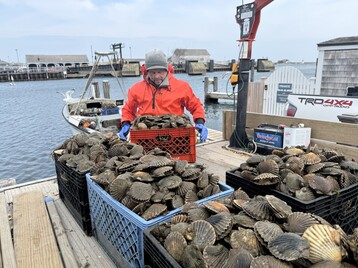
Nantucket's commercial scalloping fleet faced a harsh winter marked by a deep freeze and numerous days lost to the cold temperatures, but as fisherman Jim Sjolund unloaded his last bushel of the season Tuesday morning at Old North Wharf, he was all smiles.
Sjolund, who still managed to go scalloping more than 80 days during the 2025-26 season, said it was one of his most successful years on the water. That assessment was due to healthy, good-sized scallops, a wholesale price that stayed relatively high, and certain areas of the Nantucket Harbor being more productive than usual. Sjolund was among 10 commercial scallopers sticking it out to the end on the final day of the season on Tuesday.
Andy Lowell, the chairman of the town's Shellfish and Harbor Advisory Board, said he has been hearing similar assessments as the season comes to a close.
"It was very successful," Lowell said on Tuesday. "They harvested a much larger-looking scallop than in any past years that I can remember for a decade or two, honestly, a classic adult, very healthy-looking scallop. And the season was abundant from beginning to end. Certainly, it dropped off a little near the end. But even with the seven-box limit, several of the guys are bringing in seven boxes by 11 o'clock
as recently as yesterday."
Overall, the season will likely end with 7,500 to 8,000 bushels of scallops landed. The official bushel count exceeded 7,000 bushels on Tuesday, with additional catch reports still to be tallied. That will represent a relatively steep decline of 20 to 25 percent compared to last season - when the harvest topped 10,000 bushels - but it's close to the average for the past decade, according to Nantucket's shellfish and aquatic resources manager Tara Riley.
Riley said there are many factors to consider when assessing the season. The harsh weather certainly had an impact, she said, with roughly 20 days of fishing lost due to cold temperatures, and some scallopers deciding to end their season early. The town's shellfish regulations prohibit commercial scalloping when the temperature drops below 28Fº, a rule intended to protect seed scallops from dying in frigid temperatures.
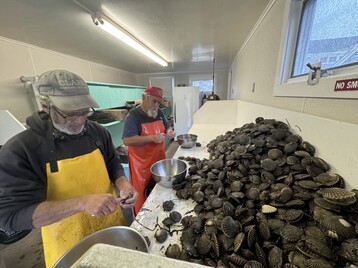
To make up for those losses, the Select Board granted two increases to the five-bushel limit commercial scallopers are allowed to take each day. In January, they raised it to six bushels, and in February, they agreed to increase it once again to seven bushels.
While fishermen were able to take more scallops, there were fewer of them out on the water. While the town sold 82 commercial shellfishing permits, the season started with roughly 50 boats fishing, and ended with just 10 or 12 in the final week. The island's fleet is aging, and there are few in the next generation coming up behind those who are close to hanging up their dredges for good.
"I think the key indicator is looking at like the past 10 years and averaging the bushels that were landed," Riley said. "I think we find ourselves somewhere around 7,000 to 8,000 bushels on average. And that's just what I gauge it by. But the one factor that is a little bit hard to capture right now is just the fishing effort. And the amount of licenses that are purchased are kind of holding steady - they've been in the 80s and 90s for a little while. But I think that number is going to continue to decline. I don't know what the exact age range of everybody who is out there right now in the active fleet, but that would probably be some interesting information to take with us into the future for predicting what the fishing effort might be. I think like looking at different management decisions based on the size of the fleet and the fishing effort is going to be key for us moving forward. If there's 8,000 to 10,000 bushels out there, and the fishing effort continues to decrease, there's no reason why we shouldn't increase the amount of bushels that you can take, right?"
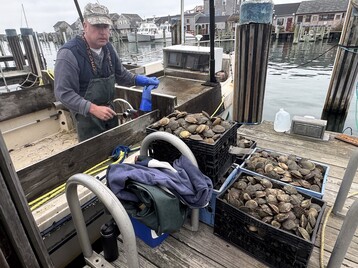
Lowell stated that the two primary factors driving the lower bushel count this year were the cold weather and the declining numbers of the commercial scalloping fleet. But the tally should not take away from what was a successful year for those who stayed fishing.
"Definitely more days missed this year, and I think fewer active fishermen, absolutely," Lowell said. "Guys dropped out in January and didn't come back. Some guys dropped out at the end of February. I think both of those are the main factors. So I don't think it has anything to do with the amount of scallops that are out there. Honestly, I think there are plenty more to be harvested. It would have been nice to extend the season a little bit longer."
Lowell said the Shellfish and Harbor Advisory Board will discuss potential initiatives in the coming months to encourage the next generation to pursue commercial scalloping.
"We're going to talk about the apprenticeship program and what we can do to attract the next generation to get involved," Lowell said.