Despite Increased Rainfall, State Doesn't Budge On Nantucket's Drought Status
Jason Graziadei •
Despite significant rainfall on Nantucket over the past month, the Massachusetts Drought Task Force decided late last week to keep the island under a Level 2 "significant" drought designation, leaving its status unchanged.
Nearly eight inches of rain fell on Nantucket over the past month, more than the island had received in the previous six months combined. So when Nantucket Water Department director Mark Willett saw that the state task force had left the island's drought designation unchanged last Friday, he was incredulous.
"I have lost what little faith and trust I had in the Massachusetts Drought Task Force," Willett told the Current.
The water in Nantucket's aquifer is technically owned by the state, so Willett is charged with managing the resource under a water withdrawal permit from the Massachusetts Department of Environmental Protection. Under the Level 2 "significant" drought status, he must enforce a series of water use restrictions required by the state for those connected to municipal water. Those restrictions include:
- Limit all non-essential outdoor water use
- No automatic irrigation of any kind, including drip irrigation
- No watering except with a handheld hose or water can after 5 p.m. or before 9 a.m.
- Fix indoor leaks, check toilets, faucets, and showers
- Limited power washing of sidewalks and buildings
- Limit pool fills (call Wannacomet at 508-228-0022 for consideration)
Willett had hoped to see the state downgrade Nantucket's drought status to a Level 1 designation, which would have lessened the water use restrictions. He shared a graphic depicting the water levels at the United States Geological Survey (USGS) monitoring well off Russell's Way on Nantucket, which has equipment that radios information about the groundwater table and elevation to the state's Drought Task Force, which uses that information to set Nantucket's drought status. Despite the rain over the past month, the water level at the well has continued to decrease, rather than increase as one might expect.
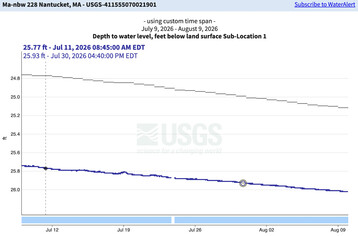
"Still moving down," Willett said. "How is that possible?"
Willett has previously expressed concern about the well on Russell's Way, stating that it does not always accurately reflect the full picture of groundwater levels on Nantucket because of the soil type in which it was drilled. He has been actively lobbying the state to allow Nantucket to use multiple wells to determine the groundwater levels and the island's drought status.
"We now have a consultant and myself working to get that change with DEP to not just be this well," he said earlier this year. "This well is screened in a tight soil, so yes, it's recovering, but it's a slow-recovering well. Throughout its history, there are other wells that are in a different material, that are more sand and gravel and less tight, silty clay that recover faster."