Despite Widespread Billing Issues, National Grid Defends Its Smart Meters As Accurate
JohnCarl McGrady •
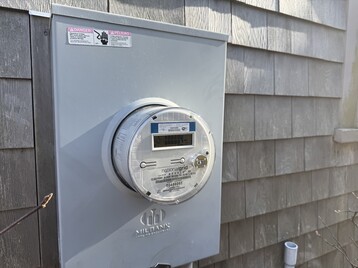
National Grid representatives reiterated to the Select Board on Wednesday that their new smart meters installed at thousands of homes on Nantucket are highly accurate, attributing increased bills to cold weather, temporarily inaccurate estimates, and personal choices. The smart meters, which National Grid began installing last October, are intended to provide near real-time energy data and help customers manage usage and reduce bills.
“If you are having billing concerns, it’s not likely that the meter itself is the issue," said Jesse Harvey, National Grid’s head of advanced metering infrastructure, before the Select Board on Wednesday. National Grid was called to the meeting in response to complaints about skyrocketing electric bills since the smart meter rollout began.
At the meeting, around half a dozen Nantucketers, including Select Board member Brooke Mohr, raised concerns about anomalously high electricity bills.
“I’m going to recommend my family member come and talk to you about her bill, but it literally went up 100 percent,” Mohr said. “Yes, there were differences in temperature, yes there were differences in rates…but 100 percent seems a lot.”
“My wattage use doubled. It doesn’t seem indicative of a 12 percent decrease in temperature,” Select Board candidate Amy Eldridge said.
Most of the increases seem to be caused primarily by higher reported usage, not the higher cost of energy.
National Grid maintains that these issues are unrelated to the new smart meters, and that over 85 percent of customers are satisfied with their new meters. Harvey said that, on average, the data shows that smart meters are not recording higher usage on Nantucket than traditional meters.
“There was really no difference between [smart meters] and the existing AMR meters,” Harvey said. “If anything, the usage skews higher for the existing meters.”
National Grid maintains that tests monitored by independent regulators show smart meters have an accuracy rate of 99.96 percent.
National Grid also indicated that smart meters could eventually be used to institute a surge pricing scheme, under which customers would have to pay more to use electricity when there is high demand on the grid.
“These meters enable the potential for a time-varying rate, but that is not imminent,” Harvey said. “I can’t give you a preview of when that would be. So, yes, these meters, because they provide interval data, could enable a time-varying rate.”
This winter has been the coldest in recent memory, which accounts for at least some of the increases. National Grid now claims that energy use across the island has risen by about 9 percent this winter due to colder temperatures, up significantly from the 6 percent figure they gave the Current two weeks ago.
“The timing has been a challenge,” Harvey said. “This was the coldest winter in 20 years, the same time we put in the smart meters.”
Those figures are far smaller than the bill increases reported by many island residents, and the Current has been able to verify increases as high as 500 percent in unoccupied homes. National Grid says that larger increases could be the result of personal choices made by individual customers, such as using space heaters or leaving windows open during the winter.
Additionally, National Grid has admitted that in some cases, when a new electricity meter is installed, whether it is a smart meter or a legacy meter, it has to connect to the network and become registered. When that happens, bills will be estimated, and could diverge significantly from actual values. The estimated bill will eventually be replaced with the actual bill once connectivity is restored.
National Grid has claimed that all issues with estimated bills were resolved by February, though some homeowners have told the Current this is not true.
National Grid representatives previously told the Current that it would not take longer than a month for smart meters to connect properly, resolving issues with estimated bills. But Eldridge said that her bill was estimated for three months, echoing concerns raised by other island residents who have contacted the Current.
So far, of the individual cases raised by the Current or at the Select Board meeting, the only increases over 50 percent that National Grid has been able to explain publicly were caused by estimated bills.
During the Select Board’s meeting, Harvey said that while it’s possible that a small number of customers have been receiving inaccurate readings from their old meters, which the new meters are correcting, it is highly unlikely that this issue has impacted many residents. This was one explanation that two homeowners had previously told the Current National Grid had offered, but representatives have shied away from that explanation in public.
“There doesn’t seem to be a widespread issue of that, and [National Grid’s team] couldn’t even come up with…anecdotal evidence,” Harvey said. “Yes, [it is] physical possible. Is it likely? No.”
Whatever the reason for the increased bills, it was enough to bring a team of National Grid representatives to the island on Wednesday and Thursday to address concerns and speak with Nantucket’s elected representatives.