Divided Finance Committee Votes Against New Our Island Home Proposal
Jason Graziadei •
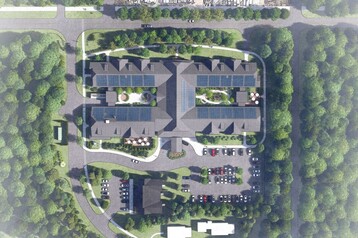
The proposed new Our Island Home skilled nursing facility will head to Nantucket’s Annual Town Meeting in May with a negative recommendation from the Finance Committee.
After a spirited debate on Monday that once again featured emotional arguments in favor of the new facility and caring for the island’s elderly population versus dire warnings about the project's daunting financials, the Finance Committee voted 4-3 in favor of a motion not to adopt the spending proposal at Town Meeting.
“We’re as split as the rest of the community,” observed Finance Committee chair Jill Vieth after the vote was taken on Monday. “I think we reflect the community.”
As proposed, the new Our Island Home facility would be the most expensive municipal project ever undertaken by the town of Nantucket. For a total project cost of $134 million, a new 45-bed skilled nursing facility would be constructed at the Sherburne Commons campus off South Shore Road, including a housing component for staff, replacing the existing Our Island Home building at East Creek Road.
In May, Town Meeting voters will be asked to approve $119 million in override spending for the project, a sum that would also need to be approved on a subsequent ballot vote. (The discrepancy between the total $134 million project cost and the $119 in proposed borrowing is because $8.5 million has already been approved by voters in 2022 for the design and retained earnings that will be used to offset borrowing).
Due to its remote, isolated location, Nantucket is the only Massachusetts municipality that operates its own skilled nursing facility, which is managed as an enterprise fund of the town. Island taxpayers have already approved a $5 million permanent operating override at the 2021 Annual Town Meeting to subsidize Our Island Home's operating budget.
While the new facility project received majority support at the 2025 Annual Town Meeting, it did not surpass the two-thirds threshold required for passage as a debt exclusion override. But the Select Board voted last December to send the proposal back to voters for reconsideration at the 2026 Annual Town Meeting this spring.
Town Manager Libby Gibson made the stakes of the upcoming vote clear at the outset of Monday’s Finance Committee meeting.
“The (Select) Board did, as part of its discussion in December, indicate that it wanted to be very clear that if the project does not get approved, if it does not receive the required voter approvals, then ultimately, the current facility will continue, probably for a period of time, but then it would have to close at some point,” Gibson said. “We don't know when exactly that would be.”
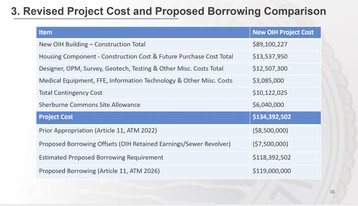
Before they voted, members of the Finance Committee reviewed a financial pro forma for the new Our Island Home prepared by the town’s consultant, Clifton Larson Allen (CLA). The financial projections show the town’s subsidy for the Our Island Home operation ballooning to $14.7 million in the first year after the new facility opens, due to the added debt service obligations required for the borrowing. That subsidy would grow to more than $17 million after 10 years, according to the pro forma.
Those numbers left a majority of the Finance Committee unwilling to support the project.
“If you add up the annual losses that this facility will have, it totals, over 15 years, about $240 million - roughly double the amount of the borrowing,” said Finance Committee member Joseph Wright, who voted against a motion to adopt the spending, but ultimately abstained from voting on the motion not to adopt. “And to me, that's not an investment that makes any sense. I'm sorry, but it just doesn't make sense...Emotionally, I think it's the right thing to do. Financially. I'm sorry, it just doesn't make sense.”
The breakdown of the 4-3 vote on the Finance Committee’s motion not to adopt was as follows:
- In favor: Jill Vieth, Jeremy Bloomer, Anthonie Goudemond, and Joanna Roche.
- Opposed: Chris Glowacki, Peter Schaeffer, Martin McKerrow.
Wright abstained, and Finance Committee member Rob Giacchetti was absent.
“I see us with this project, serving 50 people, maybe a few more, every year,” Bloomer said. “So that's 500 people over a decade, and so maybe 500 people for a quarter of a billion dollars? It just doesn't work. The numbers are just too big…We really, unfortunately, have to look at how many people will of a quarter of a billion dollars touch. That's what we're being asked for. And I think at 500 people, maybe it's 600 or 700 people, but it sounds like it's 500 in a decade on a year-round population of 25,000 and growing, just demographically, I just don't see that this amount makes sense.”
That comment prompted a response from Schaeffer.
“Jeremy, you're not counting the families of these people,” Schaeffer said. “You'd have five, six people at least, coming to see you over a period of time. That's important. Plus the 60 employees that work there and their families. So it's much more than just counting it room by room. I know it's easy to do it that way, and it's something that mathematically we like to do as bankers, but you can't look at it this way. It's just, it's too frustrating to look at it that way, because you know it’s not going to work. We admit that. We're just saying, we’re looking at it as an investment in the people who live here.”
“It’s heartbreaking,” Vieth responded. “I don't think any of us want to not have it. I don't know anybody on the committee who doesn't want it. The Capital Committee was the same. But there has to be some cost where you are looking at this and thinking, we can't do it. I mean, is this at any cost?”
Following Monday’s vote, Vieth emphasized that the pro forma presented by CLA was based on the full buildout of the facility, and with operations at 93 percent occupancy, even though Our Island Home has traditionally been at 82 to 86 percent occupancy. An additional override to subsidize the nursing home’s operations would be necessary in just seven years, she said.
“The only known is that the future of the operating costs has zero plan for solvency or near solvency,” Vieth told the Current on Tuesday. “This is not a referendum on the elderly community. It’s a referendum on this specific capital project and the financial future of the island."
Select Board member Dawn Hill, who has championed the project during her four terms on the board, urged the members of the Finance Committee to look at the project cost in a different light.
“I would phrase the question in a different way for all of you, and that is, if the community has decided that this is a priority, as we are already doing this, is this the most financially feasible way to continue to make this a community priority and continue the services that we are already doing?” Hill asked.
While acknowledging the large project cost, Finance Committee member Chris Glowacki emphasized the community’s support for the project and that he was unconvinced by the arguments that the town would be unable to pay for it.
“I think a better indication of the number of people that are touched by this facility is the amount of support this project has in the community, despite the ridiculously formidable financial challenge,” Glowacki said. “The numbers here are whack-job numbers. On the other hand, if you look at the people who are voting for this, who are stepping up, the reason they're doing it is because they've been touched by this facility in one way or another. So I think that's important to keep in mind.
“What I hear a lot of people say is, ‘Oh, I really care deeply about this. I’d love to do it, but we just can't afford it’,” Glowacki added. “But then I don't hear any context about what we can and what we can't afford. That’s a very tough argument for me to buy into. Our Island Home was founded in the 1870s, in the worst depression era of Nantucket. And here we sit in the Gilded Age where people are pushing $20 million mansions and we can't find a way to support the old people in Nantucket? That part is very difficult.”
On Monday, the Friends of Our Island Home relaunched the "Our Island Home Campaign Fund" at the Community Foundation for Nantucket, intended to raise private funds to help offset the cost of the project for island taxpayers.
“This partnership represents a major step forward for Friends of Our Island Home as we continue advocating for a modernized skilled nursing facility on Nantucket,” said Alison Forsgren, Vice President of Friends of Our Island Home, in a statement. “By working together, we can pursue private donations to help reduce the financial burden on taxpayers for the construction of a new Our Island Home.”
If approved by island voters in May, the $119 million appropriation will fund the construction of a 60,000-square-foot, 45-bed new nursing facility at the Sherburne Commons campus, complete with enclosed courtyards and photovoltaic solar arrays. Some rooms would be large enough to accommodate a second bed should OIH need to increase capacity. The new building would allow Nantucket to remain the only Massachusetts municipality that owns and operates its own nursing home.
During its debate over the project in the run-up to last year’s Annual Town Meeting, the Finance Committee initially supported the proposed debt exclusion override to fund the new Our Island Home, but at the 11th hour, it decided to reverse course, changing its recommendation to “not to adopt” after the price tag for the project increased.
- More information about the project is available from the town at this link.
- Watch the Finance Committee’s debate on the project during Monday’s meetingat this link (skip to the 42:16 minute mark).