Expansion Of Geotubes At Sconset Bluff Upheld By Superior Court Judge
JohnCarl McGrady •
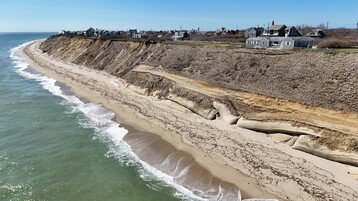
A Superior Court judge has upheld the Nantucket Conservation Commission’s decision to allow the expansion of a controversial erosion control geotube project along the Sconset Bluff.
“There was ample evidence to support the [Nantucket Conservation Commisson]’s issuance of the 2025 [order of conditions], including detailed information concerning the project's purpose, the existing conditions, administration of the proposed work, alternatives, monitoring, and extensive geographical and oceanographic survey data,” the decision reads in part. “The decision of the [Nantucket Conservation Commission] is affirmed.”
The decision, issued by Justice Elaine Buckley, rejects a petition from a number of Nantucket residents opposed to the geotube installation, including members of the Nantucket Coastal Conservancy and the Nantucket Land and Water Council (NLWC), two advocacy groups that have been against the coastal resiliency project for years.
“From our perspecitve, we understand that the major review of more enviornmentally-focused regulatory concerns is taking place with the Massachusetts [Department of Environmental Protection],” NLWC executive director Emily Molden told the Current. “So we're looking to them and hoping they will address some of the more specific concerns.”
The Sconset Beach Preservation Fund (SBPF), the advocacy group behind the geotubes and the expansion proposal, heralded the court’s ruling as a vindication of their process.
“The ruling follows years of public input, scientific analysis, environmental review, and legal proceedings, and affirms the careful work that went into developing the project,” SBPF wrote in a press release. “The Court's decision highlights the extraordinary level of review that preceded the Commission's approval.”
The plaintiffs had argued that the Conservation Commission improperly waived certain local wetland protection requirements and usurped the Court’s authority pursuant to a previous judicial order, but Buckley rejected these arguments.
“Local communities, such as Nantucket here, may impose more stringent requirements, then waive those requirements, so long as their base requirements meet or exceed state minimum requirements,” Buckley wrote. “Whatever the effect of this court's order and judgment in the 2022 litigation, the present matter concerns a distinct [notice of intent] and [order of conditions], not a relitigation of that 2018 [notice of intent]. Thus, the court's prior order and judgment in that litigation is immaterial to the present litigation.”
The decision does not clear the way for the expansion to go forward. For work to begin on the project, it still needs approval from Town Meeting, and voters rejected the 3,000-foot addition to the geotube array last spring by a narrow margin. Still, if a future Town Meeting reverses course and votes in favor of the erosion control project, there is now one less hurdle standing in its path.
“This is an important victory not only for SBPF, but for the integrity of Nantucket's local permitting process,” SBPF representative Meridith Moldenhauer said. “The Court recognized that the Conservation Commission undertook a careful, deliberate, and legally sound review before approving this project.”
For decades, SBPF has battled local activist groups and regulatory bodies over the geotubes, which are long textile fabric rolls filled with a slurry of sand and water and installed at the base of the bluff to protect the homes perched along Baxter Road above.
Opponents have raised concerns about the impacts of the geotubes on nearby beaches and about the source of the mitigation sand that SBPF is required to pour over the tubes to ensure those beaches are not eroded—a requirement SBPF has often shirked.
Proponents have argued that the geotubes and the potential expansion, which would come at no cost to Nantucket’s taxpayers, are needed to protect Baxter Road and avoid the potentially enormous expense of providing utilities to homes along the bluff should the road be deemed impassible.
“This project has always been about more than individual properties,” Moldenhauer said. “It is about protecting Baxter Road, safeguarding public utilities, preserving access, and responsibly managing a rapidly changing coastline for future generations.”
SBPF has indicated that it would like to bring some version of the expansion proposal back to Town Meeting next spring in an effort to secure the votes needed to go forward.
The expansion is a joint proposal with the town of Nantucket. The town had success at last year’s Town Meeting passing articles it backed that had failed at previous Town Meetings, and it may hope to achieve something similar next year, although so far, it has not committed to supporting a version of the proposal again.
Instead, the town convened a closed-door meeting with key stakeholders in the debate in an effort to find a “mutually agreeable path forward.” Representatives of SBPF, town administration, the Select Board, the Nantucket Coastal Conservancy, the NLWC, and the environmental engineering firm Arcadis—responsible for many of the town’s plans related to the Sconset Bluff—were invited to the meeting on July 14th, held before the Superior Court decision.
Molden confirmed that the NLWC attended the meeting, but was unsure about the likelihood of a resolution.
“I think we will never get there if we don't keep talking and having these conversations,” she said. “I would say it's still too early to tell.”
In addition to Town Meeting approval, SBPF also needs the support of the Massachusetts Department of Environmental Protection, which has not yet cleared the project. Initial responses from state agencies have been mixed. The state’s Office of Coastal Zone Management issued a sharply critical report on the project, but it cleared the Massachusetts Environmental Protection Act review process last February and now just needs approval under the state’s wetland protection bylaw. The final decision from the state is expected soon.
The Superior Court decision can be appealed, but Molden said that the NLWC is now primarily focused on the Department of Environmental Protection review.
“Certainly, we'll always consider our options, but at this point, I think a lot of our concerns rest on the implementation of the state wetland protection act,” she said.
The existing geotubes are also currently in failure. A portion of the installation collapsed after sustaining damage in what SBPF has deemed an act of vandalism, and that led to a further secondary collapse. SBPF has submitted an outline of a plan to repair the damage to the Conservation Commission, which would have to approve the work, but Commission chair Seth Engelbourg was skeptical of the plan.
Molden was also critical about the scope of the repairs.
“It's not clear to me that the Commission has the authority, through an enforcement order, to allow the extent of the work that has been proposed,” she said. “It's unfortunate. I think we find ourselves in a worst-case scenario at the moment.”
SBPF has suggested that repairing the damage to the existing geotubes without confirmation that the town will continue to pursue the expansion plan would be “not practical.” They have also argued that the repair work is not as extensive as Engelbourg and Molden have characterized it, noting that only the fabric needs to be replaced, not the sand inside it.
During a recent Conservation Commission meeting, Engelbourg suggested that it might be time to re-issue a dormant removal order for the geotubes that was also previously upheld by a Superior Court judge.
In the case the Court just ruled on, the judge found that the expansion proposal was substantially different from the array the Conservation Commission had ordered removed in the past.