Is It Too Late To Repair The Geotubes At The Sconset Bluff?
JohnCarl McGrady •
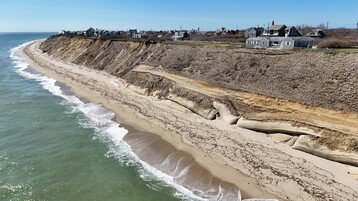
Conservation Commission chair Seth Engelbourg raised several concerns with a Sconset Beach Preservation Fund plan to repair the damaged geotube installation along the Sconset Bluff at a meeting on Thursday.
“Is it too late? Is it too far gone, and do we need to go back to our other alternative, which is seeking removal of the structure? Engelbourg asked. “I’ve tried to wrap my brain around any way to get this done, and, to me, the path just keeps getting slimmer, and slimmer, and slimmer every day.”
The geotube erosion control project was damaged in what the Sconset Beach Preservation Fund (SBPF) deemed an act of vandalism last January, and SBPF has finally submitted an outline of a plan to repair the structure—if it qualifies as a repair at all.
“This proposal that’s being put forth here is not really a repair proposal. It’s almost an entirely new system,” Engelbourg said.
SBPF representatives said that around 50 percent of the length of the geotubes has been damaged, but noted that the damage only extends to some of the project’s tiers, and that all of the sand contained within the geotubes would be reused. Only the textile fabric encasing that sand needs to be replaced.
“This is a lot that’s going to be reused,” SBPF representative Meridith Moldenhauer said. “This isn’t new material. We’re actually going to be reusing—taking the sand out, removing the geotube textile material—but then reusing all the sand that’s there. So I do think that when you look at that in the holistic nature of the repair, that it then maybe becomes more in line with the repair question.”
The other main point of contention on Thursday was over a series of returns and proposed steel sheeting and shoring that SBPF would install as part of the repair work. Those elements do not exist as part of the current project, but SBPF representatives suggested that they could become permanent if allowed by the Conservation Commission.
“The buildings, as you know, are very close to the top of the bank. The intent of the shoring is to make sure that section of the bluff is stable,” SBPF consultant Dwight Dunk said. “There are benefits from removing it on the environmental side. It is a [coastal engineering structure] if it remains. There’s some benefits from leaving it in place for long-term stabilization of those structures. So, we don’t have an answer as to whether or not it will be proposed to be removed.”
Engelbourg suggested it was unlikely the shoring would be allowed to remain permanently.
“If any project, anywhere on the island, came to us and said we want to put metal sheeting of some kind either right on a bank or right in front of a bank to prevent erosion, I doubt we would permit that,” he said. “Definitely, I would never want that to be permanent. I think it would be a dereliction of duty if we allowed it to be permanent.”
SBPF representatives agreed that the steel shoring could be temporary if the Conservation Commission required it.
“I think it can be temporary, and if it was a condition to be temporary, I think that would be acceptable,” Dunk said.
Even if the Conservation Commission does order the shoring removed, however, there is no guarantee SBPF will comply. SBPF has ignored several orders from the Commission before, including a removal order for the geotubes. At the time, SBPF said that the geotubes could not be removed because it would endanger a pair of houses on the bluff.
“It’s somewhat ironic that that same construction procedure [steel shoring] couldn’t have been contemplated at [the time of the removal order],” Engelbourg said.
Thursday’s Conservation Commission also provided the first indication of how the town of Nantucket plans to respond after a proposed expansion of the geotube installation, which was a joint partnership between the town and SBPF, failed on a narrow 182-163 vote at Town Meeting last month.
Town of Nantucket sustainability programs manager Vince Murphy said that the town plans to go to the Select Board for guidance on whether to bring another expansion proposal forward to Town Meeting in partnership with SBPF, ideally at some point in the next month.
The town has had success bringing back failed projects in the past. This year, voters backed three proposals that were defeated the year before.
Several members of the Conservation Commission, including Mike Missurelli and Tim Braine, suggested that the Commission should find a path to permit the repair of the structure.
“I am in favor of finding a way to repair the structure,” Missurelli said. “I don’t like it being in disrepair.”
Conservation Commission member Linda Williams also suggested that, if the geotubes were vandalized, refusing to allow the repair would be a win for the vandal.