Nantucket Unveils Monument For 19th-Century Black Whaling Captain And His Wife, The First Female Steamship Stewardess
Jack Bradner and JohnCarl McGrady •
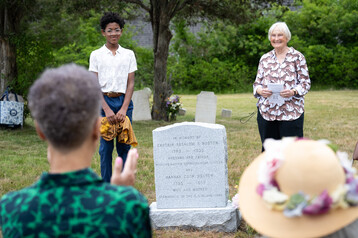
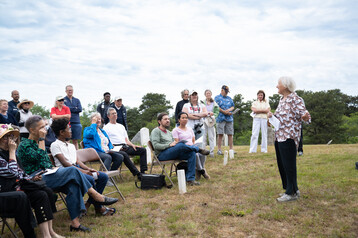
More than 171 years after his death, Nantucket’s first Black whaling captain, Absalom Boston, and his wife, Hannah Cook Boston, the first female steamship stewardess, were memorialized on Friday with the dedication of a new monument at the island’s Historic Coloured Cemetery. The dedication was part of Nantucket’s Juneteenth celebration and was led by historian and vice chair of the Nantucket Cemetery Commission Fran Karttunen.
Both Bostons were pioneers in their own right. At sea in 1822, Absalom Boston captained an all-Black whaling crew on the Industry, returning from a six-month voyage with 70 barrels of whale oil. On land, Absalom Boston pushed for school desegregation, opened an inn on the island among other entrepreneurial business pursuits, helped to create the African Meeting House, and was a leader of Nantucket’s Black community.
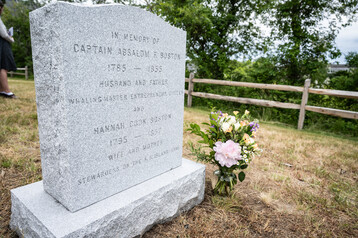
The inscription about Absalom Boston on the new monument reads in part, “Whaling Master. Entrepreneur. Citizen.”
In an interview with the Current, Karttunen accentuated the importance of celebrating Hannah Cook Boston's accomplishments. As the first female steamship stewardess on the S.S. Island Home, Hannah paved the way for other Black women to find work outside of the domestic sphere.
“Hannah was a pioneer,” Karttunen said.
Despite their historical significance, neither Absalom Boston nor Hannah Cook Boston has a headstone on Nantucket, prompting the Cemetery Commission to install the monument in their honor.
During Friday’s dedication, Reverend Erin Splaine noted that their legacies are still important today.
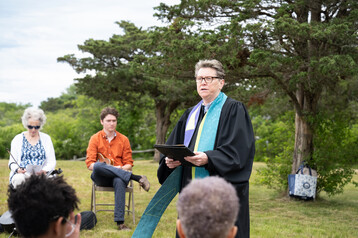
“We are reminded on this sacred ground that Nantucket has a complex and diverse history and that all of our history, all of our stories, all of our experiences deserve equal viewing, a just acknowledgment, and a place at the table of remembrance,” said Rev. Splaine, concluding her speech with a quote from Martin Luther King Jr.’s "Letter From Birmingham Jail."
Following the unveiling, several members of the crowd volunteered to speak. A few, like actor and public servant Neville Richen, recalled their earlier encounters with the Historic Coloured Cemetery. One onlooker expressed gratitude that the event introduced them to the cemetery and its history.
Karttunen added how the community underpins the monument.
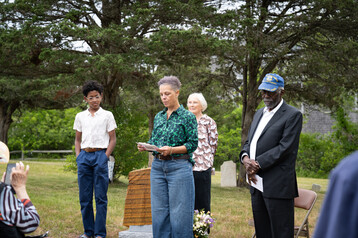
“We’re aware that a lot of people come to the cemetery looking for something they can’t find,” she said. “Not only did we want to memorialize these two very important people, but we want to give people who come to the cemetery something to find.”
Absalom Boston is perhaps most notable for suing to force Nantucket to admit his daughter, Phebe, to the island’s public school, which did not accept Black students at the time. Boston’s suit came in the middle of a protracted battle over integrating the school system that began when another Black girl, Eunice Ross, was denied admission. The case made its way to the state’s Supreme Judicial Court before, under mounting legal and political pressure, Nantucket finally desegregated the island’s public school in 1846. Phebe Ann Boston was admitted, but shortly after, she passed away.
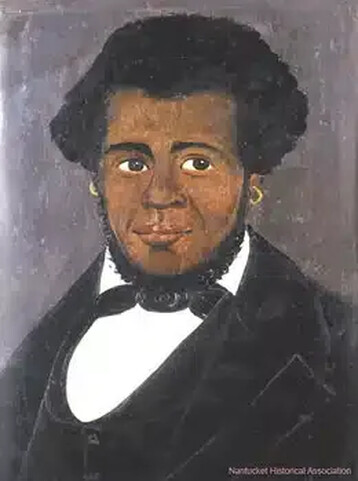
Hannah Cook Boston also supported the effort to desegregate the island’s schools and helped to create the African Meeting House.
Karttunen described the monument as a project, working alongside historian Barbara White, who formerly served on the Cemetery Commission. After receiving many inquiries over the years about finding Absalom Boston’s headstone - Karttunen even received one such inquiry some fifteen minutes before the Current’s interview - she and White started working to memorialize Captain and Hannah Boston.

According to Karttunen, the Bostons’ monument follows from her and White’s work on the Commission and through their co-written film, “Nantucket’s Historic Coloured Cemetery: Stories Told by Nantucketers.”
Juneteenth, a blending of “June” and “nineteenth,” celebrates the end of legal slavery for non-prisoners in the United States, marking the day Union General Gordon Granger arrived in Galveston, Texas. Granger put the Emancipation Proclamation into effect in Texas, the last Confederate state to retain legal slavery. While it has been celebrated much longer, it was named a federal holiday by President Joe Biden in 2021.