Nantucket Police Department's Contract With Flock Confirms Camera Purchase Made At Administrative Level
David Creed •
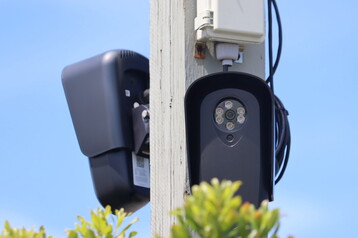
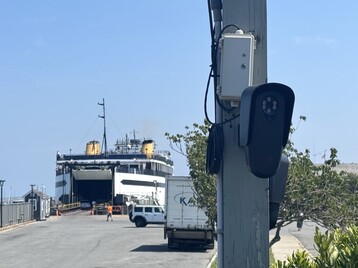
While the two Flock cameras at the intersection of Broad Street and Easy Street have been confirmed to have been in place for over five years, their presence has garnered significant attention in recent weeks as they continue to raise concerns about privacy, data collection, and their potential for abuse.
Through a Freedom of Information Act request, the Current recently obtained the original agreement made between the Nantucket Police Department and Flock Safety. The document confirms numerous statements made by Deputy Police Chief Charlie Gibson to the Current, including that the footage is stored no longer than 30 days. Last week, Flock updated its default retention period to seven days. It's unclear if NPD has adjusted its cameras to this new recommendation.
“Footage is stored for no longer than 30 days in compliance with Flock’s records retention policy,” the document reads. “(NPD) is responsible for extracting, downloading and archiving footage from the Flock System on its own storage devices.”
The contract was signed on March 22nd, 2021 by Ardis Gary, the town’s public safety information technology (IT) administrator. The cameras continue to be Flock’s property, and Flock is responsible for any future removal of the two Falcon camera units, or for installing more cameras on the island in the future. The contract also gives Flock the right to use the Nantucket Police Department’s name in its marketing.
There is a clause in the contract that would allow the town to terminate its agreement with Flock at any time. It would need to pay a removal fee of $500 per camera, but would also receive a prorated refund based on how much time remained on the contract at the time of termination.
You can view the initial agreement here.
The Current reached out to the town seeking further information on why there was no public announcement or acknowledgment made about these cameras until last week, after the Current first reported on the Flock cameras. The town's August 11th statement addressed the cameras by stating, “We want to be sure that our community is well-informed about our use of this type of technology.”
Florencia Rullo, the Town’s communication manager, replied with the following remarks:
“The Town does not routinely issue public announcements when it acquires new technology or equipment,” Rullo said. “This is true across all departments, not just the Police Department; purchases are handled through the Town's normal procurement and administrative processes, the same process that applies to equipment acquisitions townwide. When a purchase requires a contract or other formal action by the Select Board, it is brought before the Board. Otherwise, equipment and technology purchases do not ordinarily result in a separate public announcement.
“As for the timing of this afternoon's statement: ALPR technology, and Flock's systems in particular, have drawn significant public attention over the past several weeks, both here and nationally,” Rullo continued. “That interest is precisely why we thought it was worth explaining publicly how the technology is used on Nantucket.”
The Current also asked Rullo whether the Town could provide an instance in which island police solved a case or made an arrest over the past five years using the Flock cameras at the Easy Street/Broad Street intersection. She replied by stating, “To date, the Flock cameras have functioned as an investigative tool and are used in investigations similar to any license plate reader. I'm not able to point you to a case that turned on a Flock hit as the single decisive factor.”
She continued by explaining how this automated license plate reader (ALPR) technology has generally assisted NPD in recent years, using a November of 2025 case as reference.
“On the evening of November 12th, 2025, officers were dispatched to the area of Somerset Road and Friendship Lane for a report of a crash,” Rullo said. “A parked vehicle had been struck, and the operator had fled the scene. A witness provided a description of the vehicle but did not have the license plate. The officer entered the known vehicle information into our ALPR system and identified a possible match. Officers located the vehicle at the registered owner's residence, observed damage consistent with the crash, spoke with the operator, and issued him a summons for leaving the scene of a property damage accident, marked lanes, and negligent operation.
“On the Steamship Authority point specifically, much of the value there is in ruling things out: confirming a vehicle of interest has not left the island,” Rullo continued. “That's meaningful to an investigation, but it produces no arrest and often isn't captured in a report narrative, so it doesn't generate the kind of example you're asking for.”
On August 5th, the town’s Chief Technology Officer, Michael Alvarez, expressed major concerns about the cameras' presence on the island to the Select Board during public comment, offering differing perspectives on the technology from what Gibson and other town officials have offered. He confirmed he was not involved in the process of purchasing, approving, or installing these cameras – which is supported by the agreement obtained by the Current.
“I want to be very clear,” Alvarez said. “The Chief Technology Officer is not part of the Nantucket Public Safety chain of command. Neither I nor my predecessor had any involvement in the purchase, approval, or installation of any Automated License Plate Readers on Nantucket. I also want to be equally clear about my personal opinion. I do not believe Automated License Plate Readers belong on this island.
“Modern vehicle recognition technology can collect far more than a license plate number,” Alvarez continued. “Depending on the system, it can identify a vehicle's make, model, color, and other distinguishing characteristics. As these systems continue to evolve, they are capable of extracting increasingly detailed information about the vehicles, and by extension the people, passing before them. I believe that collecting this amount of information on residents and visitors without individualized suspicion or a warrant poses a real threat to our civil liberties and has no place in our community.”