"It's A Mystery" Expert Says Nantucket Shipwreck Remains Likely Not From The Warren Sawyer
JohnCarl McGrady •
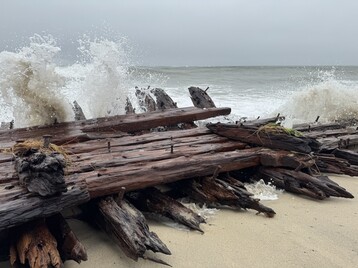
The shipwreck remains exposed by a rare fall nor’easter that hit Nantucket in September are likely not, as was originally believed, fragments of the schooner Warren Sawyer.
David Robinson, the director and chief archaeologist of the Massachusetts Board of Underwater Archaeological Resources, traveled to Nantucket on Wednesday to inspect the wreckage uncovered by the storm. He told the Current that what he saw looked “very different” from the remains exposed by erosion in 2022.
“The appearance of the wood and the species of the wood, the sizes of the timbers we saw, it just seemed very different than what we had seen in 2022,” he said. “Much larger, or significantly larger, than what we saw there, and a lot more yellow pine as opposed to some of the hardwoods.”
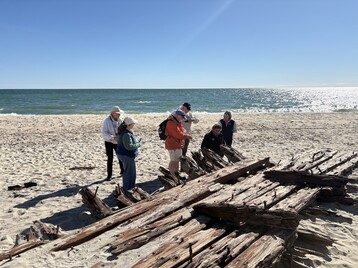
Robinson added that the new remains are about a quarter of a mile east of where pieces of the Warren Sawyer, a three-masted schooner that wrecked off the coast of Nantucket in 1884, were found in 2022.
It may never be determined for certain what ship the new remains came from.
“We definitely might never know,” Robinson said. “It’s a mystery, and that's part of the fun and what makes archaeology interesting.”
The shipwreck made national headlines when it was exposed by the nor’easter, perhaps in part because the storm itself was so high profile. Robinson thinks there may also be another reason, however.
“Shipwrecks are just inherently interesting to a lot of people,” he said.
The fragments found on Nantucket’s shores represent only a small piece of the vessel’s hull, and Robinson believes the ship was likely built in the late 19th or early 20th centuries, at a time when shipbuilding had become significantly less distinctive, which makes identifying a vessel particularly difficult.
“It's like having a part of a door from a car, and it's hard to tell what car it came from,” he said.
Still, Robinson and Nantucket’s Egan Maritime Institute are working to identify the wreckage, which is believed to be part of a large merchant vessel.
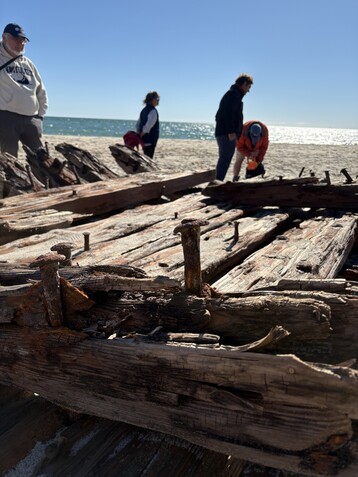
Robinson thinks the ship was built in the late 19th or early 20th century for a few reasons related to the materials used in the hull’s construction, including the types of metal fasteners used, the tool marks visible on the wood, and the types of timbers used in the ship’s body. Earlier in America’s history, shipbuilders often relied on naturally curved timbers in ship construction, using wood that was already shaped like the ships they wanted to build. But as the nation’s forests were felled for lumber, those limbs became harder to find, and shipbuilders fell back on more readily available, straighter sections of wood.
“Archaeological sites are like puzzles without the box top,” he said. “Most of the pieces are missing, and the ones we have have been chewed on by the dog. They’re just intriguing puzzles to try to piece together, and the way we do that is we look at the archaeological evidence, we look at the historical record, and try to make correlations and connect the dots between those two bodies of information.”
With earlier shipwrecks, the type of wood used in construction can often be a clue to where the ship was produced, but that is less true for ships built in the late 19th and early 20th centuries. By then, the same types of wood were in use across the country.
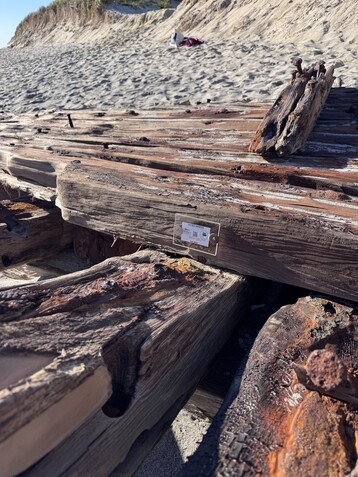
Robinson also affixed a so-called STAMP tag to the wreckage. A STAMP tag is essentially a durable QR code that can be used to track and monitor shipwreck remains. Anyone who encounters the tag can scan it, and report the wreckage’s location and condition, as well as photos, to the state.
“Shipwrecks are part of Nantucket’s physical landscape and an important part of our maritime heritage,” Carlisle Jensen, the executive director of the Egan Maritime Institute, said. “With more than 750 shipwrecks estimated in the waters surrounding Nantucket, there is still so much we can learn from these sites..”
In some ways, Robinson is like a detective of shipwrecks, sleuthing for clues in the wreckage. And like a detective, he’d appreciate it if the public stopped stealing evidence.
“It is very much like detective work, and this is one of the reasons why archaeologists feel so strongly about not distributing sites,” he said. “That is like removing clues from the crime scene.”