Latest Delay Puts Massachusetts Wind Power Contracts Two Years Behind Schedule
Colin A. Young, State House News Service •
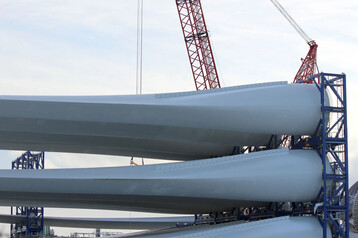
With offshore wind power projects again on hold at the federal level, officials confirmed last week that contracts for the installations that Massachusetts hoped to bring online in the coming years will not be finalized until this summer, at the earliest.
Massachusetts selected 2,678 megawatts of offshore wind power spread across three projects in September 2024, kicking off contract talks that were expected to result in higher prices for power than past projects. The contract completion milestone has been delayed at least five times, and during the delay, one of the selected projects has removed itself from consideration and another raised the potential for a multi-year delay.
The utilities negotiating contracts with the remaining projects informed the Department of Public Utilities in a Dec. 30 letter that they would not meet the Dec. 31 target for finishing contract talks, nor the Feb. 25 target date for contract filings.
The evaluation team involved in the process, which includes the Department of Energy Resources, National Grid, Eversource and Unitil, said delays are "[d]ue to ongoing uncertainty caused by federal level activities."
The group said it now expects completed negotiations and executed contracts by June 30. Those contracts would now be filed with the DPU (the step at which ratepayers can learn the cost of the projects) by Aug. 31, putting the procurement process about two years behind its original schedule.
In a statement, the Healey administration blamed "uncertainty created by the changing federal landscape" for the repeated contract delays and said Massachusetts "remains committed to an all-of-the-above approach to energy, which includes offshore wind."
"This abundant energy source produced right off our coast will lower costs, especially in cold weather, create thousands of jobs and billions of dollars in economic benefits for Massachusetts, and help move us toward energy independence," said Lauren Diggin, spokesperson for the Department of Energy Resources.
Massachusetts state government has committed to reducing carbon emissions by at least 50 percent compared to 1990 baselines by 2030, by at least 75 percent by 2040 and by at least 85 percent by 2050, with tag-along policies to get the state to net-zero emissions by the middle of the century. The state also has numerous other mandates on the books, including around things like electric vehicles.
As a candidate for governor four years ago, Gov. Maura Healey made significant climate promises, including achieving a 100 percent clean electricity supply statewide by 2030 and electrifying public transportation with clean power by 2040 (starting with school and MBTA buses by 2030).
As 2026 gets underway and Healey eyes her reelection effort, the House and Senate this session have become torn between reevaluating the costs of decarbonization plans and finding ways to reduce consumer utility bills.
The U.S. Department of the Interior's order freezing offshore wind work affects the Vineyard Wind 1 project for Massachusetts, the only project currently under contract to provide power into the state. It also impacts Revolution Wind for Rhode Island and Connecticut, Sunrise Wind and Empire Wind for New York, and Coastal Virginia Offshore Wind off Virginia.
The developers of Revolution Wind, Empire Wind and Coastal Virginia Offshore have filed legal challenges to the Trump administration's freeze, and the New York Times reported that officials behind Sunrise Wind have said they are contemplating the same.
A spokesman for Avangrid, one of the developers of Vineyard Wind 1, declined Monday to comment on the company's plans.