One Of Nantucket's Most Important - And Most Frustrating - Parking Lots Is Also Its Least Understood
JohnCarl McGrady •
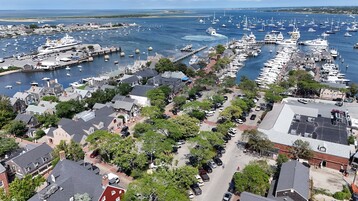
The parking lot in front of the downtown Stop and Shop is one of the largest and most important on Nantucket. It’s where many islanders who work downtown park during the day, it’s where travelers wait to pick up their friends at the boat, and it’s where some commuters leave their work vehicles overnight when they head home to the mainland. But few understand how it works.
While some people believe the lot is publicly owned, it is actually a private lot controlled by Nantucket Island Resorts. But a poorly understood state law mandates that NIR maintain the lot as a “publicly accessible parking area.”
NIR is tight-lipped about the parking lot’s operation. Reached for comment by the Current, NIR would only say that “the lot has a two-hour parking limit and does not allow overnight parking, and these rules are clearly posted on signage throughout the property. The two-hour limit is intended to encourage regular turnover, so parking remains available.”
Amid a summer in which island traffic is as bad as it's ever been, parking is at a premium, and the downtown Stop & Shop lot has the most sought-after spots in the core district given its proximity to the ferries, wharves, and restaurants. Circling the lot in search of a parking space is a ritual every Nantucket resident of driving age is well acquainted with.
There are signs in the lot claiming that parking is restricted to two hours, but it is widely understood on the island that these signs are rarely enforced, if at all. Some downtown workers leave their cars in the lot all day, and some workers who commute from the mainland leave their vehicles in the lot overnight without repercussions. Some people may leave their cars in the lot much longer than just a day without moving them, but without any information from NIR, it’s difficult to prove this definitively.
There is no publicly available plan outlining how NIR manages the lot, and NIR representatives did not answer questions about their management strategy, how many enforcement actions they have taken in the last year, or why some Nantucket residents and visitors violate the posted rules without consequence.
“The community should demand, the Select Board should be asking, for a management plan for that lot to ensure public benefit for the parking lot as a resource,” Hillary Hedges Rayport, a former Planning Board member who was outspoken about the lot during her first campaign for the Planning Board, told the Current. “Over time, it has become clear that we do need standards.”
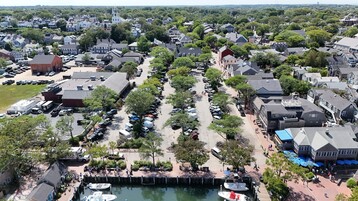
NIR’s relative silence is particularly notable because, given that the lot is privately owned, the town isn’t responsible for enforcing any regulations in the lot unless the police decide there is a threat to public safety. The police can, for instance, ticket vehicles blocking a fire lane or taking up an accessible parking space. But Police Chief Jody Kasper told the Current they haven’t issued a single ticket this summer at the lot. In practice, enforcement falls squarely on the shoulders of NIR.
“For anything beyond fire-lane or accessible-parking violations, enforcement is the responsibility of the property owner,” Kasper said.
Given NIR’s decision not to answer most of the Current’s questions, it’s difficult to know if the real estate company, which controls huge swaths of downtown Nantucket, is any stricter than the town.
Planning Board member Nat Lowell suggested that too much enforcement would be a disservice. Commuters need somewhere to park, he said, and ticketing cars parked in the lot overnight would ultimately hurt everyone.
“If they ever enforce it, you'll lose the whole thing,” he said. “To have overnight parking without obstructing the general public, it's almost impossible…we’d be fighting against ourselves. It's best to leave it alone.”
He agreed that truly long-term parking should be disincentivized, but was cautious about going too far and unintended consequences.
“If we try to fix it, we might ruin it,” Lowell said. “It's a solution in search of a problem. You have to be really careful about how far you push the gas pedal down. That's all I'm saying. But it could be made to work way better; that's definitely true.”
The pressure on the available parking spaces in the downtown Stop & Shop is evident in scenes like this one, from the summer of 2025, when a man attempted to save a space by standing and blocking other cars from taking it:
Rayport suggested that a comprehensive parking plan, perhaps paired with a shuttle service easily available to commuting workers, could help to serve some of the needs the Stop & Shop lot is currently filling, freeing up the lot for short-term parking.
Her chief objection to the current management of the lot, however, is the spaces that are set aside for private use. By the Current’s count, there are 14 private parking spaces in the lot, out of 120 total. That’s over 10 percent of the lot that can’t be used by the public.
“I just noticed over the years that of all the spaces, just more and more of them were starting to say reserved, reserved, reserved,” Rayport said. “You can't have so many spots reserved. That's not part of the spirit of this.”
The lot is governed in part by Chapter 91, a state law that regulates activities along waterways. The parking lot used to be tideland, which would have been accessible to the public. To use that filled tideland, the property owners had to agree to a series of conditions to receive a Chapter 91 license. One of those conditions was maintaining the lot as a “publicly accessible parking area.”
“I would say that's inconsistent with the idea of it being a remediation for taking public tideland,” Rayport said.
There are certain ways that NIR is allowed to restrict the lot. The license specifically states the licensee may “adopt reasonable rules governing the publicly accessible areas of the site, subject to prior review and written approval of the Department [of Environmental Protection], as are necessary for the protection of public health and safety and private property, and to ensure public use and enjoyment by minimizing conflict between user groups.”
Asked specifically about Chapter 91, the private parking areas, and whether it obtained permission from the Department of Environmental Protection to restrict the spaces, NIR replied only that “the lot is a publicly accessible parking area, and it is in compliance.”
Lowell said the island should be grateful that the lot is available at all.
“I look at that parking lot as a gift that we need to not be too critical of and not take advantage of and not exploit,” he said. “It just happens to be there, and I'm just happy that it is.”
Instead, Lowell suggested broader downtown transportation reforms, including widening New Whale Street and lowering the curbs along it.