Third Annual Nantucket Poetry Festival Keeps Focus Local
Jack Bradner •
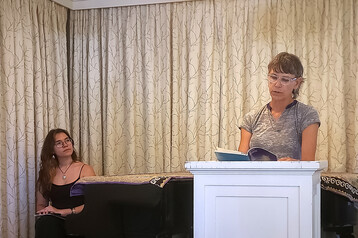
From August 27th–31st, the third annual Nantucket Poetry Festival will be taking new strides. Like last year, the festival will feature a lineup of local writers and internationally recognized poets, including Wyn Cooper, whose 1987 poem “Fun” is the lyrical basis for Sheryl Crow’s Grammy-winning song “All I Wanna Do.” This year, however, the festival plans to put more emphasis on Nantucket’s rich poetic identity.
“Nantucket has so much creative energy stored in it,” said Anna Popnikolova, the festival’s founder and a current Harvard undergraduate. “We can’t be the New York literary scene—that’s not what this place really is, and it’s never really going to be [that]. But also, that’s not what I want it to be either.”
When reflecting on the past two festivals, Popnikolova said the community most appreciated the poetry tied to Nantucket.
“Just because someone might be a big name at Harvard doesn’t necessarily mean that it’s what people care about. People loved Greg Orr so much because he feels local,” Popnikolova said, mentioning that Orr, a critically acclaimed poet, has a daughter on-island. “Last year, I was so excited about the people that I was bringing, who were from kind of far away, that I didn’t realize that [the festival] should be more of a local thing.”
To Popnikolova, this local focus came together in many ways. In partnership with the Nantucket Historical Association, the festival will kick off with an open-archive event. Spanning over 300 years, the NHA’s poetry archives boast a wide variety of poems and voices, from abolitionist literature by Anna Gardner to satirical limericks about prominent Nantucket families. Other events will be hosted at historic venues, like the Maria Mitchell Loines Observatory or Greater Light Garden—a livestock barn-turned-art-studio by two eccentric Quaker sisters in the ’30s. With readings, workshops, and heritage crafts, the festival offers something for everyone.
“Poetry doesn’t have to be this so-serious, high-minded thing; it can also be really fun and silly,” said Lucy McGowan, one of the poets who read at last year’s festival and the NHA’s Education Manager, “it helps you take a moment to pause and appreciate where you are, what’s going on around you, and I think that anyone can benefit from engaging in those types of practices.”
Looking at Nantucket’s more recent relationship to poetry shows why Popnikolova’s festival is so innovative. From 1974 to 1987, Nantucket had its own small literary press: The Nantucket Review. But according to Billy Sherry, the review’s former poetry editor, Nantucket and The Nantucket Review had a titular relationship. While The Nantucket Review was well-known in the literary world, it didn’t publish anything from the island it was named after. Instead, the review garnered submissions from authors on the mainland and beyond, operating primarily by mail.
Despite the island’s underground poetry scene, the past two Nantucket Poetry Festivals were both hits. In 2024, Popnikolova hosted Farewell Fest, the first Nantucket Poetry Festival, but she didn’t intend for it to return for a second or even third year. But after receiving numerous emails and being stopped on the street by eager attendees, Popnikolova decided to bring the festival back.
The festival’s impact goes beyond the island, too. After reading at last year’s festival, poet and Harvard professor Stephanie Burt composed a poem about her time on the island. Its title, “Wherowhero Lane,” references the address of Our House Nantucket, where some of the visiting poets lodged and where a workshop will be held this year. After Popnikolova learned that Burt had written the poem, which was recently published in The Poetry Review, she was inspired to encourage visiting writers to create work while they’re here.
“Sometimes Nantucket gets treated a little bit more like a venue than like the thing itself,” said Popnikolova. “When I have people stay here for the festival, I’m gonna ask them to, by the end of the festival, have written at least one poem and sent it. It doesn’t have to be great, but we’ll sit down and lay it all out. I’m gonna see if I can have a local artist give me a piece of their art to put on the cover. It’ll be nice, it’ll be a little chapbook.”
On its website, the Nantucket Poetry Festival posted a list of this year’s poets and a program of events. Most of the festival’s events are free and open to the public.